
Gaelic Folklore for a Multi Species Future
By Mairéad Nic Craith, published in Bella Caledonia, 23rd August 2023
Gaelic Folklore for a Multi-Species Future 1
There are few today who doubt the challenge of climate change. As I write, wildfires are burning in Tenerife, Hawaii and in British Columbia. July 2023 has been confirmed as the hottest month in the global temperature record. Much of this destruction is blamed on the era of the Anthropocene. The concept is based on the premise that humans are the single most influential species on the planet. Humankind has abused this position to drain the earth of its natural resources without any regard for the impact on other species. The challenge of the Anthropocene has become daunting and almost “too hot” to handle on a global scale. But in Rebecca Solnit’s words: “We can’t afford to be climate doomers”. Anna Tsing and others have proposed the notion of a ‘Patchy Anthropocene’ as a way forward. This is designed to focus our attention on how we can engage with all creatures in our local ‘patches’.
In Scotland there is a traditional resource that has much to tell us about living together with other species. Folklore frequently refers to local (often small) places and the different creatures that live in it, but an emphasis on local places can sometimes spark a negative reaction. At best, it can be seen as “parochial” or “inward-looking”. At worst, it can be mis-interpreted as nationalism or xenophobia – but, as McFadyen and others have pointed out: to focus on the local is to stand up against the forces of globalisation and capitalism. This is very much in keeping with the spirit of Scottish ecologist Patrick Geddes, who advised people to ‘think global and act local’.
There has been a lot of commentary in recent years from MacKinnon, Meighan and others on the concept of dùthchas (Scottish-Gaelic) or dúchas (Irish-Gaelic). A key feature of dùthchas is the interconnectedness of the species. This multi-species context is found in many indigenous cosmologies. Keith Basso writes about the multiple relationships that Native Americans have with their local places. The Celtic ontological concept of dùthchas is inherently multi-species, and Gaelic folktales offer several different models of species living together. There are four in particular I’d like to outline in this piece and the next. I call these (1) networks, (2) shape-shifting (3) parallelism and (4) mirroring. In this first piece I deal with networks. The other three models are dealt with in the second piece.
Firstly, I’d like to draw attention to a contribution by Alan Riach, where he focuses on the Scottish-Gaelic poem “The Song of the Owl” (c.1600) by Domhnall mac Fhionnlaigh nan Dàn. In this poem, the owl flies around touching the trees, circling around the mountains, and drinking from the rivers. The owl becomes a witness to the interconnectedness of nature. Riach describes the poem as “a haunting expression of the idea of unity existing between land, people, all living creatures, nature and culture”.
Another such story in the Gaelic tradition concerns the salmon of knowledge and the renowned warrior, Fionn Mac Cumhail, who as a young boy met the poet Finnegas near the river Boyne in Ireland and studied under him. The poet had spent seven years trying to catch the salmon that lived in the river. The fish was known as ‘the salmon of knowledge’, since it fed on the hazelnuts of knowledge at the well of Segais. Eventually, the poet caught it, and asked the young Fionn to cook it. He advised Fionn not to taste it, as whoever ate the first bite would gain the knowledge of the salmon.
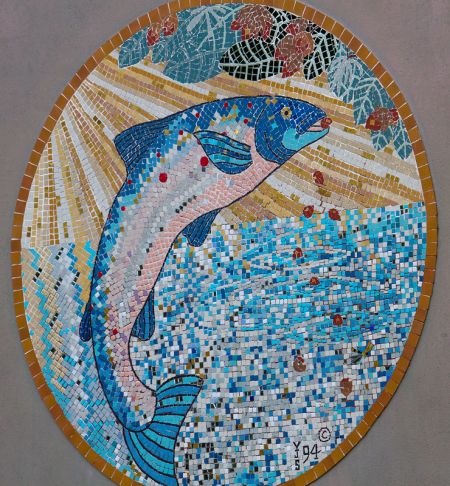
While he was cooking the fish, the young Fionn inadvertently burned his thumb, and instinctively put his burnt thumb in his mouth. This immediately imbued him with the salmon’s wisdom. When the poet returned, he saw the wisdom in the young boy’s eyes. After that, whenever Fionn put his thumb in his mouth, the knowledge he wished to gain was revealed to him. As an aside, isn’t it interesting that the ancient storytellers didn’t need to wait for the discovery of Omega 3 before they knew oily fish was good for the brain!
In this folk narrative, the different species worked together like a network or chain of connection. Nine hazelnut trees grew over the well. The nuts on the trees contained wisdom. As the nuts fell into the water, they were eaten by the salmon, who then swam downstream. The human who ate the salmon was endowed with gifts of wisdom, inspiration and knowledge. When humans die, they decompose into the land, and it is from the earth that trees grow. This is a picture of balanced unity. Each element in the network has significance and has its own part to play. Any interruption of the elements results in the breakdown of the network.
What is even more interesting about this narrative is that the gift of knowledge is not confined to humans. As the Gaelic scholar Meg Bateman notes, the intuition gained by Fionn when sucking his thumb was not that of an individual but a universal intuition. It is knowledge that is present in wells, in fish, in insects and mammals, and in the landscape itself. Humans are not the only thinking beings. In my next piece I shall look at other models of co-existence from Gaelic folk tales.
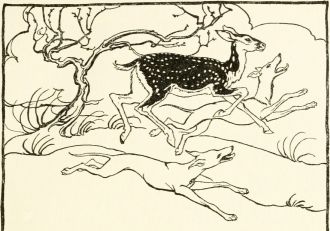
See the next issue of the Voice for Part 2 of Gaelic Folklore for a Multi Species Future. Featured image shows illustration of the legend of Oisin’s Mother, by Arthur Rackham. Irish Fairy Tales, by James Stephens. 1920.

