From Lamlash to Canada in 1829
Jim Henderson of Lamlash continues his story of how the Clearances caused so many Arran residents to emigrate to the Megantic County of Canada. Here, he gives some of the background to what happened, but in future issues he will be providing a further mass of detail about the Arran families who helped to found such a robust community. Today, over 4 million Canadians claim Scottish heritage, and Arran people played a strong part in establishing that inheritance.
There were good reasons for Arran people to leave the island and take ship to an unknown country on the other side of the world – and they were not alone in their decision. In 1853 it was reported in Inverness that 3,463,292 emigrants left Scottish shores for Canada, America or Australia. The average rent per croft in 1800 was around £5.00, with increases annually of one or two shillings. The average rent was £20.00 per annum, with only 6 farms on Arran paying over £100.00 per annum, but as hardship grew, the rent increases became harder to find.
The Highland Clearances, as they are usually known, were one of the saddest times of Scottish history. They actually began in lowland Scotland, but the Highland Clearances were originated in Sutherland by Sir John Sinclair in 1792, when he introduced Cheviot sheep and ordered the destruction of the black houses on his estate at Ulbster Thurso. This profitable idea quickly spread to all of Scotland and the Islands. Sir John was appointed as the first president of the Board of Agriculture and founded the British Wool Society. On his estate he initiated many new agriculture methods, adopting field enclosures, crop rotation and, above all, sheep, which had the greatest and most damaging effect on the Highland way of life. At Langwell he evicted 80 families to create a large sheep farm, having found that the Cheviot sheep were proving to be very profitable. They produced good quality fleece and meat with little or no maintenance, because the sheep were hardy enough to look after themselves on the Highland hills.
The people left Scotland with few possessions. But they took what was of more value, their language, music and traditions of story telling, their poetry and their long memories. In their meagre baggage, the most cherished items were their Gaelic Bibles, bagpipes and the Scottish Plaid – and of course, the essential spinning wheels.
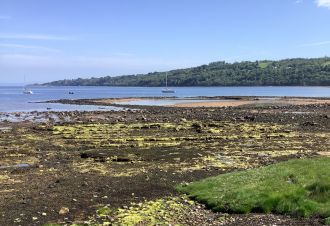
The wave of Scottish emigration lasted for decades. One of the first emigrant ships was the ‘Hector’, sailing from Loch Broom in 1772 for Pictou, Nova Scotia, but the first Arran contingent departed in April 1829 on the brig ‘Caledonia’, starting from Greenock but anchored in Lamlash Bay to embark the Arran families bound for Quebec. They arrived
on Thursday 25th June, sailing up the St Lawrence seaway, and after the long voyage with nothing to look at but sea and sky, they gazed at the whitewashed cottages by the riverside with eager anticipation. But they hadn’t arrived at their final destination yet.
After two becalmed days without a puff of wind to fill the sails of the ‘Caledonia’, Captain Miller decided to have the brig towed by a paddle steamer to the final destination of Montreal. In this slightly ignominious manner they arrived at Point St Charles, Montreal, and ventured down the gangplank to test their land legs. They had no idea of where they were to go, so they made a temporary camp to await the arrival of Mr Buchanan, the Quebec immigration agent. It was his job to allocate land in Renfrew County, Ontario, on the Ottawa River. This area south west of Montreal was part of Upper Canada, first colonised five years previously, in 1824 – but when Mr Buchanan arrived, he did not seem happy to send this new wave of immigrants there. He advised the Arran contingent that they would be much better off heading for Megantic County in Lower Canada instead. He reinforced his advice by telling the company that Renfrew County was unsuitable and unhealthy, being subject to fevers etc., and painted an alarmingly grim picture of the place to reinforce his recommendation. After a somewhat dismayed hasty conference, it was agreed that a deputation of four persons – two McKillops and two Kelsos – were taken to inspect the new area while they others sat tight. The four men returned with good reports. They had been impressed with the quality of the soil and the beauty of the area, the scene being enhanced by the time of year. In late June, everything was green and looked at its best.
Megantic County is located in the Appalachian Mountains, a beautiful area with commanding views of the surrounding landscape. It lies approximately 50 miles south east of St Nicholas, on the opposite side of the St Lawrence from Quebec. The Arran contingent packed up their temporary camp and hired a barge to take them back up the river to St Nicholas. On arrival, there were no friends and family member to help them as they had when they embarked from Lamlash. They had to engage French Canadians to transport their belongings on carts pulled by single horses, and they probably realised for the first time just what it means to move from a small place to a vast one. They were faced with a trek of 45–50 miles over rough terrain with little or no tracks, and the journey took them nearly 3 days. By the time the travel-weary group arrived at a clearing on a farm owned by John Hart by Lac Joseph (at one time called Loch Lomond) on the Becancour River it was late July.