Fish to feed fish
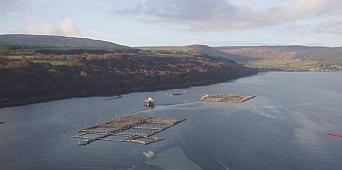
Salmon are carnivorous. In the wild, they will eat any small living thing they can find. In pens, they are fed on frequent scatterings of fishmeal pellets, delivered automatically. These pellets are made from smaller fish.
Many thanks to John Page, who sent an interesting paper on Feed Conversion Efficiency in the Chilean Salmon Farming Industry. It’s a hefty document, but facts pop out like gifts in a bran tub.
Feed-fish to salmon weight ratio (John Page e-mail)
Frankensalmon?
The U.S. Food and Drug Administration (FDA) is reviewing the first genetically engineered (GE) animal for human consumption. And it’s a salmon. Produced by AquaBounty, this transgenic fish adds genetic material from a pacific Chinook salmon and an eelpout (Zoarces americanus) to cause Atlantic salmon to greatly overproduce its own growth hormones. The new fish will grow two to six times faster during winter than wild stock and be ready to harvest at an earlier age.
By November 2013, Canada had announced that it would support the export of AquaBounty’s GE eggs to Panama. The decision marked the first time any government had given the go-ahead to commercial scale production involving a GE food animal. The FDA has yet to rule on the GE fish.
To date AquaBounty has spent about $60 million trying to coax the FDA and public into accepting their product. Within the last year, supermarket chains including Whole Foods, Kroger, Safeway, Aldi, and Trader Joe’s have said they will not stock the GE salmon.
What we must keep in mind is that this animal has never existed before; it is new to the planet; we made it. We really have no idea of what it will do when we lift it off the ‘operating table’.
The FDA states that highly secure facilities will prevent GE salmon from escaping and affecting natural ecosystems. We are told that they won’t be able to breed because they are all going to be females; each and every one of them. The GE salmon will also be made infertile to prevent breeding with natural stock should some fish escape. (Actually it’s reportedly 99.7% infertile which means thousands of breeding fish out of the millions produced).
The future of the wild salmon stocks couldn’t be bleaker. Norway is losing half a million “designer” salmon a year from ‘secure’ farms, wild stocks in Europe and the US are collapsing, yet this new fish supposedly can’t escape and even if it does, none of the millions of fish AquaBounty produces will interbreed with wild fish.
Craig Altier, a member of the FDA’s Veterinary Medicine Advisory Committee and an associate professor at the College of Veterinary Medicine at Cornell University said, “We need to treat these (GE) fish as we would a potentially dangerous medicine or pharmaceutical, and apply all of the same security measures to its production and transport.” (1)
A REPORT published today 02 May reveals how Scottish Government plans to create a network of marine protected areas (MPAs) have received an impressive level of support from the public.
Campaigners now say there is a strong democratic duty, as well urgent ecological need, to set up MPAs to help recover Scotland’s damaged sea life.
Over 14,000 people responded to the public consultation on proposals for 33 new MPAs last summer, the vast majority of whom indicated popular support for stronger protection of Scotland’s sea life with a full network.
Environmental charities are now urging the Scottish Government to take heed of public opinion and secure a network that will help the seas recover from centuries of over-exploitation. They argue that legislation passed by MSPs in 2010 places an overriding legal duty on Ministers to both protect and enhance Scotland’s marine environment.
Calum Duncan, Convenor of Scottish Environment LINK’s marine taskforce and Scotland Programme Manager for the Marine Conservation Society, said:”The growing momentum of public support for Marine Protected Areas is clear. The Scottish public called for a network of effective MPAs, a requirement of the marine legislation they helped push for in the decade up to 2010. A network of MPAs that do what they say on the tin, adequately protect areas of sea, are being called for by the Scottish people to help recover the sea and contribute to a fair and just society. Scottish Ministers don’t just have a legal duty to designate new MPAs, they now have a democratic mandate to do so, delivered by people from across Scotland.”
Dr Richard Luxmoore, Senior Nature Conservation adviser for the National Trust for Scotland said:”The results of this public consultation clearly show that the overwhelming majority of the Scottish people strongly support MPAs and want to see improvements in the way we manage our seas. Our marine habitats have suffered the industrial legacy of damage to our seabed.This has had dire consequences for the diversity of our marine life – from the magnificent fan mussel to the humble sandeel, many species and habitats are well below historical levels of abundance. MPAs are desperately needed to reverse these sad declines.”
Kara Brydson, Head of Marine Policy at RSPB Scotland, added: “Cabinet Secretary Richard Lochhead said in May 2013 that he would ‘listen closely to the views of Scotland in making final decisions.’He must now listen to the view of the vast majority of consultation respondents who want effective MPAs for Scotland and protection for other species currently excluded from the network, such as whales, dolphins,seabirds and other fragile seabed plants and animals.”