

As I write this in mid-August Arran is basking in hot sun by day and beautiful clear moonlight by night. The island is looking wonderful and there are lots of holiday-makers enjoying its charms. Both mountain and sea are attracting folk looking for healthy outdoors fun. Tourism always raises questions of sustainability, of course, but if properly promoted and managed, Arran’s many natural attractions could offer the ideal venues for sustainable and ethical eco-holidays. This must surely be the future. Over to you, Visit Arran.
The Voice for Arran is produced by a small team (sometimes just three or four people) who give their time and expertise for free so that Arran can have an alternative, independent, green voice. We welcome contributions for our content, and we would also like to hear from anyone who shares our principles and can offer their time and skills and might like to join the team. We also have some limited reoccurring costs, such as those for our internet server, and would welcome donations, however small, to help us with these. If you value The Voice, please support us.
Alison Prince, poet and writer, and for many years editor of the Voice, has been ill and has recently had surgery. Along with very many others on the island and elsewhere, we send her our best wishes for a complete recovery.
Alan Bellamy

Artist of the Month
Our featured artist this month is Charles Herbert of Kildonan, who paints atmospheric seascapes and west coast scenes in oils.
Charles, can you tell us something about your development as a painter?
I started by going to John Bell’s art class in Biggar for over ten years. Every Tuesday morning was sacrosanct – the art class had priority – which was not easy in the midst of a busy business life.
I began to exhibit and to get some commissions, often for landscapes in the local Clyde Valley area and for views of people’s farms and farmhouses. As I sold more work my confidence increased and so did my range of painting.
And how do you now come to be painting here on Arran?
My wife Jan and I decided to move closer to the sea; we love big skies and the inspiration that seascapes give to my painting. A plot of land became available in Kildonan and here we are, loving the ever-changing views and colours of sea and sky.
Corrie Film Club
The film for September 11th at 8.00pm is Selma, director Ava DuVernay’s chronicle of Martin Luther King's campaign to secure equal voting rights via an epic march from Selma to Montgomery, Alabama in 1965.
Selma received critical acclaim from critics, particularly for its acting and direction. On Rotten Tomatoes, the film holds a rating of 99%, based on 229 reviews, with an average rating of 8.7/10. The site's critical consensus reads: "Fueled by a gripping performance from David Oyelowo, Selma draws inspiration and dramatic power from the life and death of Martin Luther King, Jr. — but doesn't ignore how far we remain from the ideals his work embodied."

Land Matters
Some pertinent thoughts from the the blog and website of Andy Wightman, Green MSP:
The American land and tax reformer, Henry George, observed in his book, Progress and Poverty, in 1879, that “thirty thousand people have legal power to expel the whole population from five-sixths of the British Islands. The vast majority of the British people have no right whatsoever to their native land, except to walk the streets.”
The history of much of the world is a history of property, of the appropriation of territory and the framing of laws designed to protect the novel concept of private property. Those frozen out of this process – the poor and the landless – had to make do with belated concessions to protecting their rights – concessions that came too late for many as James Hunters’ new book on the Sutherland clearance, Set Adrift Upon the World, makes painfully clear. In the year of the Strathnaver Clearances in 1814, Sir John Sinclair, Caithness landowner and author of the first Statistical Account of Scotland, observed that, “in no country in Europe are the rights or proprietors so well defined and so carefully protected.”
Now, at a time when the Scottish Parliament is, at long last, considering a Bill – the Private Sector (Tenancies) (Scotland) Bill – to modernise tenants rights and provide greater security of tenure, it is worth reflecting that most tenants are on short assured tenancies. Despite the assurances of lifetime security, most tenants in law were never more than 2 months from eviction.
The short-assured tenancy was introduced in the 1988 Housing Act. The idea was that these tenancies would provide a landlord-friendly tenure for the private sector, allowing it to grow at the same time as Housing Associations were given the freedom to access private finance. The result has been the growth of one of the most unregulated, liberal and (from a tenant’s perspective) insecure rental markets in Europe. Britain’s obsession with homeownership has led to eye-watering levels of private debt, house prices outstripping earnings, a speculative volume housebuilding industry that profits from land value appreciation and consumers spending growing proportions of their income on housing costs.
The private rented sector has grown in a haphazard manner driven by buy-to-let landlords and little in the way of a strategic plan. A system where tenants can be evicted on a whim reveals serious flaws in Scotland’s housing tenure. One of the most glaring questions (which has, as yet, not been addressed) is quite simple. Why should families be evicted merely because the landlord wishes to sell their homes?
The short answer is, of course, because the law allows it. But this situation would never arise in, for example Germany. The fact that a pension fund might wish to sell its portfolio of flats in Hamburg to another investor does not mean that all the tenants have to be evicted. To the Germans such an idea would be ridiculous. Owning rental property is perfectly legitimate but if you sell it, tenants stay put in their homes. Tenants enjoy security of tenure and the landlord a regular return on their investment.
The Scottish Government’s Private Housing (Tenancies) (Scotland) Bill had its final reading on 17th March. It introduces welcome changes to the private rented sector including a new tenancy that affords greater security for tenants. But, crucially, the wish to sell a tenanted property remains a lawful reason to evict a tenant.
Whilst crofting tenants, agricultural tenants and commercial tenants are lawfully entitled to remain in occupation of their crofts, farms and offices when the property is sold, people whose tenancy is their home can be rendered homeless on the arbitrary whim of the owner. It is an antiquated state of affairs that has no place in a modern democracy.
Book Reviews
The Death of Sigmund Freud: Fascism, Psychoanalysis and the Rise of Fundamentalism by Mark Edmundson. Bloomsbury.
When Hitler invaded Vienna in the winter of 1938, Sigmund Freud, old and desperately ill, was among the city's 175,000 Jews dreading Nazi occupation. Here Mark Edmundson traces Hitler and Freud's oddly converging lives, then zeroes in on the last two years of Freud's life, during which he was rescued and brought to London. Edmundson probes Freud's ideas about secular death and the rise of fascism and fundamentalism, and grapples with the place of psychoanalysis after Freud's death now that religious fundamentalism is once again shaping world events.
Jonathan Derbyshire in the Guardian wrote that 'Edmundson deftly entwines the gripping story of the dying Freud's flight to England after the Anschluss in 1938 with a persuasive case for his standing as a political thinker. A riveting read'
Freud showed how charismatic leaders such as Hitler - or, for that matter, Stalin or Mussolini - promise eternal peace in place of conflict, plenitude in place of lack. That promise is, of course, illusory (disastrously so), but no less powerful or alluring for that. The absolute leader "satisfies the human hunger to rise above time and chance and join with something more powerful and more enduring than merely transient, mortal enterprise". Fascism and fundamentalism are where "humanity will go without potent efforts of resistance". This book is a timely reminder of that stark warning, and of the usefulness of psychoanalytic ideas in exploring such distressing aspects of the human psyche. At a time when Donald Trump is standing for the U.S. presidency it makes illuminating reading.
Alan Bellamy
Poem of the Month
Selected by David Underdown who also writes the commentary.
The Fly
She sat on a willow-trunk
watching
part of the battle of Crécy,
the shouts,
the gasps,
the groans,
the trampling and the tumbling.
During the fourteenth charge
of the French cavalry
she mated
with a brown-eyed male fly
from Vadincourt.
She rubbed her legs together
as she sat on a disembowelled horse
meditating
on the immortality of flies.
With relief she alighted
on the blue tongue
of the Duke of Clervaux.
When silence settled
and only the whisper of decay
softly circled the bodies
and only
a few arms and legs
still twitched jerkily under the trees,
She began to lay her eggs
on the single eye
of Johann Uhr,
The Royal Armourer.
And thus it was
that she was eaten by a swift
fleeing
from the fires of Estrées.
Miroslav Holub

A significant milestone on the path to a fully renewable future
Turbines in Scotland provided 39,545 megawatt-hours (MWh) of electricity to the National Grid on Sunday 7th August while the country’s total power consumption for homes, business and industry was 37,202 MWh – meaning wind power generated 106% of Scotland’s electricity needs.
WWF Scotland director Lang Banks said: “While Sunday’s weather caused disruption for many people, it also proved to be a good day for wind power output, with wind turbines alone providing the equivalent of all Scotland’s total electricity needs.
“This major moment was made possible thanks in part to many years of political support, which means that across the year now renewables contribute well over half of our electricity needs.
“However, if we want to ensure we reap the many benefits of becoming a low carbon economy, we need to see this political support for renewables continue.
“We also need the Scottish Government’s forthcoming energy strategy to set a goal of securing half of all of our energy, across electricity, heat and transport, from renewables by 2030.
“While it’s not impossible that this has happened in the past, it’s certainly the first time since we began monitoring the data in 2015 that we’ve had all the relevant information to be able to confirm it. However, on the path to a fully renewable future, this certainly marks a significant milestone.
COAST news – Real opportunities for West Coast communities
Scotland's Marine Protected Areas network is shaping up with many now legally enforced. Forward-thinking local stakeholders are rolling up their sleeves to make the most of them despite attempts by the dredged-scallop and trawled-prawn lobby to continually undermine the process. Coastal communities deserve to see a stronger, more diverse, marine economy. Marine tourism is a key element of this, already contributing £3.7 billion to the Scottish economy, with a huge potential for sustainable growth.
Worldwide, MPAs raise the profile of their regions, attracting investment and providing local jobs and well-being. Visitors are keen to go sea angling, sailing, kayaking, scuba diving, take long strolls on beaches or get into more active games and sports by the sea. And what better way to end the day than with some creel-caught local prawns or hand-dived scallops?
On Arran, COAST is working closely with the Arran Coastal Way, Visit Arran and Visit Scotland to promote and respond to visitor's interest in the MPA and what it has to offer. Our plans are already crystallising for a purpose-built Marine Activities and Discovery Centre in Lamlash.
COAST urges Roseanna Cunningham, the Cab.Sec. responsible for Scotland's MPAs, to encourage similar initiatives around Scotland and to ensure our MPAs achieve the profile they deserve nationally and internationally. MPAs will not bring back the Clyde's large fish stocks on their own, but they will help. It is up to the people of Scotland to fly the flag and be proud of what we have achieved so far and keep fighting for fairer management of our seas.
The Mystery Muncher
Café Thyme at the Old Byre Visitor Centre, Machrie
We tried out the Café Thyme for a family lunch, but perhaps I’ll start with the idea that the Old Byre now grandly calls itself a Visitor Centre – and so it is! With a toddler, a 9-year-old and four adults of varying ages we could have been a hard group to amuse – but we dug in sandpits, drove trucks, bought lovely clothes, played tennis, painted plates, swung on swings, threw a few hoops – all working up an appetite for lunch.
Lunch itself was easy to manage despite the varying needs of our group. For jaded adult tastes, Turkish pides cooked to order in the wood-burning oven provided variations on the pizza idea; although a little on the small side they came with a great range of toppings and fresh salads. Café Thyme tries to use local, seasonal food wherever possible, although this wasn’t too obvious from our plates. Children’s chicken nuggets and chips hit the spot for the 9-year-old, who reported that they were ‘fine’. I guess it’s hard to provide stand-out food for most children with their conservative tastes. Would have been good if the chicken nuggets could have been free-range, which amazing product is actually available on Arran at Hooked and Cooked in Brodick Harbour - of which perhaps more another time!
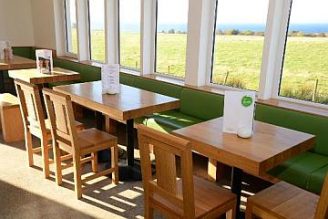
Desserts were typical of Arran fare, sticky toffee pudding being in fact precisely that: sticky and sweet. Profiteroles were our other choice – what chocolate delights could Café Thyme provide? Profiteroles are always a favourite for me and these were no exception, just a little on the soggy side perhaps. It would be delightful if Café Thyme could experiment more with its Turkish credentials and expertise by offering an unusual Turkish style dessert to go with its pides. The welcome and service was friendly and prompt, despite there being a large number of customers spilling out onto the outdoor tables. The café setting is modern and pleasant, with a unique range of teas, interesting stained glass designs - and beyond these, the most fabulous views out across Kilbrannan Sound.
400 years of Shakespeare celebrated at the McLellan Festival
To mark Shakespeare's 400th anniversary year the McLellan Festival welcomed the Durham Shakespeare Group to Arran. On Saturday 20th August at the High School Community Theatre the group presented a double bill of Shakespeare, beginning with A Midsummer Night’s Dream and following it with the bard’s last play, The Tempest.
The Durham Shakespeare Group says of itself “We are a small group of Shakespeare enthusiasts who love sharing his plays.” That enthusiasm was amply demonstrated in their performance of A Midsummer Night’s Dream, the audience much enjoying ‘the play within the play’, and the acting of Puck and Quince in particular.
Bridge Challenge
South to make two diamonds. West leads a heart.
Crossword
Across
1 A bare one is dressed for entity (8)
5 Baskets are right in inlets (6)
9 Brees I heard second-class lines (8)
10 Libero's furnace? (6)
11 Respects damaged bogles (8)
12 Bootleg a ton of contents smoothly (6)
14 Pipe I consort describing a hive (8)
18 Secret look of gumshoe (7,3)
22 Soak up Hasbro's balm back in (6)
23 Monk takes bee tonic preparation (8)
24 Line a taxi so barely contains (6)
25 Article written about zero armour (8)
26 Yet eel is making a hole (6)
27 Slanders Parsees's concoction (8)
Last word – George Monbiot in the Guardian
“What is salient is not important. What is important is not salient. The media turns us away from the issues that will determine the course of our lives, and towards topics of brain-melting irrelevance.
- This, on current trends, will be the hottest year ever measured. The previous record was set in 2015, the one before in 2014.
- Fifteen of the 16 warmest years have occurred in the 21st century.
- Each of the past 14 months has beaten the global monthly temperature record. But you can still hear people repeating the old claim, first proposed by fossil fuel lobbyists, that global warming stopped in 1998.
- Arctic sea ice covered a smaller area last winter than in any winter since records began.
- In Siberia, an anthrax outbreak is raging through the human and reindeer populations because infected corpses locked in permafrost since the last epidemic in 1941 have thawed.
- India has been hammered by cycles of drought and flood, as withering heat parches the soil and torches glaciers in the Himalayas.
- Southern and eastern Africa have been pitched into humanitarian emergencies by drought.
- Wildfires storm across America.
- Coral reefs around the world are bleaching and dying.
Throughout the media, these tragedies are reported as impacts of El Niño: a natural weather oscillation caused by blocks of warm water forming in the Pacific. But the figures show that it accounts for only one-fifth of the global temperature rise. The El Niño phase has now passed, but still the records fall.”