On Whatever
Alison Prince
I read the other day about a man whose horse fell off a mountain. He was riding it at the time, so things might have been a bit sticky, but he sensibly quit the saddle as his mount went somersaulting down the hillside. Amazingly, the beast lived and was more or less unhurt, though understandably shaken up. And the rider went on riding, though on animals that were steadier on their feet.
What is it about horses? Rationally, they are an expensive menace, costing their owners vast amounts of money for grazing, stabling, food, tack, farriery, worming and vet bills for frequent and unpredictable emergencies. One end can bite and the other end kicks, and in between, they can squash you against the stable door or tread on your feet. And yet the love affair goes on. I speak from painful experience, having been one of those tiresome little girls who shrieks from the back of the car, ‘Oh, look, look, there’s a horse! Stop, we must stop!’ Hanging over a gate to stroke the nose of some greedy nag that had approached in hopes of a carrot was my highest state of bliss, short of actually getting to ride. This virtually never happened, since a wartime London suburb offered neither grazing nor stabling nor anywhere to ride – and anyway, we were skint. But I lived in hopes and dreams, badgering my father to ‘move to the country’ where we could revel in acres of green space and have a horse. He gave me his sad smile, though he had a sneaking sympathy. He hated the suburbs, too, and had a great admiration for old, high, brick walls surrounding mansion houses. ‘Nice bit of wall, that,’ he would say in his Yorkshire way, while my Scottish mother went on being sniffy about the south and all it contained. Meanwhile, I had morphed into Black Beauty, with my hapless younger brother cast as Dan, the pony, and did a lot of mane-tossing and pawing of the ground with an impatient hoof. The only time I actually rode was when visiting my aunt, who handed me to a mad girl who owned an ex-circus pony that turned round and round in small circles for unknown reasons. Such bliss, though!
There is something about the smell of horses that goes straight to the hormones. Sniff the hands after any horsy contact and you get that herby, sweaty fragrance that makes a nonsense of the dull air in ordinary houses – or, worse, the dreaded school, flatly unromantic and stinking of floor polish, wet coats and ancient cooking. Horses represented all that was wild and free and beautiful. Oddly, it didn’t matter that the ones I mostly saw never did any galloping about. They were harnessed to bakers’ vans or brewers’ drays, or straining every muscle as they leaned into their collars to move coal trucks in a shunting yard. In some peculiar way, it still doesn’t matter; the deep-buried love affair is still there. In Copenhagen a year or two back I wandered into a yard in their very open-to-the-public palace, to find a man long-reining an Arab horse that was cantering in wide circles round him. Oh, such beauty! That floating movement, the curve of the neck matched by the arching tail, the pattern of hoof rhythm, the sheer grace and power put a precise finger on my latent adoration. The glory of it quite literally brought tears to my eyes, as it does on the rare occasions when a ballet performance manages to transcend all effortfulness and turn into magic.
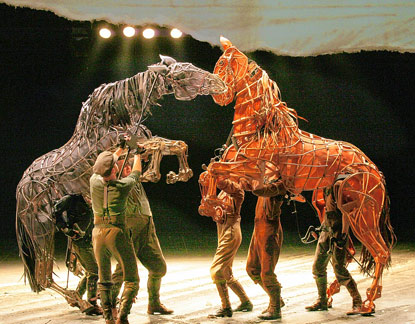 Horses actually are magic. Look at the way audiences collapsed in emotional heaps over War Horse, although they could see perfectly well that the big animals were puppets worked by the visible men who inhabited them. And think of Mayakovsky’s poem about the horse that has fallen in an icy street and lies with tears in its eyes over what he takes to be its humiliation. ‘Horse, do not weep,’ he says. ‘You are not less than any other being. Each of us, in some way, is partially horse.’ I do hope he is right. At the beginning of this utterly mucked-up year, polluted by un-horse-like humans who think a balance sheet is more important than fresh hay, I have a passionate wish that we can rediscover the big simplicities instead of calculating our worth by the number of digits after a dollar sign. Arran is better about this than most places, surrounded as it is by a magnificently indifferent sea and with craggy hills that nobody can make much of a mark on. At heart, we don’t really believe in money, essential though it is. Perhaps we are still partially horse, liking and needing the same things. Fresh food, space to walk about and look at things, shelter from bad weather, decent work to do.
Ah, you will say, if only it was that easy. And you’re right, of course. But that’s the point, I suppose. For horses, it is that easy. Even if they get beaten, starved and eventually shot, they are what they are. From the riding school hack to the racehorse quivering with excitement, they retain their absolute horsiness. They haven’t the faintest notion of thinking as humans do, even if they obligingly learn the required skills, so they always hold their peculiar thrill for the complex and needy human. It is not to be mocked. Long live the little girl who melts in ecstasy at the sight of a horse, I say. Daft or not, she’s in touch with truth and beauty, and we could do with a lot more of that.