Arran Strategic 10 year plan
Discussions on the Ten Year Strategic Plan are well advanced on Arran, with the Economy, Community and Environment Strands. However, I think there are several bridging issues that I believe are important strategically for the Island and worth raising. Complexity inevitably complicates any attempt to partition the debate over solutions onto the three individual strands of future sustainability. The issue I think especially important is to consider the environment and climate change.
1. Climate change and tidal levels on Arran.
In January I went to the conference “Coastal Futures” and one of the speakers was Joe Perry from Highland Council working on coastal management. He described in his Session about work being done in Golspie village in Sutherland, a regionally important centre for High School, Hospital, rail line and main road links to the northern extremity of the mainland. He included discussion on Golspie village and sea level implications. Recently, he gave an input online to the Institute of Environmental Sciences on the experience in Golspie, which can be viewed on the IES website. His main discussion centred around known data on information about Golspie:
https://www.the-ies.org/events/iesturningthetide-protecting
- Older population below average income.
- A STRONG sense of community
- Used to big tides and tidal surges…Joe showed a picture of tidal water in the High Street the picture outside their Coop
- Fairly substantial existing flood defences, rock, gabions, concrete revetments, seawall plus additional sand behind.
- What coastal modelling has highlighted is that “Doing Nothing” is not an option. Highland Council worked with Dynamic Coast
What did the study find?
Today’s 200 year extreme recurrent event predictions become 75 years by 2050 and a terrifying 10 year event by 2080
Unchecked maximum erosion rates of 330m retreat by 2100.
Just consider how this might be replicated on Arran.
Those born today will only be 53 years of age by 2080
The Recommendations for other communities in looking at climate change:
- Commence long-term thinking about the triggers for asset relocation or abandonment, faced with the reality of the 2050 and 2100 coastlines
- Propose beach feeding to protect existing defences and enhance the wave attaining features of the beach
- Be future smart and consider storm events/surges well into the villages causing erosion under all of the High Street: the road may be severed
- Average sea levels have already increased by 20 cm since 1880
Make clear 3 Aims:
- Look at context, the community. For Golspie, land ownership and the past history of control etc (Duke of Sutherland, clearances etc)
- Importance of context, historical and present community
- Engagement of residents and community, for example coastal walks led by community
- Community workshops as have been designed by Highland Council
Consider what the Community wanted:
- Ambition and optimism for the community
- Openness to nature-based solutions but sceptical of performance
- IMPORTANCE OF LOCAL COMMUNITY COUNCIL in an uncertain future
- Embed community voices and prioritise
- Start a conversation with other communities too
- Other areas need discussion. As climate changes, as it is already, crops, agriculture and horticulture changes need to be addressed in which there are many stakeholders. For example, more winter rains, floods, huge storms with wind etc and summer potential fires on moors, in forests etc as these areas already being damaged by over winter rains, and wild fires. Potential future threats with dry periods; also lack of insurance for properties. It will become an uninsurable planet and this process in more vulnerable areas and certain regions will rise. This will be a problem for Local Authorities too.
- Young people, their response rate was low in the Golspie study and they are much more interested in climate change. Need to consider how to involve them in local groups where the higher response currently is from older people.
So, thinking about Arran and climate change, especially coastal changes:
Climate change is expected to increase the frequency and severity of flooding across Scotland. Work at the £48 million Millport Flood Protection Scheme, on the Isle of Cumbrae, started last spring and work is progressing well on the construction of an offshore breakwater, which will create a calm area of water. Just seeing the changes around our Arran coast, even this winter, the potential for serious disruption, costs to infrastructure, amenities etc as well as properties close to the shore. We took some pictures locally. How long before the contents of the old cowp behind Brodick Beach will have to be removed or it will end up spread along the beach? In terms of farmland, the growth of rushes, erosion following fire outbreaks. Effects of heavy periods of intense storms and wind. Then damage in forests due to Phytophora, and other invasive species? Effect on land ecosystems.
The pictures taken in recent years illustrate the point that erosion and flooding issues are visiting us already.
Four pictures in Brodick of tidal effects: beach erosion in Main Street this spring, shoring up the cowp area of Brodick beach, high spring tide on Main Road in Brodick.


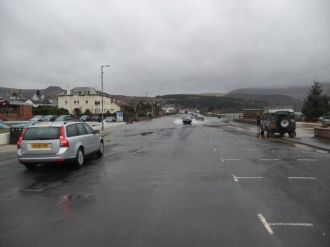
Four pictures in Lamlash: Lamlash Green erosion, Shore Road; Pier submerged with swans swimming over; waves on Shore Road; and area of boatyard by lifeboat station and public toilet


2. Sewage systems around Arran and overloading of present systems.
Implications for planning as everyone rushes to extend their houses to capture the tourist market, together with additional new build. Buildings in gardens, flats etc. Looking even at Lamlash, since the interceptor system for collection of sewage was constructed some 15 years ago, it was clear last summer that there were problems. Is this overloading, blocked pipes? There were reports of faeces, sanitary products in the water. Do we value our marine inshore ecosystem? Health implications? What is the implication over the next 10 years of yet a greater rush to planning development without the infrastructure to support it? Will new housing have to build their own septic tanks? These problems are compounded by the changing characteristics of rainfall runoff overloading the sewerage system.

In August 2023 this sign shown above, appeared around Lamlash. No one seemed to know why, or who did the analyses: There is a general lack of information. As a marine biologist who worked on biofouling and sea mussels, this notice rang alarm bells. Who does regular analyses of inshore waters around Arran? It is known some on Arran would like a safe bathing, Blue Flag designation for certain Arran beaches.
Just how much is known about the dumping of industrial waste around the coast of Arran? Is it regularly monitored and published…and available to islanders; for example, the 2 tankers daily of waste from Lochranza Arran Distillery discharged untreated into Kilbrannan Sound, containing alcohols, phenols etc. Are similar amounts being discharged without treatment from the Arran Lagg Distillery? What about the other industrial plants? Lamlash, Cladach? What about from the new industrial venture in Kilmory in the old creamery building, close to the good bathing beaches of the south end?
3. Arran potable water system.
Potable water tankers are appearing on Arran with increasing frequency during summer months. I have asked through the FOI procedure for information from Scottish Water but still none has been forthcoming. Again, a need for systemic change? The demand for more housing, whether low cost, holiday houses and letting flats. even hutting all require water connections. It is known that holiday lets etc use more water, and create more waste, so how is Arran/ Scottish Water/North Ayrshire Council to plan strategically for these? With the potential for dry summer months will the burns presently providing a crystal clear water supply for whisky making be replaced by tankers of water brought in by ferry? What is the consumption of potable water now compared to 20 years ago? Potentially drier summers will increasingly affect water courses for those on private supplies.
4. Plastic waste.
When are businesses, from distilleries, takeaways, tourist accommodation, and food producers including our Co-ops going to decide to cut down and eventually eliminate non-recyclable plastic waste? Research is now showing just how frequently micro-plastics are being found in the wider environment. Many on Arran and much wider afield fought against the proposed huge salmon farm off Clauchlands and more recently off the North End beyond Fallen Rocks. The culture of engaging islanders wanting to be heard re. pollution, planning, the value of our ecosystems on Arran of all sorts needs to be nurtured in all ages of the population. We must make Democracy work for everyone. It may well be that all three island Strands looking at the future Strategy for Arran- Economy, Community, Environment should take the lead in what amounts to a major culture change over time. Future development must mean more than housing and jobs.
5. When is Arran going to try and build community power generation by sustainable means?
By, for example 3 or 4 wind turbines, at maybe the south end, and be able to use some of the income for community needs? Perhaps we need to think like Gigha. Love, Hope and Charity were the first three windmills and another has been added. What about solar panels again on high land, south facing, and all linked to new grid connections. We will need investment from big companies with community benefit arms. Forestry is engaged in massive cutting at present, and there is a tall new telecommunications tower high on the Ross Road, about to be connected. Not a Special area of Conservation or a National Scenic Area and with trees cut, in several places in the south end, so not especially important for birds! And importantly, will not be any sort of eyesore in the views of Goatfell and the North Arran NSA. Forestry Scotland is a Scottish Government Agency, so working with this public agency could be fruitful. Controversial of course but clear positive benefits need to be set out and wider community buy-in established.
6. Low carbon life living.
How do we change our lifestyles? From types of transport, insulation of our homes, even wearing more sweaters so lower thermostat settings? It starts with our environment and education. It is about complexity, “everything affects everything”. From ferry service with reliable and resilient service coping with higher spring tides, and indeed lower spring tides (more dredging at Cloanaig?) to all our services for residents on Arran…health, education, care, waste disposal and recycling.
Some of these headings are “demanding” areas which need input from those already working in these fields, but highlighting the strategic needs over the next 10 years; especially at a time of severe fiscal restraint. Plenty to do! Some of these thoughts will not be favoured by other groups on Arran so collaborative enquiry into these areas will be important. We must make Democracy work for everyone. The Local Development Plan 3 will soon be published. We must be heard in all these areas. What is the capacity in these vital services? I am aware North Ayrshire Council is to benefit from funding as part of Scottish Government support to councils to adapt to coastal change and protect against coastal erosion. A Council project is one of ten case studies to receive a share of £1.05m from the Scottish Government’s Coastal Change Adaptation Programme, and forms part of £12m committed for coastal change adaptation during the course of this Parliament.
The ten case studies will begin in 2024/25 and will highlight good practice across Scotland.
Councillor Tony Gurney, North Ayrshire Council’s Cabinet Member for Green Environment and Economy, said:
“As a local authority, we have an ambitious vision for tackling climate change. We recently unveiled our new Sustainable North Ayrshire Strategy for 2024-2027.”
“This outlines how we are working towards fulfilling our commitment to reaching net zero carbon emissions by 2030. The planet is facing a climate – and nature – crisis and we are fully focused on doing everything we possibly can to help halt biodiversity loss across North Ayrshire and be Nature Positive by 2030.”
“Everyone can play a part, no matter how small, in working towards net zero. And we welcome this Scottish Government funding for the Coastal Change Adaptation Plan.”
You can find out more about North Ayrshire Council’s Sustainable North Ayrshire Strategy here: Council’s net-zero ambitions are laid out in new plan to help tackle climate change (north-ayrshire.gov.uk)
And there is further information about the Ayrshire SMP here: Ayrshire Shoreline Management Plan (north-ayrshire.gov.uk)
All these will involve all of us. We need to get stuck into these tasks now!
Sally Campbell
March 2024
All image credits: Sally and John Campbell