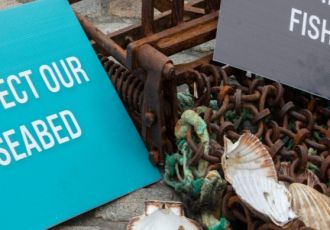
A legal victory for Scotland’s seas
Campaigning organisation Open Seas has worked tirelessly to protect Scotland’s marine habitats and last week the nation’s highest civil court ruled in their favour against the Scottish Government. The judge confirmed that ministers are legally required to ensure that harmful fishing practices, such as scallop dredging, do not damage the marine environment, as according to the National Marine Plan.
25th April 2024, published on the Open Seas website.
This week is a good week for environmental justice. After a lengthy court process, Scotland’s most senior judges have rejected the Scottish Government’s appeal and confirmed that Scottish Ministers’ are legally required to consider the impacts of harmful fishing on the environment.
Recap: last year we challenged the Scottish Government’s approach to licensing scallop dredging which risks on-going damage to marine habitats. We provided to the court several examples of environmental damage caused by scallop dredging in areas such as Flotta Sound in Orkney, Rum, Islay, Scarba (off Jura) and around the Isle of Lismore.
Our lawyers made the case that continuing to license scallop dredging in these areas “would contribute to the deterioration of the seabed” and that they were legally required to consider the National Marine Plan the duties within it to protect marine habitats. In the first judgement (July 2023), Lord Braid ruled that the Government’s approach was indeed unlawful, but Scottish Ministers then sought to appeal the decision to the Inner House of the Court of Session.
This week Scotland’s highest civil court rejected that appeal and found that the Scottish Government must “take decisions in accordance with their own National Marine Plan policies as required by the Scottish Parliament”. You can read the full decision on the Scottish Courts and Tribunals Service website. Scotland’s most senior judge Lord Carloway noted “[t]hat does not appear to be too difficult a task,” adding that it is “one which must be undertaken, because there is a statutory duty to do so.” The question then, is why this ever ended up in court.
As a small charity, working to promote the health of Scotland’s seas, we think this is a very significant judgment and pay massive respect to everyone who has campaigned tirelessly on this issue, long before it became a battle in court.
Director of Open Seas Phil Taylor said: “We are extremely pleased that the court has again ruled in support of our petition. This result is a victory for Scotland’s seas, and the thousands of people who want to see them safeguarded for future generations. Scottish Ministers must now fundamentally reform the way they license fishing to ensure that destructive methods like scallop dredging do not cause serious harm to Scotland’s marine environment.“
Our seabed habitats provide so many societal benefits, not least their vital role as fish nursery and spawning grounds. Scallop dredging undermines the health of our seas and damaging fragile habitats brings no long-term net economic benefit to Scotland. This decision should be welcomed as a clear legal framework for Scottish Ministers to implement their plans and ensure sustainable use of our seas.“
Please check out our campaign page for more background to the case.