D-Day, A Torridon Mountain Adventure, and a Tragic Accident
By Peter Finlay
In June 1944 (as we were being reminded many times last month) the biggest military operation in history took place. D-Day. The Allies moved in to finalise the rescue of Europe from the clutches of Adolf Hitler. Key to this operation was the landing of vast numbers of troops on the Normandy beaches. There is one man who is little known whose mathematical expertise was vital to the success of the landings. His name was Raymond Whipple. Doesn’t ring a bell? OK. Consider this: ‘Ray Whipple was the brilliant Oxford mathematician who In 1938 had calculated the re-radiation of a vertical conductor in relation to the incident field, a vitally important contribution to the development of radio direction finding…’ Still none the wiser? Head spinning slightly? All a bit beyond you? No doubt! Me too! But now this – ‘His work later was of huge importance in determining the positions of mines off the Normandy coast whose clearance was vital to the success of the Allied troops landing there in June 1944’. And this from ‘Mixter Maxter’ the archives of Dick and Winifred Sillitto: some memories of Ray Whipple. ‘On 5 June 1944 the system (the Decca navigator system which allowed a ship to identify its position) was used by 21 minesweepers and other vessels to navigate accurately across the English Channel and to sweep the minefields in planned areas in preparation for the Normandy Landings the following day. Legend has it that on D-Day Ray lightened the tension for the troops by getting engrossed in a particularly interesting cloud formation – and walking off the edge of the quay!’ So there you have it. Raymond Whipple’s contribution to victory in the 2nd World War. Ending with a big Splash!
Now we will leave him for a bit while I tell of my own night time adventure on one of the most magnificent mountains in Scotland. The mighty Liathach (pronounced Lee-u-guch, with ‘ch’ as in Scottish loch). Liathach – the Grey One as its name means in Gaelic – a very dark grey in some of its moods!
My adventure came about like this. I was Church of Scotland minister in the parish of Torridon in the 1970’s with my manse beside the little church on the shores of the Upper Loch. One July evening, after a day visiting the folk around the far flung parish, I was standing outside my house gazing at the great hills across the loch, my eyes sweeping round from Beinn Dàmh to a multitude of other great hills all around. Then I came to Liathach, looking as magnificent as ever in the dying light of that day. I had traversed its impressive ridge many a time over the years I had lived there, but now a new thought entered my mind. On a night like this very beautiful summer night it might be even more special. I did not resist the thought for too long and soon I had packed a few things and, accompanied by my faithful black Labrador, called Fitheach (Fee-och) – the Gaelic for Raven, that wisest of birds – I made my way through the Scots Pine woods till we reached the Coire Mhic Nobuil bridge where we could start up the most westerly peak of the range. It is called Sgorr a’ Chadail which means Peak of Sleep – though for me that night it seems sleep was the last thing I was thinking of!
We had set off shortly after 10pm and by midnight we were on top of ‘Sleep’ Peak. There were still a few lights in the village far below. From now it was onwards into a region far from human sight or thought. It was up and further up the great rising western slopes that lead up to the strangely named Mullach an Rathain, meaning ‘Summit of the Pulleys’ after the shape of two or three prominent rocks at the summit which resembled the grooved pulley wheels, the part of a spinning wheel which receives the driving cord. So there we were on the ‘Pulley Wheels’! What a sensation it was!
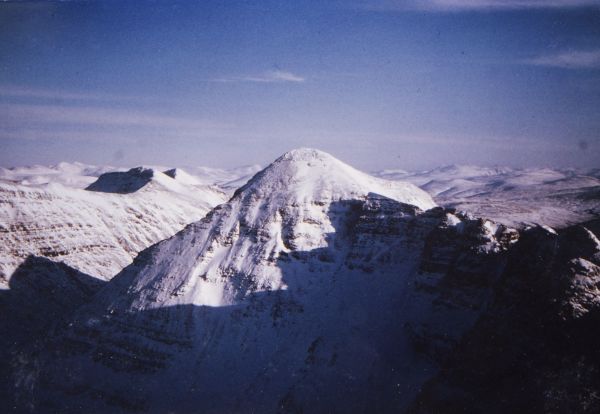
From now we were moving into real wildness and utter remoteness. Beneath was the vast chasm of Coire na Caime and ahead the Am Fasarinen pinnacles seen end on, then the beautifully shaped final summit of the Grey One, the Spidean a’ Choire Lèith. And that is where we were heading.
There is this description of the section ahead in Walkhighlands: ‘…the next section of the ridge is riven into the famous Am Fasarinen pinnacles. If all these are traversed along the crest there is a considerable amount of exposed scrambling to negotiate. Alternatively there is a path which traverses below the pinnacles on the south side to avoid the scrambling, but it is itself sensationally exposed.’
I had been over the Fasarinen many a time in broad daylight without finding it as scary as that description would suggest but now it was a step (or two or three steps?) into the dark. But at least there was now the beginning of a very slight hint of a lightening of sky in the East…. And so the pinnacles of this section were now being tackled one after the other. Fitheach kept to the skirting path (which he was quite used to in daylight) with an eye constantly on me above. And it was a surprisingly good place to be. I suppose the exposure looked less intimidating in the dark! The continuing vast emptiness to my left, the final goal ahead and a brave Raven somewhere below keeping a vigilant eye on me.
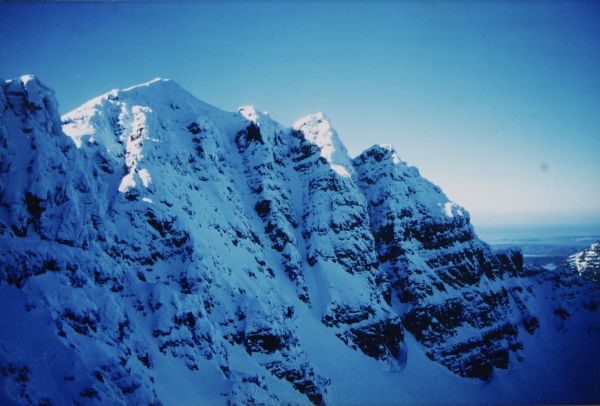
At last, the Fasarinen past, found us clambering up the great white grey quartzite blocks leading to the final summit itself. This we reached by around 3am and there was time for a longish rest and time to say to myself this must surely be the most amazing sight anywhere one could ever imagine, for it really was far beyond any of our imaginings. The half light was enough to see right down to the Coire floor. The sheer vastness of the place was totally overwhelming, grey space after grey space after grey space with no seeming end.
It was certainly not a place to hurry over. It could have been the cradle of Creation itself, and the rocks around were certainly almost ancient enough.
I used to have weird fanciful thoughts of what an experience it might be to have some great orchestra up there and, to fit the scene, the deep powerful sonorities of Haydn’s Creation, echoing there in that vastness from rock face to rock face and right up to the Heavens above. The praises of Almighty God resounding for ever from the deep heart of Torridon!
Eventually, of course, I was on my way, over two more lower peaks, on to the extreme eastern peak of the Liathach ridge. Then it was down over 3000 feet and my way home led me through the deep glens behind Liathach with views of the ridge where we had been up above us all the way.
There was another Torridon giant to the right – the mountain that – no fault of its own – fails by only a few inches to attain the critical Munro height of 3000 feet! Beinn Dearg. Strangely my energy levels were still good, so up we went and we reached the summit at 7am. Then I thought, crazily, why should this be all! We could go on to Beinn Alligin as well, so including all the great mountains closest to my house in one expedition!
I should have consulted my wise Raven first. Thankfully he had a mind of his own and this is where he put his foot – or rather his paw – down. I did not actually notice until I had ascended about 200 feet of my third hill. That was when I realised I was on my own! Looking back down I saw a black shape determinedly seated on the path below. I could almost say I could see his head was tilted to one side, as if trying to assess my sanity! So, that is when I gave in and rejoined him, and now at last we did go home. Around 10am – after 12 hours non stop exertion – I tumbled into bed and almost immediately was in a very deep sleep.
Mid afternoon I was disturbed by a loud hammering on my front door. Still totally exhausted I ignored it, turned over, and went back to sleep. It was much later I found it was a summons I should never have ignored. I belonged to the Torridon Mountain Rescue and it was they who, hardly guessing at my activities through the night, had been trying to get my attention.
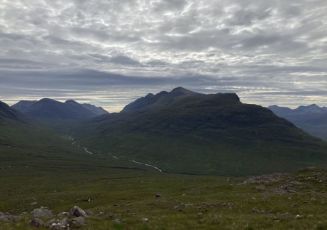
And this is where we come back to Ray Whipple. A keen climber himself he had been with his son, Simon, on the mountain just behind the Manse, Tom na Gruagaich (Hill of the Damsel), which is part of Beinn Alligin itself. They must have diverted from the safe path up its hidden Coire nan Laogh to what might have seemed a more interesting route on the ridge south of that corrie. It seems that here Raymond had slipped and taken a bad fall. Very sadly the fall had proven fatal. The rescue could only be that of his remains.
Some while later, after his funeral, his wife, Mary, and Simon called on me at the Manse to ask me if I could help with a little service for him. They had decided to scatter his ashes by the Coire Mhic Nobuil River directly beneath the place about 2500 feet above where he had had his tragic accident. Some 14 years later when Mary died her ashes were likewise scattered in the same place, though by this time I had long left Torridon.
So in this year, with millions remembering the D Day landings and all the bravery that went with them, I have a special thought of the man who certainly played his own hidden part in making the landings possible and my amazing night on Liathach so close to where his fatal accident had occurred.
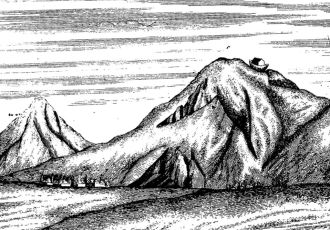
My own photos of Liathach, unfortunately not taken in July but in mid Winter! However they do show the dramatic nature of the terrain so I have included a few. I am indebted to Trefor Goronwy engaged in path construction in Torridon at present for having taken some more pictures of those mountains nearer to the date in July when I did my climb many years ago.