An Arran suffragette
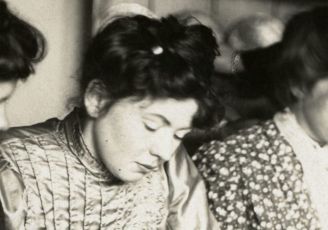
Flora Mckinnon Drummond, née Gibson, was a tiny person, only 5 feet 1 inch tall. She was born in Manchester on the 4th August 1878. Her mother, Sarah Cook, had grown up on Arran, in Pirnmill, but she married Francis Gibson, a tailor, and went with him to Manchester in search of work. However, within a year or so they came back to Pirnmill, so Flora grew up on Arran and went to school on the island.
At the age of 14, she moved to Glasgow to train at a civil service school, where she qualified as a post-mistress. However, she was declared an inch too small to meet the minimum height requirement of 5 feet 2 inches, so could not be a post-mistress. Flora, though furious, doggedly gained qualifications in shorthand and typing and attended lectures on economics at the university – a rare thing for a young woman then. Her resentment at being refused a position as a post-mistress because of her small size never left her, and did much to turn her into a fighter for the rights of women.
In a strange replication of her mother’s life, Flora fell in love with a boy from Manchester, an upholsterer called Joseph Percival Drummond. They married on the 26th September 1898 and set up home in Manchester, where they both became involved in the Independent Labour Party and the Fabian Society. Flora accepted a number of short-term jobs, which expanded her personal understanding of how women were low-paid and badly treated. A severe drop in the upholstery trade led to Joseph becoming unemployed, so Flora found herself the main wage-earner.
In 1905 Christabel Pankhurst and Annie Kenney, members of the Women’s Social and Political Union (WSPU) were imprisoned for interrupting a local Liberal rally. Flora went to a protest meeting held in Stevenson Square, and quickly made her mark as an inspiring orator, fiercely able to deal with hecklers despite her small size. She moved to London a few months later and became an active member of the WSPU, wearing a military-style uniform and leading women’s rights marches mounted on a large horse, which earned her the nickname of ‘The General’. At the end of 1906, following arrest at a House of Commons demonstration, she was imprisoned in Holloway- but it did not deter her. In October 1908 she was the main organiser of the Trafalgar Square rally, and protested with the Pankhursts from the House of Commons public gallery. A further three-month spell in Holloway followed. Flora was in the early stages of pregnancy at the time, and was released for health reasons after fainting and being transferred to the prison hospital wing. When her son was born she named him Keir, after the political leader, Keir Hardie.
Flora came back to Scotland and in October 1909 organised the first suffragette procession in Edinburgh. She was imprisoned nine times, sometimes going on hunger strike, though she was spared the brutal practice of forced feeding because she was so well known that risking visible injury to her would not have been wise. However, the starvation took its toll and her health began to fail. She returned to Arran and the family home for the summer of 1914 to recover, but when the First World War broke out on the 28th July, she returned to London, concentrating on administration and public speaking so as to avoid further spells of imprisonment. Four years later, in 1918, women over the age of 30 were given the right to vote.
Flora’s husband, Joseph, cannot have found marriage to The General easy. He left Flora and emigrated to Australia. In 1922 she divorced him and married a cousin, Alan Simpson, though for political and business reasons she kept the name of Drummond. In 1928 she was a pallbearer at Emmeline Pankhurst’s funeral -and that same year, all women over the age of 21 were given the right to vote and to stand for parliament election.
In the years between the wars Flora founded the Women’s Guild of Empire, a group opposed to both communism and fascism. Her London home was destroyed in the London blitz and her husband was killed. Flora came back to Scotland and lived near relatives in Carradale, Kintyre, across the water from her childhood home on Arran. Five years later, on January7th 1949, she was engaged building a new home at Carradale at the age of 70 when she suffered a stroke and died.
Flora Drummond was buried in Brackley graveyard, Carradale. Recently local people collected funds to mark her grave with a stone inscribed, ‘The Suffragette General’. A tiny but indomitable woman.