

Wave power
As anyone prone to seasickness will confirm, the ocean moves up and down all the time, often very vigorously. All natural movement of this kind, whether wind, tide or waves, consists of energy. Left to itself, this energy blows off its excesses as storms and floods, but just a small fraction of it can have huge potential for our own purposes.
Wave power has a surprisingly long history. As early as 1910 a man called Bochaux-Praceique built a device to light and power his house near Bordeaux in France. In the crisis of the 1970s, which now seems rather minor, there was a fresh flurry of interest in harnessing natural energy, then we got used to paying more for oil and it all died down again. Now, with oil not merely expensive but beginning to run out, the Scottish Government is very sensibly planning ahead and working towards a lasting, permanent supply of natural, non-polluting power. Last month we featured the tidal power installation being built between Islay and Jura, where the fast current running between the two islands is ideal, but there is also a wave power station on Islay.
 The idea is simple. A fixed installation has an air space inside it that is compressed when a wave surges in and released when the wave goes out again. The power of this compression and decompression drives a turbine, generating electricity. The LIMPET (Land Installed Marine Power Energy Transformer), developed by a company called Wavegen, was installed, also on Islay, in 2001, and has been running ever since, a the world’s first commercial scale wave-energy device. The manufacturers are now developing a larger system in the Faroe Islands.
Waves running up the beach create pressure inside an oscillating water column, and this in turn creates pneumatic power driving twin 250 kW generators.
The photo shows the LIMPET Islay tidal power installation. Nobody could complain that it is ruining the landscape, as it is invisible from the land. There is no reason why such turbines could not be incorporated into sea walls in many coastal districts, combining sea defences with energy generation. Theoretically, there is no need for anything else, for the World Energy Council says the world’s oceans can deliver twice the amount of electricity that is globally produced at the moment. Scotland has particularly high potential, since so much of its western coastline is exposed to the Atlantic Ocean.
Th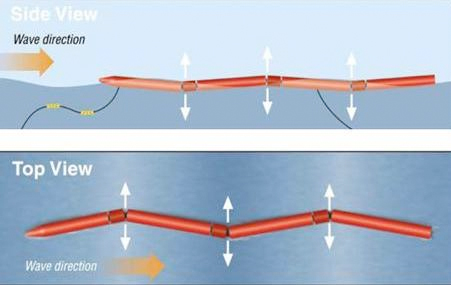 e LIMPET is not the only approach to harnessing wave energy. Imagine threading a piece of string through four plastic bottles, end to end, then chucking them in the water. This line of bottles would float on the waves and snake up and down, meaning there is movement between one bottle and the next. This simple idea underlies the Pelamis, pioneered by an Edinburgh-based company. On a far bigger scale than plastic bottles, it consists of linked floating tubes 150 metres long and 3.5 metres in diameter. The joints between them are in constant movement, so they can power a system based on fluctuating pressure than generates electricity. On 22 February 2007 the Scottish Executive funded what will be the world’s largest wave farm, the European Marine Energy Centre (EMEC) based in Orkney. It will have a capacity of 3 MW.
i
Pelamis on site at EMEC, the planned location for Scotland’s first wave farm


