Issue 140

Hello and a very happy 2023 to all our readers!

Whether refreshed or recovering, we hope this issue finds you well and that some island news will help welcome in the New Year. While Scotland’s Year of Stories is coming to an end, we start off with some wonderful Arran tales from the community led COAST project (not to be confused with COAST of Lamlash). The project has been gathering stories from around the west coast, bringing the past alive in the present in an amazing online resource that explores the culture and heritage of Scotland’s island and coastal communities. It’s an absolute joy to read through their website, and we have published just a few of the contributions from Arran.

With both the COP 15 conference in Montreal and the publication of the Scottish government’s draft biodiversity strategy last month, nature and our role in it, has become another guiding theme. The figures as we know are startlingly bad, and the rate at which the life on which we depend is diminishing is not easy to fathom. The 2022 WWF Living Planet Report reveals global wildlife populations have fallen by 69% on average since 1970, so the agreement that was reached at the conference will hopefully start to seriously address biodiversity loss and restore ecosystems.

Such big global events as COP can seem distant and lofty, and what has really brought the biodiversity issue home to me are things happening here on Arran. Within the space of a mile or so, a tale of contrasts is taking place, one that gives a great sense of hope for nature, and another a feeling of dismay. We hear from the Arran Community Land Initiative and the brilliant work they have been doing over the past year – improving tracks, planting trees, growing food, and restoring wild flower meadows.

Yet just down the road at King’s Cross, the community is facing proposals by Forestry and Land Scotland, to develop a significant area of farmland into a timber stacking and transfer facility. The destruction of a tranquil and biodiverse rich area into an industrial site is a shocking prospect, as well as being completely at odds with the government’s strategy of restoring nature and improving protected areas. (If you are interested in getting involved in the Friends of King’s Cross campaign, please do get in touch with them, there are details in this issue).

In a piece from the Shadows and Reflections series, Lally MacBeth recounts her experience of cultivating a geranium cutting over the last year. Through her description of the progress of the plant, which originated from one first potted in 1915, and the connections it inspires, “a Geranium of generations”, I understand the care we need to take if things for our world are to change. We get a sense of how the simple process of tending a plant is the basis of a healthy living world. Lally says, “This small, and seemingly insignificant gift has, for me, brought joy to each morning of this year…. A timeless Geranium that links long lost grandmothers to the present and a sense of hope for the future.”

We hope you enjoy the issue and may the year ahead be Geranium filled! Elsa

Scotland’s Biodiversity Strategy 2022 – 2045

A statement by NatureScot on the recently published draft Biodiversity strategy:

In light of mounting evidence that Scotland continues to experience dramatic declines in biodiversity, the Scottish Government has set out an ambitious new strategy to halt biodiversity loss by 2030 and reverse it with large-scale restoration by 2045.

The new strategy, published as a draft last month, aims to deliver the transformational changes needed to protect and restore terrestrial, freshwater and marine biodiversity in Scotland.


Stories from the COAST project

As 2022, Scotland’s Year of Stories comes to a close, we have brought together a few of the Arran stories from the COAST project.

Over the past couple of years, hundreds of stories have been collected by 32 local story gatherers, as well as through online submissions and workshops, from across the west coast that reflect on the culture and heritage of our coastal communities. These stories range across eight themes and include 20 cross-cutting tags from Vikings and Jacobites, to Gaelic Culture and Hiding Places.


COP15 Biodiversity Conference

Biodiversity Loss, Restore Ecosystems and Protect Indigenous Rights

The Fifteenth meeting of the Conference of the Parties (COP 15) was held in Kunming, China and Montreal, Canada, in two phases.adoption of the Kunming-Montreal Global Biodiversity Framework (GBF) on the last day of negotiations. The GBF aims to address biodiversity loss, restore ecosystems and protect indigenous rights.The plan includes concrete measures to halt and reverse nature loss, including putting 30 per cent of the planet and 30 per cent of degraded ecosystems under protection by 2030.The New ScientistOutcomes of COP15COP15 biodiversity deal is ‘new era’ for Indigenous-led conservationCOP15: How much money do we need to stop biodiversity loss?COP15: Countries debate how to share profits from Earth’s genetic dataAichi targetsMeanwhile other news suggests we still have much to do:two-thirds in 17 yearsresources into covering COP15 But in the last day, hours even, almost 200Caymans in the coal mineMichael Gove has approved the first new UK coal mine in 30 years despite concern about its climate impacts among Conservative MPs and experts.85% of the coal produced by the mine would be exportedscathing blogBusiness GreenThe Telegraphfierce criticismexpected owned‘net zero in its operations’Oil Firm Total and the Congooil giant Totaloffsetting projectUnearthed SourceMaterialhuman cost of this schemeThe EconomistThe Times MagazineTogether, we can demand the fair, green and peaceful world the world’s ecosystems all deserve. We need to fight harder for it in 2023. Signing off and wishing all of our readers a happy and perhaps more sustainable 2023.With thanks especially to Greenpeace Unearthed, Feargal Sharkey “Don’t Mess with Me:” in The Times Magazine which gave me much thought over Christmas!


Shadows and Reflections

A post from Caught by the River, by Lally MacBeth. Every year in December they publish a series, ‘Shadows and Reflections’, in which their contributors share highs, lows and oddments from the past 12 months.

At the beginning of the year Matthew gave me a Geranium cutting. It had been given to him by his mum, cut from a much bigger plant that once sat in his Grandmother’s garden. There is a label poked into the compost that states the original plant the cutting was taken from was first planted in 1915. A Geranium of generations.


News from Arran Community Land Initiative

Taking stock of developments in 2022

Our strategy for the community land includes:

• Improving access
• Growing fruit and vegetables by/for individuals and for the community
• Improving Biodiversity
• Growing Initiative sustainability
• Increased community involvement in activities

Step by step we have made progress in most of the above strategies.

We received a large grant in partnership with ACVS towards track improvement. The grant came from the covid recovery fund. This enabled construction of a track all the way from our car park to the Glenashdale exit at the south west corner of the land. It also provided a bridge over a burn enabling access to our top fields. Anecdotally we believe it is encouraging an increasing number of walkers to use the community land.


Arran Natural History Society meeting in January

Arran Natural History Society send everyone festive greetings and best wishes for the coming new year.

We have an exciting speaker lined up for our first talk of 2023 on Tuesday, January 10 at 7.30pm. This will be an online event so we hope to welcome members and supporters from near and far.

Our guest is Mariel ten Doeschate from the Scottish Marine Animal Strandings Scheme (SMASS).

SMASS is the research and reporting scheme for stranded marine mammals around Scotland's coast and rivers. As well as investigating the deaths of marine mammals, SMASS is involved in several areas of marine mammal science and uses a citizen science programme to help with the collection of marine strandings data.


Zambia long ago

A freezing December has turned my thoughts back over 50 years to the day my train trundled across the mighty Zambezi with the Smoke that Thunders only a hundred or two yards away - Mosi Oa Tunya in the name David Livingstone first heard it called in the original Lozi of the peoples in whose land it lay. He peered in wonder into its vast depths from a little island perched on its very edge. Then he made the biggest mistake of his life in naming it for a little lady in England. It was the only place in all his travels that he re-named. He had too much respect for the music and traditions of the African languages he knew so well. Yet one has to be full of huge admiration for this man who single-handedly took on the challenges of a continent ravaged by the slave trade and who through years of desperately weakening illnesses forged ahead to bring the message of his beloved Saviour to all the peoples he met - and in his deep love for them he vowed to free them as far as he possibly could from the curse of slavery. It’s hard not to see him as one of the greatest sons of his country embracing as he did both its west with a grandfather from Ulva (next to Mull) and the Lowlands too with his upbringing in the Clyde Valley.


ACVS Winter Warmth guide

Arran Community and Voluntary Service have created a guide to help community members find out where they can go to be social and spend time in a warm space during these winter months...


Arran Outdoor Education Centre petition

Sheenah Fletcher has set up a petition calling on islanders and visitors to object to the recent news that the Arran Outdoor Education Centre in Lamlash may be closing. She has written to North Ayrshire Council (see below), and you can sign the petition by following the link here

To Marie Burns, Council Leader, North Ayrshire Council

I am alarmed to have read a leaked document in a local newspaper, that suggests that the Arran Outdoor Education Centre could be closed to make savings at this time of cutbacks. I believe that shutting this resource would be an absolute disaster for not just Education, but for Arran as a whole.


Corrie Film Club

The next film showing at Corrie Film Club, on Sunday January 9th, is The Last Station (UK/Germany 2009. Hoffmann. Cert 15), at 7.30pm, in the Corrie and Sannox Village Hall.

The Last Station is an historical drama based on the last chapter in the life of Russian novelist Leo Tolstoy. Christopher Plummer stars as the famous writer, who is nearing the end of his life after a long period of ill health. He lives with his family in a compound at Yasnaya Polyana, attended to by his wife and the disciples of his 'movement': a group of people dedicated to his ideas of pacifism, vegetarianism, sexual abstinence and communal property who have gathered in a nearby forest camp. When the head of the movement, Vladimir Chertkov (Paul Giamatti), urges Leo to rewrite his will to posthumously renounce his material possessions, thereby leaving his family with nothing, Tolstoy's wife Sofya (Helen Mirren) does all she can to influence her husband and protect her inheritance.


Poem for January

The Snow Man

One must have a mind of winter

To regard the frost and the boughs

Of the pine-trees crusted with snow;

And have been cold a long time

To behold the junipers shagged with ice,

The spruces rough in the distant glitter

Of the January sun; and not to think

Of any misery in the sound of the wind,

In the sound of a few leaves,

Which is the sound of the land

Full of the same wind

That is blowing in the same bare place

For the listener, who listens in the snow,


Letters

Katy Clark MSP Member of the Scottish Parliament for West Scotland Region

Forestry Operations at Kingscross, ArranKaty Clark MSPWest Scotland Region

M01.10, The Scottish Parliament, Edinburgh, E99 1SP Email: katy.clark.msp@parliament.scot


Marine news

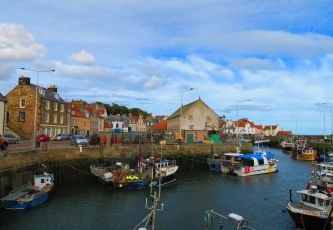
Sent in by John Kinsman, operations manager Coastwatch St Monans, east Fife. Featured image shows Pittenweem harbour.

Fife harbour calls received in Brighton

An ex Pittenweem resident fears lives are being put at risk as he is receiving calls from people trying to contact the Fife fishing harbour nearly 400 hundred miles away in Brighton. .
Ron McDonald says he received numerous calls each week from people trying to contact the harbour master at Pittenweem. His number is appearing on Google under Pittenweem harbour as his holiday rental business was listed under the same name about 20 years ago.


Recipe for the month

Vegetarian Bolognese, sent in by Anne Kinsman

Ingredients:

2 tablespoons olive oil
1 medium onion finely chopped
2 carrots finely chopped
2 celery sticks finely chopped
1 clove of garlic crushed
350g frozen vegetarian mince
1 bay leaf
500g passata
1 vegetable stock cube
100ml milk
Small bunch of basil chopped
600g cooked spaghetti or other shaped pasta
Vegetarian hard cheese to serve

Method:

1.Heat the oil in a sauce pan and gently fry the onion, carrots, and celery until the onion is starting to soften. Stir in the garlic and vegetarian mince (there is no need to defrost) and fry for a couple of minutes. Add the bay leaf, passata, vegetable stock cube and 200ml water, then bring everything to the boil.
2.Turn down the heat and simmer for 30 minutes or until all pieces of veg are tender and disappearing into the tomato sauce. Add the milk, then cover with a lid and cook for 10 minutes. Season to taste. If the sauce is a bit thin keep bubbling until it thickens.
3. Meanwhile, cook the pasta according to instructions on the packet.
4. Stir the basil into the sauce, then serve on top of plates of spaghetti. Sprinkle each serving with grated cheese.