Issue 15

Ferry views

Margie Currie

Talk of a Campbeltown/Arran/Ardrossan service as I understand might be seasonal and possibly thrice weekly. Brodick would be the Arran port. There is a lobby in Ardrossan who would welcome greater use of the port facility there. The interest in Arran appears to be a bit lukewarm. Obviously another service is welcome but, perhaps it has been less wholeheartedly received in case it would be perceived to threaten the viability of Locranza/ Clainoig/Tarbert service for which there is very strong support. I think that this fear is unfounded. The C/B/A service would be less likely to receive subsidy than the "lifeline" services which are the object of the Ferries Review.

Linda Johnston, Group Director,  Auchrannie

A summary follows, but to see Linda’s comprehensive report, click here.

It is great news that RET will be extended to Arran but extremely disappointing and worrying that the pilot scheme will not be implemented until 2014, especially as the scheme is being extended to Islay, Colonsay and Gigha in October 2012.  This puts Arran at a severe disadvantage. We suffered a downturn in tourism income in 2010 when tourism income fell 6% from £30.4m to £28.59m, and in 2011 Cal Mac’s carrying figures were down by 5.93% for passengers and 5.77% for cars. By 2014, Arran’s economy will most likely be severely affected.  We believe that visitors will bypass Arran and visit other islands with cheaper fares, thus accelerating Arran’s economic decline. 

A solution to the problems with Ardrossan Harbour must be found This year, Auchrannie has suffered the loss of 96 room nights due to ferry cancellation against 19 room nights in 2010/11. Guests stranded on either side of the water are put off visiting Arran in the future. 

The proposals set out in the Scottish Ferry Services Draft Plan would bring a vast improvement to the Arran service, leading to greater tourist numbers. Continuation of the Lochranza – Claonaig service is essential to encourage through traffic from Arran to Kintyre and to utilise partnership opportunities with these areas.

Katy Clark MP

Whilst there are some welcome proposals in the draft Plan that will affect Arran, particularly for increased sailing times, I am concerned that the Government has not ruled out the possibility that this review will lead to the privatisation of more profitable routes, including Ardrossan to Brodick.
In addition, island communities have been waiting for the SNP Government to publish its policy statement on their procurement strategy for new ferries. We were lately informed that this statement will be made in April, just after the current consultation closes. This is significant because the ferry fleet is ageing and will need to be replaced over the coming years, which the Government has estimated will cost between £509m and £604m.
This lack of information also casts a shadow over the proposal to replace the existing vessel on the Ardrossan to Brodick route with two smaller ones, which would enable a shuttle service to operate between Arran and the mainland. Whilst this could be a positive development, the prospect remains of the Scottish taxpayer funding the purchase of the new vessels and the route being sold off to the private sector on the cheap shortly afterwards.
I also have some reservations over the potential impact two smaller vessels might have on the number of cancelled journeys on the route. We already see too many cancellations in periods of adverse weather and I would want guarantees that any change in the ferries used on the Ardrossan Brodick route would reduce rather than increase the annual number of cancellations.
It is also very important that the Lochranza to Claonaig route is protected during this process. I am hopeful that journeys between Lochranza and Claonaig will increase as a result of Transport Scotland’s review, although I note that the draft Plan only commits to review the Lochranza to Claonaig service in the event of increased journeys between Ardrossan and Brodick.
Elsewhere, the suggested new route to Campbeltown is welcome, both for the transportation of goods and passengers wishing to travel between Arran and Argyll. I strongly believe, however, that this new service should be an additional rather than a replacement route.
We should look to this review to cement the position of CalMac as the provider of lifeline ferry services to Arran, as well as the numerous communities living on Clyde and Hebridean and Northern Isles ferry routes. The public sector is doing an excellent job in providing this vital form of public transport and it is well supported by local people, with high levels of customer satisfaction regularly recorded.
I am sure that Arran residents will have ideas of their own about how services to and from the island can be improved. I very much hope that Transport Scotland keeps an open mind about their proposals and that they are willing to incorporate suggestions that will benefit Arran.

Crofters

The Scottish Crofting Federation (SCF) feels that the ferry review displays a ‘lamentable lack of understanding of the geography’ of the west Highlands and Islands and threatens ‘blow after economic blow’ to fragile communities. The SCF’s Crofting Resources Programme manager, Donald Murdie, is worried that the Government is to ‘review’ the status of the route between Mull and Lochaline on the basis that it is merely ‘a secondary service’ to the one between Mull and Oban. He says, ‘If these services are lost, the only link for vehicles between Ardnamurchan and Mull will be via Oban, which of course involves a second ferry crossing at Corran. This would be particularly damaging for crofting, as the abattoir serving Ardnamurchan is in Mull. Equally Mull would be deprived of its links to the north.’ Mr Murdie adds, ‘The ferry review exercise appears to be … an Edinburgh-centred view which shows no understanding of the importance of interconnectivity between communities within the Highlands and Islands.’

Arran Community Council

The Community Council, too, supplied a full report (click here). A summary follows.

The omission of the Ardrossan port from the draft review is deplored. Since the facility is owned by Clydeport, no development plans for it are included, and we demand that the final plan should address this in detail.

Road Equivalent Tariff (RET) will be welcomed on both Arran routes. Extending the scope of the trial scheme to include 6 metre length commercial vehicles will be welcomed by small businesses. Any deviation from RET as a uniform basis for fare setting must be totally transparent and not be used to indirectly increase the revenues from the route. Statistics on traffic volumes should be
made available. Block bookings by road hauliers should be reviewed, since short-notice cancellation restricts passenger car traffic. We welcome the HGV proposals and the proposal to
include coaches in the RET fares scheme. We ask that fares should be adjusted to facilitate travel to and from education and sporting events where ferry travel is the only transport choice. This should be available to all students in full time education rather than expire at age 18.
 
We strongly support the proposal to run a two-vessel service on an extended schedule , but stress that the ferry schedules should be integrated with the rail and bus connections in linked onward travel.
Before the final layout plans are submitted for upgrades to the Brodick facilities, we ask that the
design elements of future vessels are also considered to ensure compatibility from the
start.

Each route should have a designated alternative destination in bad weather, to ensure that a basic Lifeline service is maintained. We strongly refute the draft plan view that the Lochranza-Claonaig route “largely fulfils a specialist function”. Dangerous goods carriers currently use this route but it also provides a valuable service for both commercial and residential users, and an essential lifeline alternative if the Brodick / Ardrossan ferry is unable to sail. The farming community relies on this route for transporting stock to markets in Oban or beyond. The alternative road journey would exceed 100 miles. The Lochranza route is a critical stage in the tourist routes from mainland Ayrshire through Arran and onto
Argyll and the Western Isles, and is fundamental to the “whisky trail” and “hopscotch” routes. It is essential that the winter ferry from Tarbert to Lochranza should run twice daily during winter months, as few people will leave the island without a return facility. Improved service on this route will increase traffic volumes.

Current methods of enabling users to engage with the providers in service matters are not effective.
The importance of these consultative features and how the ferry services willintegrate with the other transport services must be clearly defined, to ensure that the service is “Fit for Purpose”.

ARTICLE FOR ARRAN by George Lyon. Liberal Democrat MEP for Scotland

For too long, ferries have been treated like a political football, kicked around from one party to another in the hope of scoring some points with island communities.

Born and brought up on the Isle of Bute, I know that this kind of behaviour does not serve the best interests of islanders.

I understand the importance of ferries to our island communities and the vital role they play in driving investment as well as maintaining vital links with the mainland.

Our ferries are our lifeline and must be protected. That is why I have been so critical of the SNP Government’s handling of our ferry services.

Just like many of you, I was surprised to learn that the SNP Government has taken the decision to expand the Road Equivalent Tariff (RET) to a handful of routes, whilst handing everyone else an inflation busting 6.5% ferry fare increase for passengers.

I believe that this decision is a tax on the majority of islands to pay for benefits for the select few. These changes are discriminatory and deeply unfair. Therefore,  I have asked the EU competition authorities to investigate the actions of the SNP Government.

I have also been concerned about the proposed cancellation of Clonaig to Lochranza link.  It beggars belief that the SNP Government are proposing to drop it in favour of a service to Campbeltown.

This route is the only way in for dangerous cargo such as oil and gas to make it to the islands.  It is also a valuable ferry service for attracting tourists from Argyll by giving them the opportunity to hop over to Arran for a couple of days on the way home to the mainland.

Like the inflation busting increase to fares, removing this ferry service would cause real damage to the economy of the islands. I know there is a great deal of local concern at the prospect of losing this route, but it is time we made the SNP Government aware of the strength of feeling and ask them to back off and think again.

To show the SNP Government that their outrageous fare increase and the axing of vital services is pitting island against island, I have started a campaign that seeks to secure fair treatment of all island communities in Scotland. You can join the campaign by visiting my website www.georgelyon.org.uk

Ferries have been a political football for too long. It is time that we took a step back and worked towards solutions that serve all islanders equally and protect the communities that rely on these vital links, instead of pitting one against another.

John Bruce – SNP candidate for Arran in NAC election

Over the last 4-5 years we in Arran SNP have been very proactive in our suggestions to the Scottish Government, both directly through our own MSP Kenneth Gibson, and through individual contact with the Transport Minister. We also contributed to the 2010 consultation process.

My own views are strongly influenced by experience and use of ferries throughout Scandinavia. When a Norwegian friend came to Arran and saw the timetable, she asked, ‘Do they not want people to live here? For goodness sake, Arran is effectively closed at 6pm!’  
It would never happen in Norway. There the ferries are ‘bridges’ between communities and operate from early morning to late (sometimes very late) in the evenings. This is exactly what is required on Arran from the presently state-owned, state-subsidised ferry service.

The entire social and economic wellbeing of Arran is determined by the ferry service.

  • We need a thriving, growing population base;
  • We need to attract young families, thus increasing school rolls;
  • We need money spent mostly on Arran, benefiting local enterprise, sustaining jobs and helping to maintain and improve our basic infrastructure.
  • We need a ferry timetable fit for purpose which allows the possibility of a permanent home on the island while holding on to a mainland job.

When my wife and I were both in teaching posts on the mainland, we retained our family home in Corrie but because of the ferry timetable were compelled to live off-island during the working week. I calculated that, over the 11-year period, at a conservative estimate, over £100,000 was spent on the mainland and not on the island.

In my view, the essentials are as follows:

  • Early boat ex-Brodick for commuters (6 a.m. my preference)
  • Late boat ex Ardrossan (12 midnight)
  • Sunday service ditto
 

Enchanted April in Corrie

This month, the Corrie Film Club, very suitably, shows the deliciously wry and romantic Enchanted April – but a week later than usual, on Sunday April 15th. It’s a treat worth waiting for. Elizabeth von Arnim's original novel sprang from her own experience of an eccentric but wonderful Italian castle, and the film was shot on location in that exact place, Castello Brown in Portofino. Set in the 1920s, it tells the story of four randomly assorted Englishwomen who, each for her own reasons, come together on an Itanian holiday. Mrs Arbuthnot and Mrs Wilkins belong to the same, somewhat chilly, ladies' club, but have never spoken until alerted by a newspaper advertisement for a 'small mediaeval Italian castle on the shores of the Mediterranean, to be let furnished for the month of April'. They realise that they have something in common, as both of them are bravely putting up with unhappy marriages – but they will need other participants if they are to meet the costs of a month abroad. . Not without misgivings, they take on the waspish, elderly Mrs Fisher. The fourth is the cold and beautiful Lady Caroline Dester. It looks an unpromising foursome, yet the ill-assorted group comes together in the fabulous setting of the castle. To the surprise of all of them, they rediscover their youth in the tranquil beauty of their surroundings, and start to feel the stirrings of new hope and love.

Made in 1992, the film features fine performances, with Joan Plowright as Mrs. Fisher and Miranda Richardson as Rose Arbuthnot. Alfred Molina as Mellersh Wilkins (one of the unsatisfactory husbands) thought the castle was haunted, and said he frequently felt that a cold hand was being laid on the back of his neck – but the film comes over as pure and delicious warmth.

Again, the showing is on Sunday April 15th, at 8.00 pm in Corrie Hall. Admission is free and all are welcome – as is any voluntary donation towards the hall’s upkeep.

for more information see here & check dates on the Corrie hall Diary Here


The new Campbeltown – queen of Kintyre

In the past, Campbeltown has tended to seem an isolated place, but all that is changing. 32 new flats are being built, and houses as well, but that’s just part of it. The whole of Kintyre is set to develop as a renewable energy hub. A new road is being built for easier transport of wind turbine components, and Campbeltown and Machrihanish will develop as a centre for the renewable energy industry in Scotland.

The New Quay in Campbeltown is also part of the Kintyre Renewables Hub project. New piles will be driven along the length of the New Quay on the inner harbour side, while dredging and road widening will make it easier to transport wind turbine components and other freight. New benches, bins, notice boards, lighting, signs, pavements and plants will make the area look much better. Roads are being resurfaced and work is due to start this month on the All Weather Pitch at Kinloch Park, floodlit so that matches will be able to take place on winter evenings.

The Heritage Initiative in Campeltown continues. Shop fronts and buildings.are being rejuvenated and  brightened up. Sandy MacTaggart, Executive Director of Development and Infrastructure, said, ‘The Kintyre Renewables Hub and better housing will breathe new life into the town.’ There can be little doubt that CalMac has been impressed by all this investment and brightening-up, since it proposes for the first time to include Campbeltown in its ferry network.

see more information Kintyre Renewables Hub project.


A joyful evening of Jazz

Several people who don’t usually come to Music Society concerts (and a lot who do) had a great time on Saturday 17th March with the Nova Scotia Jazz Band. This engaging quartet played a wide variety of classic numbers dating from the New Orleans age, and stunned the audience with their technical virtuosity. Mike Daly plays the cornet with a fluency and sweetness of tone that enchanted everyone, and his soaring improvisations touched on the far extremes of invention while remaining completely coherent. Duncan Findlay, on banjo and guitar, displayed astonishing virtuosity, and changed the whole quality of the ensemble according to which instrument he was playing. Not surprisingly, he is one of the most sought after session guitar and banjo players in Scotland. John Burgess, too, moved from one instrument to another, stunningly fluent on clarinet and bringing a smoky, poetic quality to his brilliant solos on tenor sax. The power-house of the group was Ken MacDonald on string bass. Working without a drummer, the rhythm was always perfectly secure, and Ken’s bass solos had marvellous inventiveness. Together, the super-talented four re-created the hey-day of such classic figures as Muggsy Spanier, Bix Beiderbecke, Eddie Condon and Alex Welsh, and by the end, everyone was cheering. A great evening, and a great band.


What happened to the Dasher?

Katy Clark MP hosted a meeting in Parliament last week with representatives from the HMS Dasher Association. Her newsletter explains that the Dasher was a Royal Navy Avenger class aircraft carrier that sank off the coast of Ardrossan on 27th March 1943, with the death of 379 from the 528 crew. The HMS Dasher Association represents survivors from that disaster, and family members.

The Association seeks to know exactly what caused the ship to sink in 1943, as well as to learn what happened to the bodies of those who died. Katy has raised the question with every Prime Minister since she was elected in 2005, but a number of documents surrounding the events remain classified by the Ministry of Defence. Since the 70th anniversary of loss of the ship approaches, Katy is pressing the Minister responsible to meet with representatives of the HMS. Dasher Association, with a view to making these documents public.


The first geologist comes to Arran

James Hutton was 61 when he first came to Arran, but he had the energy and curiosity of a much younger man. He had given up farming in order to explore the mysterious rocks and minerals that lay under the soil of the earth and was determined to work out why they should crop up in strange places.

Between 1767 and 1774 he was a member of the committee that was master-minding the construction of the Forth & Clyde canal, called in because of his growing reputation as a minerologist – but his interest was in the structure of the underlying rocks themselves. He started to travel all over the lowlands of Scotland on horseback or, where necessary, by sailing boats, studying the landscape and geology of the terrain.

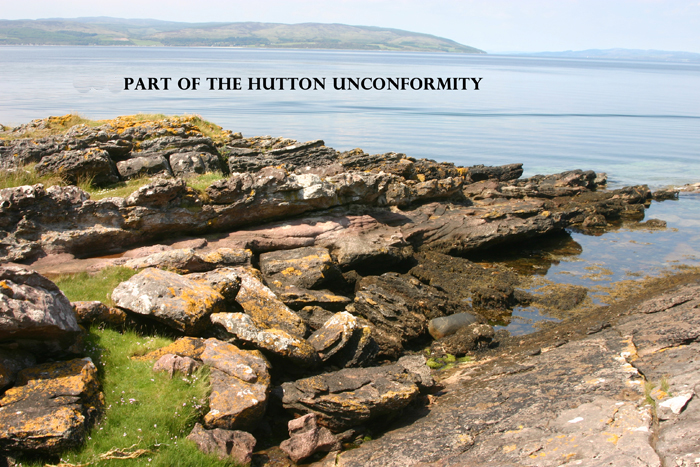
In 1787 he stared across at the craggy profile of Arran, and decided he must explore it. He crossed to the island and was at once fascinated by its rugged slopes and strange coastline, where such a mingling of different kinds of rock coexisted. It seemed to him that the accepted Biblical idea that the world had been created in a complete and finished state could not be true. It seemed obvious that some of these great rocks had parted from the larger strata to which they belonged. At the north of the island, between Newton and Laggan, Lochranza, he came upon an outcrop that baffled him. It was about 300 metres in length, and consisted of different layers. There was old red sandstone, carboniferous sandstone and new red sandstone, laid in layers above what we now know are dalriadan schists of the late Precambrian era. There were Permian conglomerates and Aeolian sands, with seams of carboniferous calcareous sands and limestone. It was a wild mixture, and there could be only one explanation for their coming together. At some time, these immense deposits had been in fluent movement. This did not conform to the idea of a permanent state of things created at one stroke.

Click pictures above to see in more detail.

For this reason, the rock stratum at Newton, leaning in schist at an angle quite different from the sandstone lying at other angles, is still known as Hutton’s Unconformity. He saw that these rock formations must have come together over a long period of time, probably many millions of years. He also realised that the sea had played a part in this, for the raised beaches that are so notable on Arran show clearly that much of the flat land round the edge of the island was once under water.

Angular unconformities had been noted by earlier geologists who interpreted them in terms of Neptunism as ‘primary formations’, but Hutton suspected that they were evidence of later movement. He observed that ‘solid parts of the present land appear in general, to have been composed of the productions of the sea, and of other materials similar to those now found upon the shores.’ The more radical idea of Earth as a cooling mass of minerals did not occur to him, but he was the first person to deduce that the world familiar to us now had once been a very different place. He had already been working for many years on a book to be called Theory of the Earth; or An Investigation of the Laws observable in the Composition, Dissolution, and Restoration of Land upon the Globe. In it, he suggested that the earlier world had been composed of sea and land, with tides, currents, and ‘such operations at the bottom of the sea as now take place.’ He went on to assert that ‘while the present land was forming at the bottom of the ocean, the former land maintained plants and animals; at least the sea was then inhabited by animals, in a similar manner as it is at present.’ It was a bold concept.

Hutton wrote a paper on his findings that was read to meetings of the Royal Society of Edinburgh in 1785. Later that year he read an abstract of Concerning the System of the Earth, its Duration and Stability to a Society meeting, and had it printed and circulated privately. His theory of  ‘plutonism and uniformitarianism’ suggested that the earth was much older than previously considered by academics and theologians. Some of the latter were outraged by this radical idea. A leading Irish academic, Dr. Richard Kirwan, FRS (1733 – 1812) said Hutton’s theories were blasphemous – but James Hutton worked on.

More about Hutton and the effect of his discoveries  will appear in the May issue of Voice for Arran
 

Boundary Commission Consultation – blink and you’ll miss it

On 1 March 2012, the Boundary Commission for Scotland started its four week ‘secondary consultation period’ within its Sixth Review of UK Parliament Constituencies. Five public hearings were held during November 2011 in Edinburgh, Glasgow, Lanark, Inverness and Dundee. There was, as far as we know, no press release, but the comments made can be seen on the Commission’s website.

The main recommendation was to reduce the number of constituencies in Scotland from 59 to 52. This is part of an overall reduction in the number of Members of Parliament across the United Kingdom from 650 to 600.

Dr Hugh Buchanan, Secretary to the Commission, said, ‘The secondary consultation period, new for this review, enables members of the public to scrutinise and remark on comments and alternative designs which we have received. This will be a very useful process to help us understand the strengths and weaknesses of the different arguments that have been put to us.’ Which does not, when decoded, actually say much.

Although the consultation came and went like a midge on a sunny afternoon, emarks can be submitted through the ‘dedicated response facility’ on Scottish Boundary Commission's web site,
www.bcomm-scotland.gov.uk or by email to comments@scottishboundaries.gov.uk . The material is
being distributed to ‘display points at public libraries and council offices’ across Scotland.

So that’s all right, then.


Dance in the autumn

Scottish Ballet plans to come to Arran next November for a long weekend of every possible kind of dance. ‘Forget tutus and ballet shows,’ they said. ‘Dance and movement are brilliant ways to improve balance and strength. It’s for good reason that Moscow Dynamo use ballet techniques in their training sessions. Footballers, Rugby players, farmers and lorry drivers can all get the benefit of increased flexibility and muscle efficiency. Athletes and sports players of every kind can benefit, but so can mums and dads and grans.’

For the four inclusive days between the 2nd and 5th of November, nine dancers will be on Arran, together with a pianist and several teachers, and they aim to run as many as 30 classes during their packed stay, many sessions overlapping. There will be classes for older people and for little children, and for everyone in between. Local musicians will be welcomed as providers of music for any kind of dance. ‘We’re not thinking of just Chopin and Tchaikovsky,’ says Kate Morrison of Scottish Ballet, ‘there’s jazz as well, and Spanish and American and heavy rock. It’s all possible. And – it’s all free! There will be no charge for any of the classes.

www.scottishballet.co.uk


Nice glass of methane, anyone?

The ever-fascinating American site, Truthout, had more to say on March 23rd about ‘fracking’ for subterranean gas. Since this process is now licensed for exploration in Scotland, it is not just an overseas issue – we may find ourselves facing the same problems.

The Pennsylvania town of Dimock complained bitterly in 2009 about a water well explosion allegedly caused by fracking. The Pennsylvania Department of Environmental Protection (DEP) ran tests and agreed that Cabot Oil and Gas Corporation had allowed methane and other contaminants to seep into nearby groundwater. Affected residents filed a lawsuit. The broader Environmental Protection Agency (EPA) Region 3 did its own study and said the water ‘did not show levels of contamination that could present a health concern’ – though it did agree to look further at two homes where arsenic had been detected in the water supply.

Critics demanded to know why the EPA was issuing a statement before the full testing had been completed. They collected the EPA test summaries from six of the eleven families concerned and had the samples reviewed by independent experts – who found that the summaries actually did report explosive levels of methane, heavy metals and hazardous chemicals. In four of the six summaries, methane levels exceeded the 7 mg per litre actionable threshold under Pennsylvania law. One of the test results showed methane levels at seven times that limit. Dozens of other contaminants, including heavy metals and chemicals used in the hydraulic fracturing process, were detected, although safe levels have not been established for a majority of these chemicals. Water Defense has now called for the complete test results to be released by the EPA for further analysis, citing inconsistencies in the available data. Best of luck.

Natural gas wells owned by Cabot Oil and Gas in Dimock, Pa., in December 2009. (Photo: Fred R. Conrad / The New York Times.


A Return Trip To Malta.

Last month, Jim Henderson returned to the Island of Malta for the first time in 12 years. Malta is almost the same size as Arran, though there are huge differences, as Jim notes. And he regrets passing of the old yellow buses.

Malta, ruled by the British from 1814, became independent in 1964. The last British forces left in 1979, and Malta joined the EU in 2004.
           
The last time I was there was in November 2000, I expected a few changes, but the most disappointing one was the demise of the yellow buses. The old.buses were part of the Malta story. Many were over 50 years of age and of course were mechanically way past their sell by date. Suspect brakes and holes in the floor were all part of the Malta bus experience. But they were cheap, dependable and such fun to use. Most of them were privately owned, but the Malta government controlled the entire transport system and stipulated that every part of the island must be served. Independent inspectors regularly boarded the bus and fined anyone on board who did not have a ticket for the journey. However, last July, as part of a health and safety process, the entire fleet was taken off the road and replaced with modern Arriva buses. Many of them were the bendy kind, discarded from use in London, and because of their extra length, a lot of the routes had to be changed to accommodate them – much to the annoyance of the locals. People are very critical of the new service, as the old yellow bus system was so dependable, with a bus every 10-15 minutes on most routes.

Though Malta is smaller than Arran, 17 miles long and 8 miles across, it is home to 408,000 people. Added to that, it caters for over half a million visitors at any time during the year. On a bus journey of some 15 miles through the northern part of Malta, one will seldom see any clear areas or cultivation. Built up areas are continuous, with erstwhile villages merging into each other. Houses and shops, garages with fuel pumps in the middle of the pavement, hospitals and every other kind of building are close-packed, with few if any gaps.

Because the Island is small the infrastructure is fully stretched. Countless luxurious hotels are needed to accommodate the visitors, so everything is very built up. Malta is well worth a visit, but one would need at least two weeks there in order to sample some of its highlights and to visit the less crowded smaller island of Gozo. The volume of traffic is of course very high, yet the Malta road system is excellent I never saw one pothole and I travelled many areas (even rural country single track roads) outside the main tourist attractions. On the west side of the Island (the main route to Gozo) extensive road works were being carried out, yet the surface of the route still in use was much better than what we have to put up with in Arran. Our Island home, which depends so much on tourism?

Figures bear out the great differences between Malta and Arran. Malta’s highest point is only 830 feet, as against Goat Fell at 2,866 feet. It has only one golf course, whereas Arran has seven. In Malta, there are 4,000 people to every square mile, but on Arran, just 31. We have approximately 25,000 visitors a year, while Malta has 1.3 million  - and that number is rising.*

The Island of Malta is steeped in history. During World War II Malta became the most bombed place on the planet. 6,700 tons of high explosive bombs were dropped during a period of only six weeks, and in 1942 the Island was awarded the George Cross for its endurance. One famous story is always remembered. On April 9th 1942, when a congregation of 300 was assembled for Mass in the Mosta Church, a German bomb dropped by an Italian pilot fell through the lofty dome. It landed in the aisle and skidded the entire length of the packed church, injuring no one – and it did not explode. The Maltese have since looked upon this as a miracle and a replica of the bomb is on display in the small museum behind the church, together with photographs of the British troops who risked their lives in removing it. Quite recently, within the past 3 years, the Italian pilot returned to Mosta and apologised to the congregation.

Click pictures for more details

* But we suppose that amount of tourism pays for good roads. Me, I’d rather have the potholes. Ed


The Crown Estate condemned

The Crown Estate Commissioners, (CEC) as their name indicates, manage the various lands, properties and interests belonging to Royalty. In Scotland, there is a surprising amount of it - and the Scottish Affairs Committee is not happy about the way the job is being done. Its new report says the Secretary of State for Scotland should announce the Government’s commitment to ‘devolve and decentralise CEC’s ancient rights and responsibilities’ in Scotland.

Evidence to the Committee has identified major issues over the CEC’s management, particularly in relation to the seabed and the foreshore. The shortcomings add up to a shocking list, including the following:

Lack of accountability and transparency,
Lack of communication and consultation with local communities,
The inappropriateness of the CEC‘s statutory remit for its responsibilities in the marine environment,
Cash leakage from local economies and other adverse impacts arising from the way the CEC operates,
Limited benefits in Scotland from the CEC’s involvements.

The Committee concludes that the CEC’s responsibility for the administration and revenues of the ancient Crown property, rights and interests in Scotland must end. However, simply handing these responsibilities to Holyrood would not address the fundamental problems identified: the Committee says devolution of these powers should be further decentralised to local authority and local community levels as far as possible. Chair of the Committee Ian Davidson MP said it was the body of highly critical evidence about the CEC that led to the launch of this inquiry into its work.

Financial shortfall

He went on, ‘Despite the CEC’s claims that a key benefit to Scotland of its operations is that it can call on the wider financial resources of the UK-wide Crown Estate. … The data compiled shows that there has actually been a net outflow of capital from Scotland over the last five years. Since devolution the CEC has raised £10.6 million more capital by selling assets in Scotland than it has invested in Scotland over that period.
 Mr Davidson considered that the CEC should no longer be the body responsible for marine and coastal assets in Scotland. He said, ‘The point is to conserve these assets and maximise the benefits to the island and coastal communities most closely involved with them. We are convinced the only way this can be done is by devolving as much of the responsibility – and benefit - down to the level of those local communities as possible.’

Notes
1. The Scottish Affairs Committee will launch this report into The Crown Estate in Scotland, at 1.00pm, on Monday 19 March, at the Kingsmill Hotel, Inverness. Members of the press and public are welcome to attend this event. The Committee will hold a briefing to media on camera at 1pm, followed by opportunities to interview the Chair Ian Davidson MP and other Members and witnesses to the inquiry. Members of the media should contact Jessica Bridges-Palmer: 020 7219 0724 / 07917 488 489.
Committee Membership is as follows: Mr Ian Davidson MP (Lab/Co-op, Glasgow South West) (Chair), Fiona Bruce MP (Con, Congleton), Mike Freer MP (Con, Finchley and Golders Green), Jim McGovern MP (Lab, Dundee West), Iain McKenzie MP (Lab, Inverclyde), David Mowat MP (Con, Warrington South), Pamela Nash MP (Lab, Airdrie and Shotts), Mr Alan Reid MP (LD, Argyll and Bute), Simon Reevell MP (Con, Dewsbury), Lindsay Roy MP (Lab, Glenrothes), and Dr Eilidh Whiteford MP (SNP, Banff and Buchan)
Media Enquiries: Jessica Bridges-Palmer: 020 7219 0724
Committee Website: http://www.parliament.uk/scotaffcom
Watch committees and parliamentary debates online: www.parliamentlive.tv
Publications / Reports / Reference Material: Copies of all select committee reports are available from the Parliamentary Bookshop (12 Bridge St, Westminster, 020 7219 3890) or the Stationery Office (0845 7023474). Committee reports, press releases, evidence transcripts, Bills; research papers, a directory of MPs, plus Hansard (from 8am daily) and much more, can be found on www.parliament.uk.


Roots of Arran volunteer day on Sunday 1st April at 12.00

We are having our volunteer day a week early (usually second Sunday of the month) on Sunday 1st April at 12.00. Please come and join us! We are going to clear invasive sitka and rhododendron to allow deciduous trees such as birch and oak which are establishing themselves on the site, to flourish. We also will try to put up wooden A-frames for a shelter in the willow circle as a temporary shelter (wooden poles and tarp on top variety) which will be really useful when we are using this site for school visits or work on the willow or pond and so on. Children must be accompanied by an adult and suitable clothing/boots and packed lunch are a must! We will meet as usual in the viewpoint car park between Brodick and Lamlash at 12.00 and walk down to the site (approx one mile).
We are happy to report that the willow planted in January has taken. We will be pruning this to ground level in the winter to encourage bushy growth in the following spring. Another success was our broom-making day – the kids had a great day making birch brooms (see photo).
Shiskine Scout group really made a difference last volunteer day when they planted some decidous trees to one side of the path to the new pond (including a lime and a chestnut tree) and went on to clear sitka and rhododendron near the beech grove. Many thanks to them and we hear that some of them are really enthusiastic about helping again!
Our public consultation is taking place all this week in Brodick library. Do pop in and give us your ideas on how to develop the woodland further. Do you want to see more paths, or maybe a bird hide or mountain bike loop….the possibilities are endless. All you do is write your ideas on a bit of paper and post it in the box on the table display in there. The opening times are:
Tuesday 10-5pm
Thursday 10 – 7.30pm
Friday 10 – 7.30pm on this day, Lyndy Renwick from Galloway District Forestry Commission and Andy Walker, Arran forester, will be in the library to discuss things further and offer guidance to us.
Please remind anyone who you think would be interested to go along as we hope it will generate some great ideas and get more people on board this project.

see their website at www.rootsofarrancommunitywoodland.org.uk/


Pan fried fillets of sea trout on a risotto of Arran camembert, peas and mint.

We are lucky that Richard Attkins, a Member of the Master Chefs of Great Britain, is sending us a recipe for inclusion in the Voice every month. You can sample Richard’s cooking at Arran on a Plate, in Brodick. Here is Richard’s first contribution
 
Sea trout is basically a sea-going, brown trout. It looks very similar to salmon and its flesh colour and flavour is down to its diet of crustaceans. The average size is about 2kg, perfect for 4/6 people. The season for sea trout starts in April and runs through to the end of summer. It will work as a substitute for salmon in most cases, smokes really well, is nice raw, but the best flavours come through when it's pan fried with a crisp exterior.
This recipe should only take about 40 minutes to prepare for a meal for 6.


Ingredients
6 pieces of trout approx 180g (ask your fishmonger to leave the skin on, but to pin-bone)
300g risotto rice
1 small onion
1 clove garlic
1 litre vegetable stock
200g peas
175ml white wine
1 small wheel of Arran camembert
1 small bunch mint
Oil, butter and seasoning.
 
Method 
 
Bring your stock to the boil. Dice your onion and garlic and place in a warm pot with oil and cook without colour. Wash your rice then add to your onions, ensuring all grains are lightly coated in oil. Now add your glass of wine. Stir well to ensure nothing sticks to the bottom of the pot. Leave on a medium heat and add one ladle of stock at a time, letting the rice absorb this before adding the next ladle. Keep doing this until the rice is cooked, but still has a slight bite to it.
When your rice is almost done, place a non-stick frying pan on a high heat. Place a little oil in the pan and season the skin side of your fish. Place this skin-side down in the pan, and then season the fish on the flesh side. Sea trout is not as thick or dense as salmon and will cook more quickly. After about a minute turn the fish and add a couple of knobs of butter. This will foam up slightly and you can baste the fish with this when it's cooking. 
Fish almost done; pop your peas in your risotto and tear your cheese up through it also, so it starts to melt through it. Last thing chop your mint and sprinke over. (Don't put the mint in any earlier as it will discolour).
Check your fish is cooked (it's fine to leave a little underdone).
Serve with a nice medium-dry white wine.

www.arranonaplate.com


April by Judith Baines

In April the blackthorn was in full bloom and I found a lovely natural arrangement down in the wood,  I chose to interpret it by making a greeny background of vertical mixed threads linked by machined zigzag and then applying “bracken” and “blackthorn blossom” made by free machining on dissolvable fabric.  The latter technique is great fun to do. For free machiningyou need to be able to drop or cover the feed-dogs on your machine and then, using a darning foot, just draw with the needle as thought it was a stationary pen and the fabric, in this case cold water dissolvable taut in a ring, is moved under the needle in circles or up and down or side to side as required – ie moveable “paper”!

The Dandelions have a felt background with the edges damped and pulled with a needle to distort the shape then free machined in green to indicate leaves.  The flowers were made by stretching calico in a ring and drawing round a twopenny piece, cutting out the circle and free machining backwards and forwards many times across the hole!  When you have done one cut out another circle and repeat.  When you have enough flowers release the fabric and cut the flowers out just inside the fabric.  Fluff them up and apply to the background

Click pictures above to see them in more detail.


New Arran candidate for North Ayrshire Council election

There are four council seats allocated to represent the Ardrossan/Arran Ward in North Ayrshire Council. At present, the only sitting councillor resident on Arran is Margie Currie, (Independent), but in the coming election a new Arran-based candidate enters the field. He is
John Bruce(SNP) who lives in Corrie, and he writes the following about his aims and his very broad experience..

In 1971 (pre-oil) my wife and I were working a full summer season in the biggest wooden hotel in the Norwegian fjords – Kvikne’s Hotel, Balestrand, Sognefjord. Stunning location.  Majestic scenery.  A small community idyll solely supported by regular ferries criss-crossing the fjord and faster hydrofoils from Bergen.  In the summer tourist months the mail came by seaplane.  We worked hard, made firm life-long friends, enjoyed our free time and picked up the language (Anne soon became singularly fluent.)  Crucially, we began to make across-the-board comparisons with the Scotland that we knew then.  As the season wore on we realised that our home country was faring rather badly in this comparison process.  But why?
 
The Damascene lightening-bolt moment struck as we were coming home at the end of the season. At 7am in the railway station cafeteria in Drammen, waiting for the Oslo train, breakfast was served with late summer flowers in pewter jugs on white linen tablecloths and we were eating newly baked rolls, rundstykker, and freshly brewed filtered coffee. Quality stuff. And the questions posed themselves: ‘What’s wrong with us?’ And – ‘How do we fix it?’

Thus began a political journey of some 40 years. Previously apolitical, we joined the SNP on May 1st 1974. If we are not on Arran we are somewhere up a Norwegian fjord, which is where Kenneth Gibson MSP found us last summer and persuaded me to stand as an SNP candidate in the forthcoming local elections.  The CV I presented ran as follows:

Lived in Corrie since 1985.
Born in Glasgow but moved to the new town of East Kilbride at the age of nine.
Honours degree taken at Glasgow University - Politics and Scottish History.
Career to date – Local government, libraries, hotel management, teaching.
Early retirement - (laugh, never been busier!).
Interests:  my family, my friends, my library, my music, my poetry.

Politics
I have always been convinced that the challenges facing us - socially, politically and economically – as citizens of Scotland, are best addressed by a government in Scotland.  In a
nutshell, this means that we as a community and a nation, take on the responsibilities required to make things happen and bring about change where it is needed, to make our society better.

I consider that Independence is the normal position of nations in the international community.
It is normal for independent nations to raise and spend their own taxes and use their own resources to benefit their citizens. It is normal for them to make treaties and alliances with other nations, again to benefit their citizens, e.g. for trade, security and monetary purposes.

At a local level, it is equally normal for communities to have empowerment through democratically elected and accountable bodies to tackle the challenges that face them directly in their localities. 


Brodick Estate to be ‘Signature Project’

The National Trust for Scotland has chosen Brodick Estate, including the Castle, Country Park and Goatfell as its first ‘Signature Project’. The idea is that the Estate will stand as an example of how the entire organisation can work.

We have no clue what this means in practical terms, but Trust Chief Executive Kate Mavor said they would be ‘working creatively, with people from inside the Trust, the community and experts from a wide range of backgrounds to help us find the best way forward.’

Property Manager Ken Thorburn said he is ‘pleased to be trailblazing on behalf of the Trust and Scottish heritage as a signature project.’

Meanwhile, there will be a Cadbury Easter Egg Trail on Easter Sunday, 8th April.


Fishing Expo in Glasgow …

The 25th Fishing Expo at the SECC in Glasgow last month attracted over 70 exhibitors from the Scotland, England, Ireland and overseas. At the ‘Sea to plate’ event, Bertie Armstrong of the Scottish Fishermen's Federation, told Scottish Fisheries Minister Richard Lochhead that the fishing industry was committed to working closely with the governments in Edinburgh and London to develop sustainable solutions. However, he claimed that restrictions were ‘threatening the very viability of the fishing industry.’

The Minister stressed that further scientific knowledge is needed. He announced £150,000 of funding to support research by the Fishing Industry Science Alliance (FISA) which is studying new types of fishing equipment, gathering information where stock data is poor and developing strategies for inshore fisheries.

John sends us a picture of his official Voice for Arran badge at the Fishing Expo.


…and a Voice romance

John Kinsman has become engaged to Anne Adams, who writes recipes for the Voice. Anne proposed to John on Valentine's Day and fortunately, John said yes! John and Anne live in the tiny fishing village of St. Monans in the East Neuk of Fife.
John was born in Newton Abbot in South Devon but moved to Scotland nearly forty years ago. He has a daughter and four grandchildren who live in Torquay, though his wife died several years ago. Anne was born in Glasgow but moved to St Monans, where she met John. They have been together for several years.

Congratulations to them both!


Blue skies – or pink, or what you choose

Arran Visual Arts offers a two-day workshop on the weekend of April 21st and 22nd, run by John Knox, a well-known painter. He will take students through the oil painting techniques of representing landscapes and skies, particularly including the clouds that can add so much atmosphere to a picture. Both newcomers and experienced painters are welcome. The cost of the weekend is £50 for AVA members, £70 for non-members. All details from Alison Barr at 6 Manse Crescent, Brodick, tel 01770 303607. or see the website at www.arranvisualarts.co.uk/


Blue bins get more useful

From Monday, 9 April, bluebins on Arran will be able to accept glass and a wider variety of plastics for recycling..

Currently, the blue bins are used for paper, cardboard, metals, and plastic bottles, but from next Monday, we will be able to add just about every other kind of plastic. The blue bins will accept supermarket food and fruit trays, yoghurt pots, small toys and even hard plastics such as flower pots. They can take plastic bags , too, and other plastic wrapping such as clingfilm and polythene.

Information leaflets are available at the local Council office in Lamlash, the library, local shops and schools. Council staff will be at the Co-operative Food store on Thursday, 5 April between 10am and 4pm to answer any questions about the new improvements to the recycling service.

Click here to get the NAC leaflet - listing what we can now put in the blue bin


MoD War Game Warning

Exercise Joint Warrior will include an amphibious landing in Sannox Bay on April 16th. It’s part of a long exercise that will run in the West of Scotland from April 10th until 13th May. The Sannox Bay landing will include elements from an Air Assault Brigade and a Commando Brigade, but ground troops will not leave the beach area.

In case of enquiries or complaints, several 24-hour contacts are given, as follows:

Mr Peter Lane C2 (MSF), HQ 51 (Scottish) Bde, Forthside, Stirling FK7 7RR,
tel 0131 310 4938 or mobile 07775 822753

Captain Sammy Craig, HQ 51 (Scottish) Bde, G3 LTAR, Forthside, Stirling FK7 7RR,
tel 0131 310 4857 or mobile: 07747791140.
Additional Out of Hours Contact:
HQ 2 Div Staff Duty Officer, Craigiehall, South Queensferry, EH30 9TN, tel 0131 310 2211.

Low Flying Complaints:
Low Flying Complaints: MoD Complaints and Enquiries Unit,
Air Staff, Level 5, Zone H, Main Building, Whitehall, London, SW1A 2HB
Tel: 020 7218 6020


Anne’s recipe

Anne Adams sends us a quick-and-easy recipe that can be made in just 20 minutes.

Pea-Crusted Lamb Cutlets

Ingredients

 200g frozen peas.
20g butter
 1 slice of white bread.
 2tbsp mint jelly
8 lamb cutlets

 Method
Cook the frozen peas in boiling water for 2mins, drain and whizz in a food processor with 20g butter, a thick slice of white bread torn into chunks and 2 tbsp mint jelly, then season.
Grill 8 lamb cutlets under a medium preheated grill for 8 mins per side then press the pea mixture onto one side of each chop.
Return to the grill for 2 mins or until cooked to your liking.
Serve with Jersey Royal potatoes and asparagus, or vegetables of choice.


Fair Trade at Arran High

On Thursday 22nd March a highly successful and unusual event took place at Arran High School – a combined concert and fashion show.  This highly entertaining evening showcased many talented students from all year groups who sang, played wind and brass instruments and performed at the wonderful new piano. In addition, the evening highlighted the creative abilities of those who had designed and invented their own incredible outfits out of crisp packets and newspapers as well as delighting us with a reminder of costumes from school shows past, striking outfits for wedding guests and some cute bunny costumes for Arran High School staff!
At the same time the evening had a serious purpose – to raise awareness of Fair Trade and the many fashionable items available through Fair Trade clothing outlets. The young people modelled these with aplomb and elegance and several members of the audience went on to purchase Fair Trade items from the show at the interval.
All round, this was an evening which not only gave much pleasure through talented performance  but encouraged a worthwhile cause in Fair Trade.

Fairtrade posters & poems by the children of Arran

To view more posters or look at the above in more detail see here