Issue 16

Easter has passed and the tourism season is in bud. We start to fret about the need for a back-up ferry and hope to see a full blossoming of business in the summer months. It’s the most urgent and useful time to advertise.

Take-up of Voice for Arran continues to increase at an ever faster rate, off the island as well as on it. The magazine goes out to people in many countries and carries a strong visual message about the beauty of Arran. People can see from our pictures how lovely the island is – just look at the rainbow above – and our reporting conveys the breadth of the island’s interests and outlook. It is the perfect setting for advertising Arran’s many activities.

With the welfare of small Arran businesses in mind, we offer a single beautifully designed full colour advert for £10 or a run of six for a mere £35. Local community groups are even luckier and pay just £5 for a one-off ad. Send us an e-mail at info@voiceforarran.com and we’ll do the rest.

If you don’t need to advertise but have a penny or two to spare, we’d be grateful for contributions. All of us work for nothing, and there are expenses to meet, so any small help would be extremely welcome. Just click the Donate button. Bless you, guv.

Wonderful Gaelic film at Corrie

Seachd: The Inaccessible Pinnacle, the title of the next offering from the Corrie Film Club, begins with the Gaelic word for the number seven, magical in the ancient mythology of the Celtic world. Shot on Skye, the film features poet Aonghas Padruig Caimbeul as the grandfather of a young boy (Padruig Moreasdan) whose parents died on the mountains. The boy has become a young man now, but still seeks to know the truth about his parents’ death on the Inaccessible Pinnacle on the Isle of Skye. He goes to see his grandfather, who is dying in hospital, for the last time, and once again is caught up in the old man’s ancient, fearsome tales.

Làn fhìrinn na sgeòil. The truth is in the story. A whole swathe of true Gàidhealtachd history emerges. Are there seven stories, as the film’s title hints, or more? One loses count, and it does not matter. They encompass poisoned lovers and bloody revenge, water-horses and the gold of the Armada, and the ancient truth that emerges is one that the young man never expected to find.

Chris Young, the producer of Seachd , lives in Skye and learned to speak Gaelic. His previous successes included Festival and Venus Peter, but inexplicably (or perhaps only too explicably in the view of Gaelic speakers) Seachd was refused entry in the Foreign Language category of the 2008 Bafta Awards.

Bafta missed a treat. The film is stunningly beautiful, and the sound track has glorious Gaelic singing. The film will be shown at Corrie Village Hall at 8.00 pm on Sunday 13th May. All are welcome and admission is free, though contributions to the upkeep of the hall are always warmly welcomed.


Arran Visual Arts in a new venue

The Easter show put on by Arran Visual Arts was in the Community Theatre at the High School, as an experimental change. Zig-zagging screens provided ample hanging space, but the venue was as a result a series of small exhibitions rather than a single large one, and felt slightly less ‘communal’. However, the standard was as high as ever, and varying styles and individual vision abounded.

Of the many landscapes, I liked Jean Fforde’s Glen Rosa for its sense of space and distance. The tiny houses sheltered among trees gave an exact sense of scale to the sweep of the glen. In complete contrast, Audrey Allan had a close-up impact, and her Smugglers Museum, Eyemouth was seen with a sharp, stylish eye. Michael Grant’s Forest above Eas Mhor, painted with his customary professionalism, held a powerful sense of the mystery of trees, while Kate Robertson’s pen and wash study of The Glade was beautifully handled.

Angela Elliott-Walker is in a class of her own with her poetic, extraordinarily evocative visual essays. Words creep into her intensely decorative pictures, but with such subtlety that they only reveal themselves on close inspection. Her study of The Douglas sets the great hotel in its landscape of sea and hills, but also reveals more personal enjoyments in its barely-visible newspaper cuttings. ‘I believe in love at first sight’ is a statement that deserves to be preserved, and there it is for all time, an integral part of a place that endears itself with no introduction. This artist is highly collectable, and I very much hope to see The Douglas on a wall within that hotel as its permanent home - or they’ll have missed a marvellous trick.

On a more close-up scale, Morag Campbell’s Three Greek Cats used a faint lilac shadow to great effect, catching the sense of hot exterior sunshine perfectly. (And you had to look hard to spot the third cat!) Lesley McDowall’s Old Paisley had a clear, slightly nostalgic sense of style, and with a complete change of vision, Kelli Hogg-Smith had taken a close-up, highly dramatic view of Oystercatchers, impressively rendered in ink and acrylics.

Three-dimensional work excelled. Robert McCrone has taken an impressive step forward in his highly evocative little ceramic figures, both on their own and in groups. His The Reader sits like a garden gnome in his own world of a book, and Tam evokes an extraordinary sense of some family seen in its own, private surroundings.

Judith Baines, with her matchless artistry, shows exquisite beaded purses, detailed in their chosen colour range and so tiny as to accept only money from some fairy ring. On a bolder scale, Alison Barr shows her wonderfully skilled use of felt, formed into bowls that, like Judith’s work, seem strangely magical. There were two glorious shawls and a Shetland bonnet by the talented Rorie Rutherford, and Howard Walker’s Sohan, a little sailing ship that might belong to the boldest and most imaginative of pirates, remains long in the memory.

In addition to all this, the Art in Mind scheme produced some covetable things. and AVA is much to be congratulated for another splendid show.

Please click on the picture on the right to see a slide show of some of the works from the exhibition.


Drawing for Absolute Beginners

Can’t draw? Rubbish - you are probably just too scared to try. AVA’s next workshop is by Felicity Walker on May 19th, at the Rangers Centre in the Castle grounds, and it promises to change all that. Felicity is happy to tackle what she calls ‘scary topics’ and promises to increase your observational skills. She holds that people often plunge into the use of broad colour because what they see as the strict discipline of the pencil is too forbidding, but it doesn’t have to be like that. If you are interested in attending, contact Alison Barr on 01770 303607.


Thank you for the daffodils

This month, daffodils have been blooming along the whole length of The Knowe farm on the Heights road above Whiting Bay. They weren’t there before, so some assiduous planting must have gone on last autumn, and many people have enjoyed the results. Thank you for a wonderful spring surprise!


Civic Trust enjoys an evening with Tim Pomeroy

On the evening of March 29th, Arran Civic Trust hosted an illustrated talk in the Ormidale Pavilion by Arran’s distinguished sculptor, Tim Pomeroy. All present were both entertained and richly informed by what he had to say. After recounting the slow process by which his artistic career took shape over some eight years - from Latin scholar at Hamilton Academy, via varied stints teaching and lecturing, to his emergence as a full-time freelance painter and sculptor - Tim went on to describe the various projects and commissions in which he has been involved.

As he talked, those present gained fascinating and valuable insights into the creative process, Tim’s sources of inspiration in, for example, nature, geology and archaeology (but also such everyday objects as string), and the technicalities and difficulties of working with materials such as granite and bronze. His talk was tellingly illustrated throughout with photographs. It would take too long here to cite all the examples of Tim’s work that were covered, but the audience will certainly have taken special note of local examples, such as the fascinating sculptures in Merkland Wood, and some major off-island works, particularly the font he made for St Andrew’s Cathedral in Glasgow, with its wonderful frieze of figures waiting to be baptised in the Jordan. This alone involved some five hundred hours work. There was also a spellbinding account of the technical feat involved in drilling a pathway for the continuous flow of water.

It was interesting to learn that the commissioning of this font was suggested to the Archbishop by an earlier one that Tim had created for Provand’s Lordship. With other commissions for such patrons as the Duke of Devonshire, Carnoustie Golf Club and Cawdor Castle (a four-and-a-half metre Tree of Life in bronze), as well as exhibitions in leading London galleries, Tim Pomeroy’s reputation has spread well beyond Arran, and the island is fortunate to be his base. It would be difficult to sum up his versatile talent in a nutshell, but perhaps one key to his wide appeal is the observation that he uses traditional materials, but in a modern idiom.


Russian peace tribute

In Russia, unlike Britain, the Second World War will never be forgotten. There is nobody in that vast country who was not involved in the onslaught that killed millions of civilians as well as soldiers, and every family has people to mourn and remember.

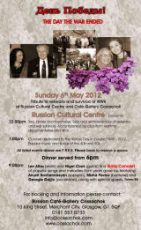
Many Arran people have been thrilled over the years by the violin and viola music of Lev Atlas and more recently, Djordje Gajic, grand master of the piano accordion, and it is good news that the pair of them will be coming to give a concert in Brodick this summer. Meanwhile, they will be playing on May 6th at the flamboyant and moving peace celebration in the Russian café in Glasgow. If anyone would like to go, the details are on the poster.


Hunterston enquiry gets the bird?

The public inquiry into the £3 billion coal-fired power station proposed for Hunterston now seems pointless, since a new Scottish Government report has rejected the need for additional coal-fired plants anywhere in the country. Proceeding with the enquiry is likely to cost upwards of a million pounds, and Alan Hill, an SNP councillor at North Ayrshire Council, said, ‘It would be good to save taxpayers the expense of an inquiry.’

As 20,000 people objected to the proposed scheme and each one of them has the right to speak to the reporter individually, the inquiry is likely to be a massive exercise. However, NAC as the relevant planning authority has not withdrawn its objection, and the Scottish Government cannot risk a complaint from either side that its new report has prejudiced the inquiry, so it seems set to go ahead.

Peel Energy, who proposed the power station plan, is not in a happy state. It has lost its Danish partner Dong Energy - and as if that were not enough, local birdwatcher Marco McGinty has brought a case against them for judicial review.


Make your own electricity

After some negotiations and a really cheap deal, I’ve just taken a deep breath and got solar panels on the roof. It was amazingly quick. A van arrived off the 9.45 am boat with three guys who bolted together a quick scaffolding, swarmed up it and fixed the panels. The whole job was done by 3.30 pm, and a neat new meter in the cupboard is blinking its green light to record the electricity going through it.

The system works on any level of light, so the dear little thing is at it from dawn to dusk, even in mid-winter. The Westminster government, of course, is busy snipping bits off the Feed In Tariff, but it still makes some income as well as juice. Can’t be bad.


Baked Scottish brown crab en croute with new season potatoes and asparagus

We are lucky that Richard Attkins, a Member of the Master Chefs of Great Britain, is sending us a recipe for inclusion in the Voice every month. You can sample Richard’s menus at Arran on a Plate, in Brodick.

May is a significant month in Scotland where everything starts to warm up and the season for fish and vegetables changes. With lobster stocks depleted, the simple Scottish brown crab is a much more affordable replacement, a portion costing around £3.50, with all the work done. The brown crab is fished up and down the West Coast of Scotland, but as with all of our shellfish, they are sold off to the markets in southern Europe and very few are consumed at home. British asparagus is a delicacy, but has a very short season. Don’t be fooled into buying the American forced stuff, which lacks the flavour of ours. New season potatoes such as Jersey Royals are just coming into season and again take advantage of them as the season is short. You could use Arran Victory potatoes, but the season for these is not for a couple of months; that's if you can find anyone that sells them!

Ingredients (for 2)

2 Dressed brown crabs
25g Butter
25g Flour
1 tablespoon Arran mustard
100ml milk
100g Torrylin cheddar
8 Asparagus spears
200g New potatoes
1 Sheet puff pastry
1 Egg

Method

Firstly make a white sauce by melting the butter, incorporating the flour and then slowly adding the milk. Ensure you have no lumps. Now add the mustard and stir in the cheese. You are looking for your sauce to be nice and thick and mild in taste so as to not mask the taste of the crab. Now mix in the crab meat ensuring there are no pieces of shell. Season to taste and put the mix back into the shells.

Cut your puff pastry to fit the shells and press down hard around the edges to ensure it does not come apart when cooking. Separate your egg and brush the pastry with the yolk; this will give you a golden finish. Bake this in a moderate oven around 180°C for around 20 minutes. Simply boil your potatoes and blanch your asparagus for a couple of minutes, season and brush with butter.

Delicious!


Professor bashes the big banks

Professor Richard Werner, writing in the Sunday Herald of April 15th, held that big banks are damaging to the economy and said, ‘We need to move to a banking sector that consists of hundreds of autonomous, locally headquartered banks.’

The logic is irrefutable. Local banks can’t lend large sums to speculators and are more interested in supporting small investors. Werner points out that Germany, the admired financial wizard of Europe, has so many local banks and credit unions that they amount to 70% of the nation’s banking. Britain, in stark contrast, has just five banks, which between them mop up 90% of banking. We should, he says, ‘be offering incentives for people to create local co-operative banks.’ Local government, too, could be moving into this, as recent legislation gives councils the power to set up banks.

Professor Werner is director of the Centre for Banking, Finance and Sustainable Development at the University of Southampton, and featured as a keynote speaker at the Just Banking Conference in Edinburgh on April 19-20.


Antibiotics allowed in white fish

America’s Food and Dug Administration (FDA) has approved an antibiotic called for use in all freshwater-reared finfish. It is approved for use in all freshwater-reared warm water finfish at 15 mg/kg for the control of mortality due to streptococcal septicemia associated with Streptococcus iniae. This organism has been causing ‘significant economic losses’ in farm-raised fish of all species.

Aquaflor was developed specifically for aquaculture use, and its active ingredient - florfenicol - is not used in human medicine. The need for it must be a matter of some concern, since deaths from a wide range of diseases appear to have been widespread. Enteric septicemia is common in catfish, and freshwater-reared salmonids are prone to furunculosis associated with Aeromonas salmonicida.

Accuracy of dosage must be called into question. Aquaflor, its makers claim, ‘can be top-coated or incorporated in both floating and sinking feeds. It is also highly palatable, which helps to optimise antibiotic intake.’ So how many tasty antibiotic pellets are the strongest and most pushy fish likely to ingest? It’s anybody’s guess. If you are still buying fish in supermarket packs, have a look at the source, and be careful. Information is available at www.aquaflor-usa.com.


America still in upheaval

An article by Arun Gupta for the feisty website called Truthout makes clear that the Occupy movement did not go away when the police cracked down on its presence in many sensitive places last autumn. The British press has been silent about this, but the picture tells its own story.

Occupy Wall Street demonstration on March 15, 2012. (Photo: Sunset Parkerpix)

Two Arran-dwelling candidates for the NAC election

There will be a wide choice of candidates on the polling paper this week, but for the first time in many years, two of them are Arran residents. John Bruce, SNP, lives in Corrie and Marc Head, Independent, in Whiting Bay, and both are well-kent and clear-thinking characters. We offered them space for a brief statement of their views, and these appear below. Either - or preferably both - would be a valuable addition to NAC, and we wish the pair of them luck.


Arran’s bottle banks threatened?

Press releases from North Ayrshire Council are as rare as hen’s teeth, but one arrived last week, announcing that Waste Awareness Officers had visited Arran ‘to advise residents of the improvements to their blue bin kerbside recycling service.’

What exactly are these improvements? The blue bin, it seems, will now take more or less everything, including plastic bags, supermarket food trays, yoghurt pots, small plastic toys, empty plant pots - and glass. Yes, the bottles and jars that used to go into the bottle bank are now supposed to go in your blue bin.

People saw at once that a single blue bin was not going to be big enough. They also wanted to know what is in store for the existing bottle banks. Are they to be withdrawn? NAC was coy (and wordy) on both subjects. ‘Residents can make a request for an additional blue bin but are asked to try using their existing blue bin first.’ And, more ominously - ‘Residents were advised that a review of bottle banks will take place once the scheme has been fully implemented during the next 12 months and residents are using their blue bins to recycle glass.’

Questions bristle. What guarantee do we have that bottles in a mixed bin will be separated and recycled? Will British Glass take cullet that is contaminated with general waste? What about the safety of workers on a picking belt who have to handle broken bottles and jars - if indeed they do? The suspicion must be that the entire mingled waste mass will be packed for export, and this would be of great concern to many of us.

Arran’s bottle banks were set up by a small local group who had been told by NAC that glass recycling was not viable for Arran’s small community. The group proved that it could be done, and ran it until the bottle banks came within NAC’s general waste disposal agenda. There is now cause to wonder whether the intention is to withdraw this service in the name of economy. But if there are no public bottle banks, where will the great numbers of tourists dispose of bottles and jars? Leave them on the beaches to be broken by the tide and endanger people’s feet? Economy is not the only thing that matters.

The rare press release says, ‘More information can also be found at www.north-ayrshire.gov.uk.’ If anyone finds anything useful, do let us know.


Music Society summer concerts

To the delight of all who know them (and the stunned amazement of those who don’t), Djordje Gajic and Lev Atlas will be playing in Whiting Bay Hall on Friday 15th June at 7.30pm. The pairing of such masters of the piano accordion and violin respectively promises to be utterly intoxicating. Consummate classical musicians, they are equally skilled in countless other genres, and their capabilities swirl effortlessly from Bach to music from Eastern and Central Europe. They are well-versed in the gypsy and Jewish traditions, and are guaranteed to thrill their audience. Lev has been well-known on Arran since the heady days of the Rostov String Quartet, and Djordje has given two immensely exciting concerts for the Music Society’s winter season. Both of them are absolute spell-binders. More about them in next month’s Voice, but meanwhile, note the date - 15th June, in the unusual venue of Whiting Bay Hall.

Bad weather prevented the Scottish Tango Ensemble from getting to Arran for its booked concert earlier this year, so the Music Society is delighted to feature them on Sunday 29th July, again at Whiting Bay Hall. This will be an afternoon concert, starting at 3pm. As their name makes clear, this group specialises in all styles of tango music. It covers an astonishingly wide range, from the classic beauty of the Salon to the exotic (and erotic) music of the tango dance. Always packed with emotion, it ranges from the seductive to the ferocious, and touches on the marvellously decadent Milonguera myth of the woman who lives utterly for tango. The programme will of course include the fabulous music of Astor Piazolla, who came back from studying in Paris to introduce the New Tango to his startled native Argentina. Piazolla was a virtuoso of the bandonéon, shown above, and his haunting, plangent tunes stay long in the mind. More details next month.

These two ‘extra’ concerts are of course open to the public, but Music Society members will like to know that both performances are included in the "pay for four concerts and get a fifth one free" programme. A membership card with four stamps in it entitles you to free entry, so remember to have it with you.


Jazz in the dark

The Jazz Café Band had only just settled into its stride at the Kildonan Hotel when the lights went out. With them went volume for the guitarist and bass player and Biff’s voice, though everyone carried on regardless. Candles were set on the tables as darkness fell, but the jazz, though appreciatively applauded, was somewhat shadowy. Rory Cowan came to the rescue with the offer of a portable generator, so sound was restored. Light wasn’t, and the bass section deciphered its chords by means of a torch clipped on a music stand. Towards closing time, electric radiance burst forth again, and Stormy Weather gave way to Spread a Little Happiness. Or something.


Never mind the earthquakes – fracking puts out more carbon than coal

Following the government’s assent to hydraulic fracturing for shale gas (‘fracking’), there has been a confused outcry of protest. Fear of earthquakes and of tap water that can be ignited have been the most spectacular worries, but the Scottish Greens regard these as minor concerns. They hold that we should be more bothered by the potential for chemical contamination of local water supplies, and by a Cornell University study that shows the carbon impact of shale gas from fracking to be worse than that of coal.

The Greens have lodged a motion at Holyrood calling for a moratorium on all types of unconventional gas extraction until a full independent environmental assessment has been done. Green MSP Alison Johnstone, presenting the motion, pointed out that emissions of fracking gas could play havoc with Scotland’s climate change targets, as well as having unknown effects on the local environment. She said, ‘Rather than a new dash for dirty gas, we must halt all new projects in Scotland now and have a proper debate about the impacts first.’

DECC, the Department of Energy and Climate Change, is commendably cautious about the whole thing. Click here to have a look.

The Cornell article is here. Its conclusion reads: ‘The large GHG footprint of shale gas undercuts the logic of its use as a bridging fuel over coming decades, if the goal is to reduce global warming.’


Arran actor’s latest success

Paul Tinto, well known on Arran for his early brilliance as an actor, is making his way in the profession. He had planned to tour with last year’s Festival Fringe play, Release, but his agent came up with a better offer. At the at the beginning of May, the Hampstead Theatre in London is putting on a stage version of Chariots of Fire, the 1981 film about the British athlete, Eric Liddell. Paul has a part as a young Scot of Liddell’s acquaintance, and also appears in many group scenes. The Olympic theme is timely, and if the play does well there are hopes that it will transfer to the West End. We wish Paul all good fortune.

Click on the picture to see the rehearsal pictures on the Hampstead Theatre website.


Katy Clark protests about stamp price increases

Katy Clark MP includes the following in her e-mail newsletter:

I have tabled an Early Day Motion in Parliament criticising the decision of Royal Mail to substantially increase the price of stamps. From 30th April 2012 the price of a first class stamp will increase by 30% to 60 pence and the price of a second class will rise by 39% to 50 pence. The Business, Innovation and Skills Committee, of which I am a member, recently looked into this issue and produced a report emphasising the damaging impact which stamp prices could have on vulnerable customers and small businesses. The report also noted that increases could lead to a reduction in the number of Royal Mail customers.

With the proposed privatisation of Royal Mail I believe this is a worrying sign of things to come as I believe that any private company is likely to increase prices and reduce services as a way of boosting profits. I will continue to highlight the importance of the Royal Mail, particularly to rural communities, and do all I can to fight for the future of this essential public service.

You can find Katy’s website here.


Footpath to Nowhere?

Over the last few weeks there has been some frenetic activity building a new footpath from Duchess Court. The first part of the path replaces an existing path from Duchess Court around the bend at Strabane to the end of the public footpath across the Brodick Golf Course. In fact, the existing path was only laid a few short years ago and was in perfectly good condition.

So far so good, however there’s more! Having ripped up and relaid the old path, the contractors have now extended it almost as far as the Brodick Castle exit gate. Almost being the important word here, as the path ends abruptly about 25 meters before it gets to the gate. It's difficult to see where the path will lead next, but it's certain that it will force pedestrians on to the road in the dip behind the Rosaburn bridge where they will be completely hidden from oncoming traffic!

One wonders if this is a useful way to spend our Council Tax when the roads on Arran are in such an appalling state.


Pirnmill School’s Centenary

On May 16th, Pirnmill Primary School celebrates its first hundred years of life - a time spanning two wars and countless changes. It promises to be a festive occasion, with a hog-roast and children’s performances, plus music from the Jazz Café Band. Hazel Gardiner, the Head Teacher, sends us the following words:

‘The Centenary Year at Pirnmill School is a wonderful opportunity to combine and expand the curriculum through real-life events and occasions. As Head Teacher, I feel honoured to be guiding the school through a calendar of events and experiences that are so educationally and socially rich for our children and our community. If you would like to find out more, a calendar of the year’s events is available by contacting the school. Scanned copies of photographs of past pupils are being collected now for an historical display so please get in touch if you have relevant photos that we can use. I’d like to take this opportunity to say through the Voice, “Thank you very much indeed” for all the support we are being shown in our special year.’

The children, too, have things to say. One of them commented, ‘School Centenary Year is a great event because it only happens once in a life time. It is part of history.’ Another said, ‘It’s been a lot of fun to design things for the events, like the Pirnmill Primary School tartan and the centenary logo.’

Miss Gardiner says the event Ben is most looking forward to is the Centenary Olympics in June. Catherine loved the Curim in February because she recited the Address to the Haggis. Nicol likes the fact that ‘the community comes to watch us perform.’ Gordon liked getting to perform in front of a crowd of more that 100 people at the Burns Supper in January.

Everyone agrees that the Centenary year is a good chance to celebrate 100 years, but for some, there is a trace of regret. Meagan, a P7 pupil, observed, ‘I’m leaving in the centenary year so it’s like a long big goodbye party for us.’

We at the Voice wish the school and all those who work in it every good fortune as its second century of happy learning begins.


NESTA – an opportunity

Nothing to do with chocolate. NESTA stands for the National Endowment for Science, Technology and the Arts, and it is currently proposing to hand out £50,000 to a small community that is moving towards an integrated way of using new technology to promote itself. Arran already has a tourism agency capable of reaching out to people with ‘smart’ phones, and there is an interest in local radio. Voice for Arran is going out all over the world electronically. The island is in a strong position to bid for this substantial grant - but we need to get our skates on, as the application ‘window’ is only open for two more weeks. Contact us on info@voiceforarran.com if you are interested, and we’ll organise a get-together.


Roots of Arran AGM

Juliette Walsh reminds us that the Roots of Arran AGM will be on Friday 18th May at 7pm in the Ormidale Hotel. She says, ‘After the meeting there will be a folk music session and raffle, so do dust off your instruments/voice for this please and bring a raffle prize!’

Sounds like good fun. For more details, see www.rootsofarrancommunitywoodland.org.uk.


Fewer fishing boats catch more fish

John Kinsman

Scottish fishermen last year reached a 10-year record of 358,000 tonnes of fish, up 15% on 2010 and worth £500 million. Richard Lochhead, the Scottish Fisheries secretary, said the increase was driven by mackerel, with landings worth £164 million. Mackerel accounts for nearly a third of the overall Scottish total, and Mr Lochhead remarked, “That's why the EU must urgently progress plans for sanctions to address the reckless over-fishing of mackerel by Iceland and the Faroes. Otherwise this valuable fishery may not be there in the years to come.” He claimed that the Scottish success “comes against the backdrop of a continued focus by Scottish fishermen on long-term stock conservation,” but did not explain how this worked.

There are now 2,096 actively working fishing boast in Scotland, 54 fewer than previously. 5005 fishermen are employed on Scottish fishing boats, a drop of over 230, but the figures suggest that they enjoy greater profits.


Woman crosses Scotland on 1963 tractor

Eilidh Grieve drove 250 miles from Campbeltown to Fife on her 1963 Fordson New Performance Super Dexta tractor, to raise money for the RSABI - Royal Scottish Agricultural Benevolent Institution. She’d already gone from John 0' Groats to Lands End - but not, we imagine, on the motorways.


Sampling Northumberland

Alison Prince

England’s most northern county is a surprisingly good place for a short break. From Ardrossan via Edinburgh, you can drive there in less than three hours, and the open, wonderfully empty landscape is a joy. As always when people are not overcrowded, everyone is relaxed and friendly, and the place is filled with a strong sense of history. Castles abound, and the sense of having one eye on marauders from the sea and the other on the wild men of Scotland is very strong.

Delights include the wondrous Barter Books, housed in the cavernous space of Alnwick’s now disused railway station. An extensive model railway track runs above the shelves, with little trains chugging busily round, and the ceilings are gloriously decorated with murals. Evocative scraps of poetry are lettered wherever the eye may rest, and the owner is a knowledgeable, well-organised enthusiast. Perfect for an all-day browse, and the café with its rooms sandwiched between ex-railway lines evokes all the atmosphere of Brief Encounter. A poem printed in its entirety on the wall under the little railway track moved me so much that I wrote it down and am now in close touch with its author, Katrina Porteous. She has kindly given permission for it to appear below.

Woodhorn colliery museum, near Ashington, is an evocative, almost heart-breaking experience. The winding gear stands motionless now, and in many ways, one could not wish to see men and boys working in such awful conditions - and yet the spirit of the place and the pride in facing daily danger held a quality that we have lost. Specially affecting is the exhibition of miners’ paintings, which became so famous that it went out to China. The men depict in touching detail small incidents that tell their own story - a family spring-cleaning their front room, a man watching an injured work-mate being treated by a doctor on a makeshift table, a dead pit-pony bundled into a coal ‘tram’ to be taken to the surface. When Thatcher demolished the mining industry, a new, rich seam had just been found in Ashington. It lies there to this day, untouched. With carbon capture and better machinery, we might still be using coal, rather than destabilising the country’s geology in search of shale gas. Ah, the pity of it all.


Beyond the Frame

Contemporary Cuban Art

Beyond the Frame presents fresh and diverse work by 29 of Cuba’s leading artists, never before seen in Britain. It is in Gallery 5 at the Lighthouse in Glasgow from 07th to 13th May 2012.

From the political to the poetic, the visionary to the everyday, the show embraces the vitality of the island's contemporary art scene, together with original works by other internationally acclaimed artists plus artworks by two of the Miami Five.

It includes painting, drawing, mixed media, prints and photographic work, all available for sale.

A programme of special events plus talks by visiting Cuban artists, Choco, Lesbia Vent Dumois and Gustavo Díaz Sosa, will accompany the exhibition.

Click on the picture to see the exhibition flyer.


Pedants’ Corner

Call us nitpickers if you like, but we pounced with delight on a noteworthy mixed metaphor from Tom Gordon of the Herald on the Council elections. He wrote on Saturday, ‘If Labour hold on, despite all their problems, it will be excruciating for the SNP, who have thrown the kitchen sink at Glasgow knowing it could be a springboard to independence.’ The kitchen sink bouncing round in George Square is an image to treasure.