Issue 18

Many Arran people will remember the long campaign fought to prevent Border Biofuels from installing a fuel-oil-producing plant in the forestry above Whiting Bay. The threat of air pollution and consequent danger to eyesight, coupled with the risk of toxic spillage, eventually carried the vote against the plant – but now, a similar installation is proposed. Two days ago, Barbara I’Anson set up a Facebook group for anyone concerned about the idea, and in 24 hours, 93 people had signed up to it. Some are seasoned campaigners worried by a repeated threat and others are worried because they do not fully understand the proposal and want to know more, but everyone is wary of being stampeded into tacit agreement with an industrial plant in our midst.

The prefix, ‘bio’ suggests green credentials, but in fact it merely states that the fuel being used has at some point been a growing plant of some kind, whether grass, corn or trees. Jon Hollingworth pointed out on the Facebook thread that the Biomass Plant application ‘requires serious scrutiny’. Having read the proposal closely, he quoted a part of it as follows: ‘Emissions parameters Table 5 details the emissions volume at 15.23 cubic metres per hr but the flue stack parameters and exit flow rate indicate the emissions volume will be 54,850 cubic metres per hr based on stack diameter 1.2 m with emissions flow.’ That is a serious amount of air pollution.

If we value the clean air of Arran, we need to watch this situation very carefully.

Arran Visual Arts Summer show – and workshop

The summer exhibition will run from Saturday 29th July to Thursday 2nd August in Lochranza Hall. Work should be handed in on Thursday 26th July, and any non-member requiring details should contact Jan MacGregor on 700 249

The next workshop will be on the weekend of July 7th-8th, when the highly entertaining Jim Williamson will demonstrate the elusive skills demanded by water-colour. It’s a far more subtle technique than is commonly realised, but can yield glorious results. All details from Alison Barr, on 303607.


Glorious dance film at Corrie

The ever-enterprising Corrie Film Club has chosen a beautiful film called Pina for its showing on Sunday 8th July. Pina Bausch was a phenomenally talented dancer and choreographer who was the living inspiration for the Tanztheater Wuppertal in Germany, and this documentary was being made when she died of cancer, far more suddenly than anyone had expected. The director, Wim Wenders, thought it was impossible to go on with the film, but the other dancers implored him to continue, pointing to the wealth of recorded footage that already existed. He agreed to go on, and the result is moving and beautiful.

The film combines long sequences of Pina’s work, intercut with the dancers’ recollections of her. It was partly shot inside the Tanztheater but many scenes are set in outdoor locations in the famously eccentric German city of Wuppertal. A glance at the trailer will show something of the daring, almost dangerously trusting quality that Pina Bausch expressed with such clarity, and it is easy to see why dancers adored her and found her mesmerically influential.

Originally made in 3D, some critics far preferred the normal, two-dimensional version, feeling that dancers do not need to be shown from strange camera angles or leaping out of the screen. The Corrie showing, at 8.00 pm in Corrie and Sannox Village Hall, will of course be the ‘normal’ version, very close to the real experience of watching dancers work. All are welcome. There is no charge for admission, though any contribution to the running costs of the hall will be gratefully appreciated.


Jackie Kay at Arran’s McLellan Festival

The famous poet and writer, Jackie Kay, is coming to this year’s McLellan Festival, which will run from August 31st to September 9th and promises a multitude of delights. She will be judging the poetry competition (there’s still time to enter) and will be running a practical workshop on the Saturday morning for those interested in writing poetry. This is an extraordinary chance to work with one of Britain’s most outstanding and charismatic poets. Jackie, of Scottish and Nigerian ancestry, combines thought-provoking insight with a robust humour, and is rightly celebrated for her outstanding work both in poetry and prose. She is currently Professor of Creative Writing at Newcastle University, and lives in Manchester.

For all details of the poetry competition, see the Arran Theatre and Arts Trust website.

Other highlights of the Festival include an opera performance by the immensely talented students of the Royal Northern College of Music, a staging of Robert McLellan’s play, Jeddart Justice and an all-welcome performance of Haydn’s Creation, in which Arran singers will join as members of the chorus. A comprehensive brochure will be available in plenty of time for the early September festival.


Lev and Djordje – magical musicians

On Friday, 15th June, Whiting Bay Hall held an audience that became more and more excited by amazing performances from Lev Atlas and Djordje Gajic on violin and accordion. Both are consummate professionals, in high demand as performers and academically respected as university tutors for advanced students - and both have the capacity to bring listeners to their feet through the exhilaration of the music they create. Djordje, playing a vast black accordion that can sound like anything from a church organ to a hurdy-gurdy, is an astonishing virtuoso, as is Lev, who when not doing countless other things is Principal Viola with Scottish Opera. Together, they went from Brahms to Villa Lobos to an enchanting folk tune called The Seagull, with much in between, each piece introduced with a relaxation and good humour that gave no sign of the exacting standards they demand of themselves. There was laughter as well as sheer wonder at the technical brilliance of the performances, coupled with moments of reflective thought as a tune wove its way into the mind. By the end of the evening, everyone was on their feet, shouting for more. Lev and Djordje are absolute magic.


A new approach to potholes

Motorists will be happy to notice that NAC has abandoned the cranky Jet Patcher, whose patches fell apart as though made of black custard powder. Instead, they are deploying a piece of apparatus that looks like a super-heated sun-bed. Using gas cylinders, it cooks up a small amount of hot tar and aggregate that is dumped into the pothole then rolled firmly into place - and it works. The result is a smooth, flat mend that appears so far to last well. At first sight the machine bears a gimcrack resemblance to an entry for the Whiting Bay raft race. It’s distinctly low-tech, but the thinking behind it is brilliantly simple. Instead of shipping a fast-cooling tanker-load of tar from the mainland, a small quantity is heated in situ, fresh and hot every time. Well done, NAC.


A quick trip to Dublin

Alison Prince

From Arran, it’s quicker to get to Dublin than it is to London. Once you’ve reached Glasgow Airport, it’s a short whizz across the Irish Sea and you’re there. Friendly and cheerful Aer Lingus charges no more than the unthinkable Ryanair, and would not dream of making you push your handbag into your single permitted piece of cabin baggage. People were happily drinking pints of lager in the departure lounge (or rather, corridor) and we trouped up the steps into the modest turbo-jet clutching a handy muddle of sandwiches and newspapers. All very amiable and civilised.

Dublin was as always, a delight. It lives in an easy state of gentle chaos, but the friendliness reaches out like an arm round the shoulders. I was there to meet cousins from Canada who had paused in Ireland on the way back from Portugal, and wherever we went, there was a ready welcome and instant conversation. Despite the economic downturn - or perhaps because of it - people seem close and mutually supportive. Sandwich-board men make a small living as walking adverts for pubs with good music, and shops are closed in the city outskirts, but it’s obvious that the Irish government has not caned its local authorities in the name of austerity. Pavement-sweeping machines are everywhere, and the city is fantastically clean - a far cry from the gum-blotched and litter-strewn streets of Glasgow. It had the flags out for the football international match and the whole place was fluttering with orange, white and green. A man in a thriving bookshop said, ‘The owner took a bit less profit and put the change into more stock.’

We stayed in what claimed to be a hotel, in rooms above a bar heaving with live music. Bags had to be lugged along narrow corridors and up countless stairs, past a lift so long out of order that it looked like a museum piece - but no matter. ‘Black Velvet Band’ boomed out across the quay and the river, and everyone was having a thoroughly good time. Downstream towards the ‘harp’ bridge that swivels to let ships through, life-sized sculptures of people wrecked by the famine stand as a silent reminder of inhuman policies. A little further along is the replica sailing ship, Jeanie Johnston, where visitors can see how emigrants survived six-week voyages to Canada. The legacy of that bad time lives on. There’s a strong sense that being thrown into debt by the greed and stupidity of banks (and by governments that encouraged them) is a minor blip compared with what Ireland has known. Sing on, brave boys, sing on. “Don’t Think Twice, It’s All Right.”


Power from the sea

Shetland has long been busy exploring the use of underwater turbines to generate electricity, and a recent item in the useful website called EU Fish news reveals that the NAFC Marine Centre has produced a range of maps to show the best places to put wave and tidal turbines.

The maps are designed as a ‘decision support tool’ to give people greater knowledge when developing any kind of new plan for uses of the sea. It’s available to view at the UHI Marine website.

NAFC is part of the University of the Highlands and Islands.

Marine Centre’s Dr Lorraine Gray commented: “Our goal is to integrate local environmental, social and economic considerations into the site selection process for marine renewable energy and these new maps will allow users of the sea to make future decisions on - making sure the right developments happen in the right places.”

“This current assessment has created buffers on features, such as important fishing grounds or areas for recreational use which has been informed by local experts.”

“Marine renewable energy development has the potential to create significant community and environmental benefits, as well as contributing to Shetland’s wider - and sustainable- economic development.”

“While the maps should only be used as an information tool, we are confident that the new guidance will be extremely valuable to developers during pre-application consultation and will, in turn, help promote the potential for this emerging industry.”


And nasty news on sea lice

In the same issue of EU Fish News, 13 June 2012, comes a report on sea lice in fish farms that makes disturbing reading.

The Salmon and Trout Association (S&TA) has analysed the reports of the Scottish Government’s Fish Health Inspectorate between June and December 2011. They show that over 30% of the marine farms inspected were breaching the industry’s own Code of Good Practice on sea lice standards. At 17% of sites, there was actual resistance to sea-lice treatment, coupled with lack of efficacy when this was attempted.

Hughie Campbell-Adamson, Chairman of S&TA Scotland, said, ‘These figures explain why the industry has argued so vehemently against the publication of farm-specific weekly sea lice counts. The case for legislative action is now cast-iron.’

This summer, there are already reports of very high densities of sea lice larvae in the coastal margins of parts of the north-west Highlands. Juvenile sea trout netted for monitoring purposes shows that they are already carrying alarmingly high lice burdens, at levels which Campbell-Adamson says are likely to prove fatal.

The S&TA believes that the fish farming industry can thrive alongside healthy self-supporting wild fish populations, but only if existing fish farms in sensitive locations are relocated away from the wild salmon rivers. Ultimately, the industry should move into closed-containment systems that create a ‘biological separation’ between wild and farmed fish. Only by doing so can polluting discharges to the sea be controlled.

Paul Knight, CEO at the S&TA, points out that the salmon farming industry currently discharges ‘waste food, faeces, toxic chemicals, huge numbers of parasitic sea lice and escaped fish’ into the marine environment as though assuming that it is theirs to exploit.

Guy Linley-Adams, Solicitor to the S&TA Aquaculture Campaign, raised the question of ‘industry intransigence’ coupled with inadequate food labelling of Scottish salmon. He said, ‘The big supermarkets need to realise that the impact of poorly-managed fish farms on the Scottish marine environment is not something they can safely or legally gloss over any longer.’

Meanwhile, we might well point out to our own Brodick Co-op that the smoked mackerel sold in packs of two or three are well below the size of mature fish, sometimes barely six inches long. How can a species maintain itself if its immature juveniles are taken when they are below breeding age?


Coastguard closure

Katy Clark MP fights on about the planned closure of the Clyde Coastguard service, scheduled to be handed over to Belfast and Stornoway Coastguard in November 2012. The coastguard station has to move out of premises owned by the Ministry of Defence as the lease has come to an end, but this will happen before the new national arrangements are in place. Katy points out that this may result in dangerous a gap in provision.

Thousands of members of the public have already written to the UK Government Minister expressing their concerns and asking for reassurance that lives will not be put at risk, but to date the Minister has failed to reply.


Arran and the first geologist

Jim Henderson rounds off his series on James Hutton, who came to Arran in 1787 and realised what the structure of its rocks implied.

James Hutton was one of the first men ever to grasp the idea of the earth as a living organism that is still in the process of slow change; there are people living today who still do not quite grasp this fact. But Hutton’s friends were quick to share the excitement of his revolutionary thinking. In 1788, the year after his visit to Arran, Hutton went in a boat with John Playfair and Sir James Hall to look at the cliff below St. Helens, where there was what Hutton called ‘a beautiful picture of this junction washed bare by the sea.’ James Hall himself became a geologist and geophysicist, and when Playfair saw what Hutton was showing him about the significance of the rock construction, he could hardly grasp it. He said later, ‘The mind seemed to grow giddy by looking so far into the abyss of time.’

As the top picture shows, Hutton supposed that these rock beds had been formed horizontally in water. When he saw conglomerate covering them at altitudes that showed how far the water-level had receded (lower photo), he said, ‘We never should have dreamed of meeting with what we now perceived.’

We in turn can feel giddied by the brilliance of the men who were exchanging new ideas in the time that followed the Union in 1707. A visitor to the city at the time said that standing by the Cross of Edinburgh, in a few minutes he could take by the hand ‘Fifty men of learning who are geniuses in their particular field.’

Hutton’s friends were extraordinary, and formed what is now very accurately called ‘The Enlightenment’. The loose group of fresh thinkers met in Edinburgh frequently, at the Select Society or Poker Club, exchanging their ideas or debating fresh approaches to the academic principles of the day. It was the coming together of astonishing perceptions, when undreamed-of ideas came bursting forth like some new form of oxygen.

John Playfair, born in Angus in 1748, was a scientist, mathematician and philosopher. He had entered St Andrews University at the age of 14 and at the time of his friendship with Hutton was professor of natural philosophy at Edinburgh University. He was already well known for devising an alternative postulate to Euclid’s work on geometry, and he published Hutton’s Illustration of the Theory of the Earth in 1802.

The founding father of the Enlightenment had been the philosopher Francis Hutcheson (1694 - 1746), who died when Hutton was 20. The students he taught at Glasgow University included Adam Smith and David Hume,and carried his creativity into the next generation. Hume was born in Edinburgh’s Lawnmarket in 1711, and went to Edinburgh University at the age of twelve. His concepts of political and religious philosophy are still fundamental to all thinking in the field, as is the work of Adam Smith, born in 1723 and recognised as the pioneer of political economics. His book called An inquiry into the Nature and Causes of the Wealth of Nations, published in 1776, was of lasting influence.

Hutton’s friends were not all philosophers and economists. He saw the more hands-on skills of medicine and engineering as equally important and exciting. Joseph Black, born in France in 1728, became Professor of Medicine at Glasgow University, but also lectured in chemistry and physics. He identified latent heat and specific heat and discovered the presence of carbon dioxide. His close friend, James Watt, had been appointed as philosophical instrument maker for the Glasgow University - a post that provided financial support for his quest to improve steam engines. His idea of the condensing boiler improved the existing design so much that it facilitated the arrival of the industrial revolution.

A portrait of James Hutton,
painted by Sir Henry Raeburn.

Old tyres make new roads

In 2006, the EU ruled, perfectly sensibly, that old tyres could not be dumped in landfill. But what was to be done with them? Burning them resulted in massive CO2 emissions, and shredding them merely changed their shape. By 2009, the UK had piled up nearly 480,000 tonnes of used tyres. The need to find some way to recycle them became urgent. Attempts were made to incorporate rubber into asphalt, which usually involved trying to melt the rubber completely before mixing it with stone and bitumen. This didn’t work very well - but now Breedon Aggregates, working for Transport Scotland, has succeeded in making a new asphalt that incorporates rubber from recycled waste tyres. It uses new technology developed by a Danish called Genan, based on incorporating rubber particles directly into the binding agent. This can be done at relatively low temperatures, which reduces particle emissions, with significant environmental benefits.

At the end of May this year, a short stretch of the A90 dual carriageway between Perth and Dundee was resurfaced with the revolutionary material. This stretch of road is one of the busiest in Scotland, carrying around 35,000 vehicles a day, so it is an excellent test. Preliminary trials had shown the new material to pass a ‘grip test’ and the early indications are very encouraging. Over the next few months the material will be closely monitored against a number of performance criteria, including skid resistance.

Alan Mackenzie, chief executive of Breedon Aggregates Scotland, is of course delighted. ‘This could transform our approach to road surfacing in the UK,’ he said. ‘Our industry has been trying for years to successfully incorporate recycled rubber into asphalt, without much success. Thanks to this new technology, which we are partnering with Genan to promote in the UK, we can help change that.’

Old tyres to new asphalt looks like an all-round winner. It’s more economical that any previous product, and environmentally friendly as well.

Three cheers for Breedon.


An on-the-land working holiday

Most Arran people have enough earthy experience on their hands with their own gardens and greenhouses, but if you should be reading this in a city and could fancy a break on a farm at virtually no cost, have a look at Wwoof. Nothing to do with dogs - it’s a practical charity that enables people to work on organic farms, gardens and smallholdings, all offering food and accommodation in exchange for practical help on their land. They won’t expect you to know a lot about farming when you arrive, but you’ll learn a lot, and Wwoofers constitute a kind of nation-wide club, tending to keep in contact. It’s a brilliant holiday if you’re a bit broke and don’t mind getting your hands dirty.

The only cost is a one-off payment of £20, or $30 for a couple, to join WWOOF UK, who then send you a list of all the available hosts. It’s then up to you to contact one that you fancy to arrange your stay. You need to discuss what kinds of activities you will be asked to take part in, what accommodation is on offer and also the length of your stay.

Wwoofers generally work about 25-30 hours a week. They are volunteers and so are more free to come and go than an employee. For more details about how it all works, simply Google WWOOF, and all will be revealed. You have to be over 18 to participate on your own, but younger people are welcome if accompanied by a parent or legal guardian.


Listen to the rain

Yosef Brody, writing in the American Seymour Magazine and quoted on the ever-interesting site, Truthout, says that through a phenomenon that scientists call neuroplasticity, our brains are rewiring themselves to adapt to the constant stream of digital information. The constant blast of fragments and hyperlinks has significant effects on concentration, memory and understanding, and he contends that ‘blank time’ should not be undervalued.

The amount of time we spend doing nothing at all, just being alone with ourselves, is fast dwindling. Our digital devices are busy making us feel what Brody calls ‘a little less alone, a little less anxious’ - but, he asks, ‘Does that mean we are also listening less to the rain?’

On Arran, probably not. Oh, how lucky we are.


Vote for Bill

Bill Roberts of Whiting Bay is the only Arran candidate standing for the Co-op's South West Scotland's Area Committee, which covers an area stretching from Paisley to Gretna. Eight candidates are vying for just four places, and if Arran is to have any input into Co-op decisions, it is important to vote for our Bill as their first preference.

The postal ballot papers will be sent out on 2nd July, but the Co-op has decided to send ballot papers only to those who voted in the last two years, when there was no Arran candidate. This strikes us as undemocratic, since many of those who are eligible to vote may not be able to do so. If you haven’t received a ballot paper by 9th July, you should request one by phoning 0800-015-6008. It’s a Freephone number, so it won’t cost you anything.

Thanks to Russell of Rotary for the information.


The Wizard of Oz

Review by Alison Prince

Over the years, Arran High School has built up a fine tradition of first-rate theatrical performances, and the latest production, The Wizard of Oz, was no exception. From the first notes played by the very professional band, the packed audience felt in safe hands. It was a colourful, always entertaining show, with some outstanding performances.

Katharine O’Donnelly, whose stage presence has steadily increased in several years of theatrical experience, brought her own quality to the central role of Dorothy. This was no ethereal, vulnerable Judy Garland-type Dorothy, but a girl closer to Alice, who dealt with the bizarre events of her Wonderland with good sense, coupled with amazement. Katharine kept her astonishment intact throughout the action, with a ‘You must be kidding’ smile that set her apart from all the crazy characters of Oz. She remained a denizen of the real world, and at times this was deeply touching. A stoic West Highland terrier named Tizzy played the stage dog, Toto, with bemused but obliging endurance, and did much to point up the vulnerability of living creatures, human or animal, when confronted by the world of dream. Katharine has developed a strong voice and puts a song across with real conviction, and in this show she exhibited true star quality.

It could not have happened without extraordinary performances from Christopher Jenks, Catherine McEachern and Eloise McNeaney as the Lion, the Scarecrow and the Tin Man, doubling also as Dorothy’s real-life friends. Each of them presented an endearing, credible character, helped by brilliant costuming that changed the slender Jenks into a vast, vulnerable buffoon of a lion and gave both girls an enchanting presence, strawy and metallic to the last degree. Iona Flewitt contributed a brilliantly alarming Wicked Witch, spiky as a malign spider, and every member of the cast put in a solid, credible performance, with constant small cameos that were a delight. The literally spell-binding dancer, Jitterbug, was perfectly presented by Céile Swinton-Boyle, and group appearances were all strongly characterised and telling, whether crows, monkeys, trees, Munchkins, Emerald Citizens or the glum Scottish Munchkins, whose kilted gloom brought the house down.

Overall, the success of the show owed a vast debt of gratitude to the backstage crew. John Baraclough, who provided the lighting; Stevie Garraway who provided a running back-projection that evoked the storm, the twister and the progress along the Yellow Brick Road with constantly changing atmosphere and of course the set designers, builders and painters. The changes of colour on the stage suggested shifts of emotion with consummate skill. Production by Heather Johnston never missed a trick in making the most of the set-pieces, ably supported by David Lambert and his skilled musicians. There could have been more made of the emotional set-up at the beginning of the story, which needs to be powerful enough to fire up the whole tale of what is essentially a search for love, but overall, the show was a triumph.

Photographs by Dave Ingham of Arran Photography.


‘Allotment’ – a Nutshell play in a Corrie garden

Review by Sarah Cook

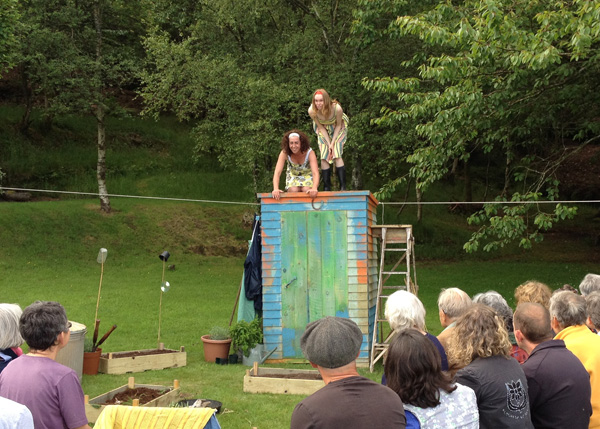
On Saturday 9th June Nutshell Theatre Company brought their award-winning play, ‘Allotment’, to Arran. Undeterred by the midges and refreshed by tea and scones, around fifty folk were entertained by a touching tale of sibling rivalry and affection performed by two actors in an allotment - in this case Heather and Stuart Gough’s garden.

The play tells the story of two sisters and their lives spent together tending their vegetables, sharing memories and squabbling. There are strict rules - no flowers and no visitors. The sisters see the world outside the garden as a threatening place, full of men who do unspeakable things to you and children who are unruly and will trample your veggie beds.

Performed entirely within the vegetable garden, the world beyond was skilfully conjured up through the actors’ actions and words describing the view from the top of the shed or the arrival of a regular passer-by. There were delightful moments of comedy, pathos and tension - sometimes changing in a breath as the relationship between the sisters unfolded. As the characters grew from girls to young women and on into old age the actors subtly altered their voices and movements to suggest their different ages.

The set and costumes were deceptively simple - a shed, a ladder, some veggie beds and garden tools, a selection of hats, aprons and jumpers and, of course, Teddy and Sindy. Each prop or costume was used to great effect to enhance the telling of the story or to reveal some aspect of the characters’ relationship.

Charming, occasionally unsettling and ultimately touching, ‘Allotment’ was a pleasure to experience. It was a real treat to have such high quality professional theatre brought to Arran.


New proposal by COAST – please help!

The Community of Arran Seabed Trust, known to us all as COAST, is proposing a marine protected area (MPA) around the south of Arran, as shown in the map below. It is not aiming to be a No Take Zone like Lamlash Bay, so sea anglers and hand creelers will be welcome to use it.

The COAST team drafted their proposal over the winter months, with help from islanders and supporters elsewhere, and it was delivered to Scottish Natural Heritage on 9th May. The proposal is now being considered for inclusion in Scotland’s MPA network, which is currently being developed by the Scottish Government. A decision will be made by the end of this year. COAST hopes very much that their proposal will be accepted, since it will help to protect rare marine features such as maerl beds and forests of seagrass. It has the potential to form a significant part of the recovery of the Clyde from its present bereft and over-fished state.

Howard Wood, COAST’s chairman and co-founder, describes the proposal as ‘An investment for the future of Arran and our Clyde waters.’ If the fish spawning and nursery grounds round Arran’s southern and western coast can be protected and nurtured, it will do much to restore the Clyde to what Howard calls a ‘productive and sustainably managed fishery.’ In the not-too-distant future, it will not only increase ecological tourism but will actually serve to increase the marine stocks needed by the Scottish commercial fishing fleet. Everybody stands to gain, including the currently threatened creatures that live in our seas.

Please help! There may be protracted negotiations before the MPA can be considered as part of the Scottish plan, and the proposal needs all the support Arran can give it. If you are in agreement with the aim of a Marine Protected Area, or if you have any comments or suggestions, COAST wants to hear from you.

Write to COAST at the Old Hay Barn, Park Terrace, Lamlash, Isle of Arran, KA27 8NB, or e-mail andrew@arrancoast.com. If there are any queries, call 01770 600656. You can read the whole proposal on their excellent online newsletter.

Katie Thomson, an undergraduate marine biology student from Glasgow University, is gaining practical knowledge with COAST at the moment. Katie has been working with children at Shiskine Primary school - see the picture below, courtesy of the COAST website. She is off to Bolivia for the summer weeks to extend her studies, but happily, she will be back on Arran for her Masters year when the school term resumes.


Prize-winners at the High School

North Ayrshire’s first Rising Stars Awards are intended to honour what Councillor Tony Gurney rightly calls, ‘Talented and inspirational young people’ for their hard work and the commitment of their teachers. Arran High School features twice in the list.

Iain Clarke

Bad hotels or bad bureaucracy?

Arran’s Chris Attkins wrote a pointed response to an editorial in the Scottish Review of June 20th that had called for the Scottish Government to improve the standards of Scottish tourism. With his permission, we reproduce it here.

‘Heaven help us,’ Chris said, ‘if, as Kenneth Roy proposes, the Scottish Government tries to improve the standards of Scottish tourism. From past experience, this will be attempted via crude legislation and additional burdensome bureaucracy.’ He went on to cite the reasons.

‘Previously a member of VisitScotland for 10 years, we welcomed the introduction of “grading inspections”, but were dismayed when these became an expensive annual trauma - the ultimate purpose of which seemed to be to turn every establishment into the same characterless clone. Our local council seems hell-bent on having all accommodation providers rip out any architectural features in their properties for which they do not have fire safety statistics. Such blunt instruments will destroy more than they fashion.

‘In these days of online reviews,’ Chris continued, ‘guests are quick to criticise (sometimes unfairly) so there is no excuse for discerning visitors to book into sub-standard facilities. The reason appalling places survive is because tour operators (and individual visitors) continue to seek out unrealistically cheap deals. Scotland offers a great range of first-class accommodation, fabulous food and an incredible choice of entertaining activities. It's all easily found and booked with a mere twitch of one's mouse finger. Let's not cripple the industry with even more regulation.’

Chris Attkins
Guest house proprietor and restaurateur, Isle of Arran


Shake-up at NAC

There are signs that the new balance of the parties is resulting in some changes. It’s never easy to read the runes of what goes on in a local authority, but a press release about re-structuring talks of ‘streamlining the organisation and development of Council services’. Clearly, a shift of power is going on. The dual function of Head of Planning and Monitoring Officer, for instance, will now be split between two people, ‘to improve governance.’ It causes some wonder that the Head of Planning was previously charged with doing his or her own monitoring.

There will be a new Development and Environment directorate to oversee Roads, Lighting, Transportation, Planning, Economic Development, Trading Standards, Grounds Maintenance and Waste Services.

With the practicalities taken care of, that leaves the financial sector. Heads, it seems, have rolled. The Solicitor to the Council and General Manager of the Chief Executive’s Service are both to be removed. In their place will be a Corporate Director of Development and Planning, coupled with a Head of Democratic and Administration Services.

Has there been a night of the long knives? We will never know, but it is clear that the old order has to some extent been broken up. The runes have never been so full of interest.


Poem of the month

selected by David Underdown

My Papa’s Waltz

by Theodore Roethke

The whiskey on your breath
Could make a small boy dizzy;
But I hung on like death:
Such waltzing was not easy.

We romped until the pans
Slid from the kitchen shelf;
My mother’s countenance
Could not unfrown itself.

The hand that held my wrist
Was battered on one knuckle;
At every step you missed
My right ear scraped a buckle.

You beat time on my head
With a palm caked hard by dirt,
Then waltzed me off to bed
Still clinging to your shirt.

The American poet Theodore Roethke (1908-63) grew up in Michigan in a German immigrant family. His father Ott, who died when Theodore was just fifteen, was a particularly important influence on his life. In this, his most widely anthologised poem, we see his characteristic blend of strong rhythm and rhyme combined with vivid imagery. My Papa’s Waltz first appeared in his second collection ‘The Lost Son and Other Poems’ published in 1948.


Fish coming back to the Clyde – but still small

John Kinsman

A study by Marine Scotland shows that the white fish biomass - the total weight of white fish species in the Firth - is now twice as great as it was 70 years ago, when fishing methods were simple and intensive trawling had not started.

However, although the weight of fish is now much larger, 72 per cent of it is one species, whiting. Of that species, 85% is smaller than the legal minimum landing size. The report concludes that ‘while not yet a healthy fish population’ there are signs that the Clyde ecosystem can be restored.

Fisheries Secretary Richard Lochhead said: ‘“What this report indicates is that with careful, collective management it may be possible to improve biodiversity and nurture the Firth back to a more diverse fishery, able to support mature fish stocks that can be sustainably harvested.’ He continued, ‘However there are no quick fixes and that’s why the Scottish Government, alongside other stakeholders, will consider this report carefully.’


Recipe of the Month

Savoury Mince Pie.

Ingredients

1lb lean minced beef
1 tablespoon olive oil
1 onion, finely chopped
2 ripe tomatoes, skins removed and finely chopped
3 tablespoons tomato puree
2 tablespoons finely chopped fresh parsley
salt and pepper
12ozs short crust pastry
1 egg, lightly beaten

Method

Heat the oil in a large pan.
Fry the onion for about 5 minutes without browning.
Add the minced beef and fry for a further 6 minutes until it is just cooked.
Add the tomatoes, tomato puree and parsley.
Season with salt and pepper.
Put a lid on the pan and simmer gently for 45 minutes checking that the mixture does not stick.
Roll out the pastry and line your chosen pie dish, making sure to reserve enough pastry for the lid.
Place the filling onto the pastry and spread it out evenly, leaving a good margin of pastry all around the pie dish.
Roll out the reserved pastry to make a lid, sealing the edges with a little milk.
Make a slit with a sharp knife in the middle of the pie.
Brush the top of the pie with beaten egg.
Bake at 220°C for about 15 minutes.
Reduce the temperature to 180°C.and bake for another 20 minutes, until the pastry is golden brown.

The pie can be eaten hot but is also nice cold, with a green salad.


Julie Nelson

Countless people will remember Julie Nelson as a valued and hard-working member of the Whiting Bay community, but in addition, her accomplished stage performances will live long in many minds. Whether in the Whiting Bay summer repertory season, the Drama Festival or in larger scale productions, she brought her own reliable, authoritative contribution as a performer. She had a presence and timing that were masterly, coupled with an ability to take the audience with her into whatever situation she chose. Her range was immense. She could be autocratic or vulnerable, comic or touching, and everyone, right to the back row of any hall, always heard every word she spoke.

Undoubtedly, Julie might have made a great success of the professional theatre, but her life in the real world came first, and much of her talent and hard work went into caring for the many people who needed her. She was utterly generous, making her energy and her kindness available without stint. Her creativity lives on in the memories of those who watched the expression of her rare talent on the stage, but it survives, too, in the family she nurtured and in the innumerable people who benefited from her good humour and her down-to-earth wisdom. She will be greatly missed.


Hunterston proposal abandoned

To the relief of many, Ayrshire Power Ltd withdrew its planning application for a coal-fired power station last week, conceding that it was ‘contrary to local and national planning policies and would not have captured 100% of carbon emissions from day one.’

North Ayrshire Council Leader, Willie Gibson, welcomed the decision. He said: ‘The Council unanimously rejected these proposals last November on the basis that the application lacked sufficient information on the potential impact on human health and the local environment.’ He added, ‘We have the highest unemployment rate in Scotland, and while this proposal would have brought much-needed jobs to the area, the cost was simply too high in terms of risking public health. The company’s decision to withdraw the application is a victory for common sense.’


A Garden of Earthly Delights

John Roberts sends us an account of the Arran Civic Trust visit to Little Sparta on Wednesday 13th June.

Little Sparta is a garden full of works of art created in the late ‘sixties and onward by the artist Ian Hamilton Finlay (1925-2006) and his wife. It lies in the south west of the Pentland Hills near the village of Dunsyre. The site is not easy to find, being at the end of about half a mile of rough farm track, but once located, a visit repays the effort a hundredfold.

Sparta was the traditional enemy of Athens, so the name Little Sparta was deliberately chosen in ironic contrast to the nickname of nearby Edinburgh, the “Athens of the North.” The garden does indeed contain references to ancient Greece and Rome in its sculptures and monuments, but Finlay’s imagination roams far wider. The visitor can pick up references to the French Revolution, the sea, and the Second World War, as well as inscriptions with wise aphorisms, proverbs, puns, pure flights of stream-of-consciousness word association and similar verbal fancies. Some of the imagery is undoubtedly violent - for example the pair of stone hand-grenades topping brick gateposts - but paradoxically the whole gives a feeling of wonderful peace, relaxation and freedom. One could lose oneself for hours there.

But Little Sparta is not just a collection of works of art. It is a garden - or rather, a set of individual but interconnected gardens. There is a Woodland Garden, a Roman Garden, an Allotment, English Parkland, and so on. Effective use is made of water in the Temple Pool Garden and with the completely natural-looking Lochan Eck. And there are special features, such as little temples, the Hortus Conclusus (Enclosed Garden) set in a roofless former farm building, and a curving path neatly edged with cunningly trimmed longer grass in the English Parkland. The maintenance of all this must be constant hard work, but it is beautifully done, and the staff are to be congratulated on their efforts.

Since 1994, and especially since Ian Hamilton Finlay’s death, responsibility for the upkeep of the garden rests with the Little Sparta Trust. Needless to say, this needs the support of the public, through charitable donations but also through admission charges and sales. If you are thinking of going to see it, first check the details on www.littlesparta.co.uk.

In the words of the art expert Sir Roy Strong: “The garden is one of the few made post-1945 which must not be lost. It remains to me still the only really original garden made in this country since that date”.


A little island, little known

Easdale Island, reached by turning off the road from Lochgilphead to Oban and following the single-track B844, is so small that you can walk round it in half an hour. It is a worked-out slate quarry, and everything, from houses paths to the walls of the harbour, is built of slate, in massive blocks or odd-shaped pieces or sometimes, carefully shaped decorative discs. There are no roads - the single-storey, whitewashed houses sit among grass, and at the jetty where the ferry boat (maximum 12 passengers) ties up after its five-minute journey, wheelbarrows and two-wheeled wooden carts stand on a grassy bank, ready for use.

There’s no shop, but an excellent pub called The Puffer after the Clyde work-boat that used to call there does very good meals and is, like the whole island, full of friendly people. Though there are only about 63 of them, the island boasts a spectacular community hall, built of slate like everything else and heated by a solar energy generator. Beyond that lie the deep excavations of the quarrying that used to employ over 400 people. A catastrophic storm in 1818 flooded the pits and the houses and brought the mining to an end - a story well told in the little museum lovingly tended by the knowledgeable Annabel. If you want a glimpse of an island that lives on in its own terms but has little to do with the conventional world, Easdale is well worth a visit.

Alison Prince

The Easdale Ferry

We pay for ‘bullets to shoot seals’

Marine Scotland data has revealed that fish-farm companies have shot more than 300 seals during 2011 and 2012.

John Robins, Secretary of the Save Our Seals Fund (SOSF) in Scotland, said they are calling on the US Government to ban imports of farmed salmon and on retailers to stop selling the produce of ‘seal unfriendly’ Scottish salmon farms. He went on, ‘I hope the US Government can force Scottish salmon farmers to install seal exclusion nets, something the Scottish Government and the RSPCA have disgracefully failed to do. When you buy Scottish farmed salmon, even RSPCA-endorsed Scottish farmed salmon, you pay for bullets to shoot seals.’

The Scottish Government, SOSF claims, have admitted that 80% of the nation’s salmon farms licensed to shoot seals do not have anti-predator nets. Marine Scotland has refused to name the particular sites where the seals were killed, but when the Arran Community Council investigated the St Molios fish farm in Lamlash some years ago, its manager said seals were shot when necessary. He claimed that a seal tangled in an exclusion net dies a worse death than through shooting.

What do readers think? Drop us an e-mail on info@voiceforarran.com.