Issue 28

Flame and Citron for Corrie Film Club

This dark thriller may come over as pure John Le Carré, but it is based on fact. Denmark was occupied by the Nazi forces from April 1940 until VE Day in May 1945, and the Resistance was far more complicated, both politically and morally, than a mere Robin Hood exercise of knocking off the Sheriff’s men.

Ole Christian Madsen’s 2008 film is based on fact. ‘Flame’ is the code-name for a red-haired young man called Bent, and calm, bespectacled Jørgen is known as ‘Citron’, as sharp and dry as a lemon. (He is played by Mads Mikkelsen, who may be remembered as Le Chiffre in Casino Royale.) These two were in real life the chief assassins of the Resistance, but relationships between Denmark and Germany were always complex, and there was no clarity about where the loyalties lay. The film, set in 1944 when the tide of the war was turning, sees that liberation is coming closer. The increasingly desperate Gestapo is tightening the screws, and the Danish civilian government has been replaced by martial law, whose leading Establishment deals in negotiation rather than murder. Its leaders increasingly see Flame and Citron as loose cannons whose usefulness is at an end, and the two killers do not know who, if anyone, can be trusted. This intelligent, gripping film has much to say about morality and the tensions that still beset much of the world.

The screening starts at 8.00pm in Corrie Hall on Sunday, May 12th. Admission is free, and you need not be a Film Club member, though donations to the hall’s costs are always welcomed.


We’ve published another book!

Following the success of Jim Henderson’s book about Arran’s Clearance-impelled migrations to Canada, Voice for Arran Online is producing something quite different - a book of thoroughly silly poems by our editor, Alison Prince. It is called Flying Cat, the title taken from a zany papier maché sculpture by Zoe Tomalin, and all readers are invited to a launch for it, to be held in Corrie Hall on Friday, May 10th at 8.00pm.

Here’s a sample. As you’ll gather, this is not the heavy-handed kind of poetry. As it says on the jacket, it’s ‘just for some kind of fun’. Yours for £7.50.

Gerald Ting

Gerald Ting was phoney-sexed.
He lived for bleeping lines of text
and even in the works canteen
had never once looked up and seen
sweet Tracey of the luscious lips
who always gave him extra chips.
While smiling at his messages
he hardly saw her sausages.
Tracey was of course enraged
at being so thoughtlessly upstaged
and so, with clumsy-handed ease,
she doused his phone with mushy peas.
“Ooh, ‘eck,” she said, without surprise.
The hapless Gerald met her eyes
and dropped his phone into the bin.
Tracey. ‘OK,’ he said. ‘You win.’


Twice as many ferries …

People could hardly believe it when the news broke. Arran is to have twice as many ferries, the Isle of Arran doubling with the Caledonian Isles on the Brodick - Ardrossan run and also providing a direct link between Ardrossan and Campbeltown. The Community Council suggested this a long time ago, but added that the problem of the narrow entry into Ardrossan Harbour could only be solved by using smaller boats with a deeper draught and less freeboard. That proposal is being thought about, with various plans on the table, but in the interim, we have double the number of sea crossings - and yes, there will be a train to meet each ferry.

The Voice would like to congratulate Transport Scotland for listening to the public feedback rather than the obviously disconnected Arran Ferry Committee, who prefer to promote their own views rather than those of the residents. This schedule with early mid week departures and the late Saturday return although, they may not be initially be popular, will enable residents to enjoy a full day on the mainland or with family and still travel home.

This together with the revisions to the new port will give us a basis for a year round two boat service which will allow our young to take on a practical and cost effective mainland job without being removed from their families and the need to cover expensive housing / living costs.

The timetable can be found on the CalMac website here.


… but a cut in pay for CalMac staff?

Cal Mac has recently written to around 70 members of its shore staff to tell them that weekend and shift allowances may be cut, together with annual holiday bonuses. Changes to rostering may also lead to staff having to work two additional hours a week. The Transport and Salaried Staff Association (TSSA) estimates that this could leave shore staff up to 25% worse off than at present.

Katy Clark MP said, ‘There is absolutely no justification for Cal Mac to slash its shore staff pay in this way. The company made a profit of £4.5 million last year and returned £5.8 million to the Scottish Government so there is no urgent need to cut costs.’


Progress on the new pier for Brodick

CMAL are holding a third public meeting at 7:30pm on Tuesday 7th May 2013 in the Community Theatre at the High School.

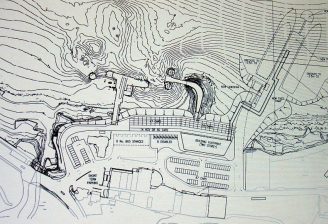
The Voice for Arran Online has been priviledged to get a preview of the new layout which we show below. It's clear that CMAL have listened carefully to the discussions at the previous public meeting regarding foot passengers having to cross the traffic access to the marshalling yard and have re-routed that access to the rear of the existing terminal building. The new marshalling yard is now located on the reclaimed land in the existing basin and the new terminal building will be on the existing marshalling yard. A great improvement.


Arran’s Returning Local Hero

There’s just a couple more weeks before the start of the 2013 Arran Mountain Festival on 17-20 May. Festival organisers report a record number of bookings this year, from both new and returning visitors. To go with the busy days on the hill, there is also an exciting programme of evening entertainment, which is open to everyone.

The highlight will be the illustrated talk given by local hero Calum McNicol on Saturday 18 May at Corrie Hall. Find out about his record breaking attempt when rowing across the Atlantic Ocean earlier this year. Doors open at 7pm and your chilli and rice dinner is included in your ticket price (£10 and £7 for under-16s). 50% of each ticket sale will be donated to Calum’s charity, Ayrshire Hospice. The night has been generously sponsored by Arran Active, the Outdoor Specialist shop found at the Cladach Visitor Centre, a longterm and faithful supporter of the Festival. Please be generous and back this fabulous evening: tickets are available at Arran Active or online.

Returning by popular demand is the Friday night (17 May) social gathering, this year at the Ormidale Hotel in Brodick from 5.30pm. On the Sunday night (19 May) there will be the mountain pub quiz, again at the Ormidale, starting at 8.30 pm (£2 per person, three in a team).

If you are still hoping to get onto one of the Mountain Festival walks, please urgently book as many of the routes are now full. Bookings can be made online here or by phone on 01770 302244.


Get compensation for power loss in Arran’s big freeze

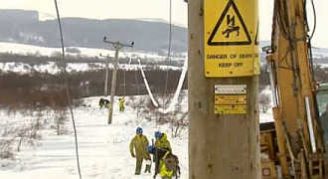
People who were without electricity after the March blizzard brought the power lines down should contact Scottish and Southern Energy (SSE) power distribution, who are offering compensatory payments for the inconvenience suffered.

A goodwill payment of £35 is available to all domestic customers who were still without electricity after 10am on 25 March 2013, and £70 for business customers. A further £27 is offered for each subsequent full 12 hour period during which customers still had no electricity supply, and £54 for business customers. In addition, SSE is organising a series of local meetings and inviting people to talk to some of SSE’s senior managers about what happened.

Katy Clark MP, who is urging Arran people to take up the SSE offer, said ‘This compensation doesn’t really reflect the inconvenience caused by the loss of power but is a small recognition of what so many went through.’

If you want to claim, Google Scottish and Southern Energy, and scroll down to find the form, which simply asks for your name and e-mail and postal addresses. They will do the rest, but warn that it may take them a week or two. They do not ask how long you were without power, but it’s to be assumed that they will know this.


Katy loses patience with the Chancellor

Our hard-working MP, Katy Clark, had a moment of exasperation last week, and declared that George Osborne ‘is in denial.’ She continued, ‘Since 2010, time and time again we have seen that the austerity measures of this Government are just not working. …The Government’s fiscal policy is in ruins and the IMF is telling the UK Chancellor to rethink and slow down. Borrowing is now set to be £245 billion more than planned. Now that even the IMF is calling for a change in economic strategy, I urge the Chancellor to devise a plan B without any further delay.’

Don’t hold your breath - but all the best to Katy for a good try.


Mr – or Mrs – Badger

Alison Prince

Coming back from Lochranza last week, for the second time in a few months, I had to brake for a badger shuffling its quiet way across the bridge over the burn. These private, intelligent animals are not proved to have anything to do with bovine tuberculosis, which some farmers say is linked to over-use of manufactured intensive food-stuffs, yet there is open season now for badgers to be shot by anyone. The idea is to wipe out the badger population, regardless of the suffering involved. Heaven be thanked, this is not happening in more sensible Scotland, but if you object to the slaughter campaign in the south, there’s a vigorous petition going on that you can easily sign. Click on http://epetitions.direct.gov.uk


Save the Children

Jean Robertson writes to say the annual fundraising week for Save the Children takes the form of a house-to-house collection in every village. Collecting cans will be in many of the shops, and dedicated workers for the charity hope to cover as much of the island as possible. Last year they raised the sum of £2,500, and as things are going, help for children this year will be more vital than ever. Please help if you can.


Golf on Arran

Jim Henderson, author of From Arran to Canada, One Way, has begun new research, this time into the history of golf on Arran. It’s a story that goes back much further than you might think, and we at the Voice are finding it fascinating. Jim’s introduction to the subject follows, and he will add to the history in subsequent issues of the Voice.

Introduction

The sport of golf has been part of the Scottish scene for over 600 years but on Arran it has only been played for around 125 years, partly because its hilly terrain was not easy to sculpt into golf courses. However, this very fact makes Arran’s golf particularly attractive, and over the past 60 years it has become one of the island’s main tourist attractions, a sport participated in by people of all abilities and ages.

There have been many claims about the origins of golf. Scholars and historians have argued about it for a long time, both here and in the Netherlands, which has a strong claim to have been in at the start. The name of it, at least, is clear. ‘Golf’ derives from the Scottish word, ‘gowff’ a verb meaning ‘to hit’. And golf as a Scottish institution was born on the dunes that form the machair of Fife near St Andrews. Before that, however, lies a long history.

In the late 14th century sailing craft were pursuing a regular trade between the East coast of Scotland and Holland. The Scots exported wool - the one commodity they had in abundance - usually through the port of Bruges, which was the centre of the medieval wool trade. There, raw wool was woven into fine cloth and luxurious tapestries. Many enterprising Scots, using gold and silver as their currency, settled in Holland, enjoying the fact that merchants from across Europe were beginning to ask for Melrose wool by name. Scottish exports expanded to include raw materials such as coal, salt, malt, hides, skins, tallow and salmon, but Scotland was still a place of primary products, and manufacturing had not started, and there was a strong demand for manufactured goods of luxuries of every kind. The Scottish traders were acutely aware of this, and rolled up their sleeves to supply it. The Bank of Scotland was founded as a branch of the Bank of Amsterdam, and the ships that went back to Scotland’s east coast catered for the growing demand for luxury goods. Stowed in the holds along with much else were barrels of small wooden balls, Golf was being played in Scotland, and the Dutch golf balls were a much better quality than the ones produced locally.

There was a lively exchange of people, too. People from the Low Countries had been settling in Scotland ever since the Dutch princess Mathilda married the Scottish king, David I, during the Dark Ages, and by the 15th century there was a sharing of customs and ideas - and sports. The Dutch, with their abundance of flat seaside land, had been playing a form of golf for many years, but it was the Scots, with their unstoppable tendency to think they could do things better, who started to improve the sport. Scottish craftsmen began making weighted clubs that could more accurately strike a ball towards a mark placed in the ground. It was not long before they replaced the marks with holes, and the equipment they designed helped to establish golf as we know the sport today.

In 1411 St Andrews University was founded. A form of ‘gowff’ had long been played among the local sand dunes, but lecturers and professors, we can presume, were quick to improve the crude old game, using improved clubs and balls. Between.1424 and 1437, records show that King James 1st of Scotland was spending a considerable amount of money on golf equipment.

Twenty years later, in 1457, King James 2nd, who was evidently not such a keen sportsman, banned ‘gowff’ because it was interfering with his troops’ archery practice, but the sport kept going. At first it was exclusively for men, but in 1567 Mary Queen of Scots changed all that, and was the first woman to have been recorded as playing the sport. Her English counterpart, Queen Elizabeth, probably did not know the sport existed, but after her death in 1603 James V1 of Scotland became James I of England, and he took the game of golf south. It caught on fast, no doubt because of its royal patronage, and the first club in England was formed at Blackheath only five years later, in 1608.

Golf has never been a cheap sport. Unlike football, which started as the competitive kicking of an inflated bladder down any handy village street, golf depends on good, well-made equipment. In the early years of the sport the number of people able to participate in it was limited by the cost. Clubs made with wooden shafts were easily broken, as were the expensive wooden balls. ‘Featherie’ or ‘feathery’ balls were invented in 1618 and used through the 17th century, but these, too, came at a price. They consisted of a hand-sewn round leather pouch stuffed with chicken or goose feathers and coated with paint, usually white in colour - a time-consuming business. Even the most experienced maker could only produce a few balls in one day, and so they were expensive. A single ball would cost between 2 shillings and 5 shillings, which would be £15 to £25 today.

Arran knew none of this, for golf did not become established on the island until 1889 - but it caught up quickly, and by the time the First World War broke out in 1914, there were 10 golf courses being played on the Island.

In the next few editions Jim Henderson will cover the story of how golf on the Island has influenced Arran’s life and tourism.


Veggie Table for May

Well, fingers crossed, I hope that wasn’t our summer, though if previous years are anything to go by it might well have been. But anyway, forge on.

Remember to water your sown seeds, so they have a chance to germinate, but not your potatoes until they start to flower, which is when the tubers are starting to develop. Sow parsnips now, two or three seeds at 150mm spacing or 75mm for smaller varieties like Avonresister, into ground which has not been freshly manured. Thin to one at each station.

Onion and shallot sets can also go in now at 100mm spacing. Make sure the soil is firm so they have something to push against. Push them in so the tips are just showing and be prepared to push them back in again if the birds pull them out to try and use them as nesting material. I find the results from sets much better here than from seed, due to the short growing season. Ailsa Craig is a well-named old favourite , but you could also try Sturon or Red Baron, both of which are slow to bolt and store well.

Later this month sweet corn can be started off. I have found the results tend to be disappointing unless you can grow them undercover, but well worth it if you can. First of All might be the best variety to grow here, though I still rate Kelvedon Glory. Summer, winter and red cabbage can be started now, and also kale, either in situ or in pots and for transplanting later.


Big power companies scared of solar

David Roberts, writing in the US website, Truth-Out, reports that the Edison Electric Institute (which he describes as ‘typically stodgy and backward-looking’) came up in January with a serious suggestion that solar power and other renewable energy technologies could lay waste to the big power-providers.

At the moment, these ‘regulated monopolies’ thrive on selling power through the national grid that they manage. The more juice is used, the more money the monopolies make. But what if people start generating their own? Solar panels on residential or commercial roofs don’t make a bean for the big boys. They are what’s known as Distributed Energy Resources, DER for short. At the moment, it’s variable in output because the sun doesn’t always shine, so customers still need to stay on the grid. But what is improved battery storage technology or micro turbines could free everyone from grid-dependence? Edison Electric’s report warned that ‘irreparable damages to revenues and growth prospects’ would result.

This revelation will worry the current (sorry) investors, who are likely to shift their money elsewhere. So the big companies will be forced to put their prices up. And what do people do in response to that? Fit more solar panels, of course. Within a decade, we may be paying electricity bills only for the maintenance of the physical wiring network that enables us to share the power we’ve generated. Interesting times.

Bloomberg New Energy Finance is very cheerful about the future of renewable energy. Its most recent report says that renewables will account for half of all generation capacity by 2030. Looks as if Scotland is on the right track, then.


Socialist bank loved by Conservative state

North Dakota is an aggressively Republican state, full of pro-lifers and gun-toting red-necks - and yet it loves its state-owned Bank of North Dakota (BND), which pays no fat bonuses Why? Because it works. It supports no fat cats. In 2011, its handsome profit of more than $70 million went straight into the state's coffers.

Banks are supposed to make our savings and deposits available to other businesses and consumers in the form of affordable loans. But that’s what the large British banks are not doing. Hence our high level of unemployment. The BND, on the other hand, provides loans at below-market interest rates to businesses, but only if those businesses create at least one job for every $100,000 loaned. Must be a lesson for Britain in there somewhere.

If you are really keen, have a look at a book called The Looting of America: How Wall Street's Game of Fantasy Finance Destroyed Our Jobs, Pensions, and Prosperity - and What We Can Do About It. Big mouthful of a title, but the author, Les Leopold is the executive director of the Public Health Institute in New York. He knows what he’s talking about.


Poem of the month

selected by David Underdown

To His Love
By Ivor Gurney

He’s gone, and all our plans
    Are useless indeed.
We’ll walk no more on Cotswold
    Where the sheep feed
    Quietly and take no heed.

His body that was so quick
    Is not as you
Knew it, on Severn river
    Under the blue
    Driving our small boat through.

You would not know him now …
    But still he died
Nobly, so cover him over
    With violets of pride
    Purple from Severn side.

Cover him, cover him soon!
    And with thick-set
Masses of memoried flowers -
    Hide that red wet
    Thing I must somehow forget.

At first sight lyrical and pastoral, the bleakness of the final line break is visceral. Ivor Gurney was born in Gloucester in 1890, the second child of a tailor and a seamstress. He was musical and sang as a chorister. His teacher, who also taught Vaughan Williams, regarded him as ‘hugely talented but unteachable’. Enlisting as a private soldier in the Gloucesters in 1915, he was working on his first book of poetry when wounded on the Western Front in April 1917. That September he was gassed at St Quentin and this exacerbated an existing bipolar condition. He survived the war but spent the last 15 years of his life in mental hospitals.


The delights of dandelions

Pause with that trowel! And don’t dream of spraying noxious chemicals. The dandelion is full of useful substances. Its leaves and flowers contain a massive range of vitamins, and the lecithin in its yellow flowers detoxifies the liver. (Bear that in mind when waking with a thick head in the morning.)

In Greece, they add tasty young dandelion leaves to salads and use them with roast lamb. They’re good fried with bacon, too, as an alternative to spinach. And the milky white stuff that comes out of a dandelion’s stem is valuable as well. The old herbalists used it to ease the pain of wounds and bee stings.

All that apart, the dandelion does a great service to other plants. It has a long taproot, as tidy-minded gardeners know to their despair, but this brings minerals and nutrients up from deep below the surface, making them available to shallower-rooted plants. That’s why primroses do so well when there’s the odd dandelion around.

As Pink Floyd might have said, ‘Hey, gardener - leave them dandelions alone.’


El Hierro powers itself

Countless British visitors know the Canary Islands, but not all of them will be familiar with El Hierro, though it has a small airport and a ferry terminal, connecting it to Tenerife.

El Hierro is about to become the first island in the world to become totally energy self-sufficient. This will be achieved through a €54 million project combining five wind turbines and two hydroelectric projects. It will run three water desalination plants, and the hydro storage system will store surplus wind power by pumping water up 700 metres (approximately 2,300 feet) to fill the crater of an extinct volcano. When there is little wind or when demand exceeds supply, water will be released from the crater to run down the hill into an artificial basin at the bottom, generating 11.3 MW of electricity as it does so. It will stay in the lower basin until there is excess wind power, which will then pump the water back up again to the upper reservoir.

This ‘closed-loop’ hybrid wind/hydro system is to be tested by the end of 2013, but is expected to save approximately four million US dollars currently spent on importing some 40,000 barrels of crude oil every year, making the island completely self-sufficient for electrical energy.

People on Arran are thinking along the same lines. Surely this must be the pattern for the future?

Google “Green Islands” for a general overview, or follow this link.


What to do if your cat goes missing

Linda, as most cat owners will know, is Arran’s representative of the Cats Protection League, and she has rescued and homed countless cats, one of whom, Mitzi, appears in our photo.

Several cats have gone missing recently. Some have been returned and some, as yet, have not. If your cat vanishes, you are in for a very stressful time, and you will need to be patient, determined and well-organised.

Try to remember where you last saw your cat, and look there first. Keep calling him or her. It’s best to call as you are moving back towards your home, because if the lost cat hears you when you are somewhere else and tries to find you, it may end up moving further away. Keep calling your cat frequently throughout the day.

Ask all your neighbours and friends to check their homes, sheds, cars, outhouses, holiday homes etc. You’ll be amazed where cats will find themselves, either from curiosity or fear. Letting everyone know what has happened ensures that lots of people are keeping an eye open for your cat.

Put food down outside. Yes, it’s possible another cat or creature may take it but if your cat is new to you or frightened or fearful, you need to encourage him/her to stay in the vicinity.

Get photos of your cat and put up posters to say it is missing, in the shops, newsagent, post office and even the pub! Contact the veterinary surgery and let them have details and a photo too, in case an unknown cat should be brought in. Put an advert in the local newspapers and if you can afford it, ask them to include a photo.

If you have your own Facebook page add details of your cat to that. Cats Chat also has a section on missing cat details. We at the branch can add your details to this website or to Facebook if you don’t know how to do this, and if need be will advise other branches.

If your cat is prone to getting in vehicles (some of them are) you need to check with the local Postman and drivers for haulage or courier companies. If they have been to you, ask where they stopped next.

Having your cat microchipped when you first acquire it will help to establish ownership in the event your cat is found, but this of course is scant comfort if it has already gone.

Most importantly, do not give up! A cat can be missing for several days or even weeks, and in some cases, months. I know of a cat on the island that came home a year later! If you need help about what to do or simply want to a friendly voice to talk to, please don’t hesitate to call 820611 or email me on linda@arran-cats.com . We will happily help in whatever way we can.


Marine news

from John Kinsman

Mercy Mission to Cruise Ship

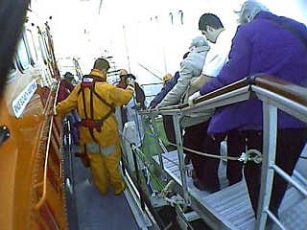
Tobermory's lifeboat crew were called to a 170metre cruise ship in Bloody Bay, north of Tobermory, just before 8-30 am on Monday April 15th, to transfer an elderly man who was taken ill.

The picture, taken by the RNLI aboard the cruise ship, which carries 1,000 people, shows the patient being helped down the gangway transferred in Force 6 winds to the lifeboat, together with his wife and ship's doctor. All three were taken to Tobermory, where they were handed over to a waiting ambulance.

Tobermory lifeboat coxswain Andrew McHaffie said. ‘This was a routine call out for us, and despite the windy conditions, the transfer went smoothly. We were pleased to be of service to the man and wish him a speedy recovery.’

Fishing Trawler Grounded

On the night of April 5th, the Oban Lifeboat Mora Edith MacDonald was launched just before 2.45am to assist the fishing trawler Adaptable which was aground at Ardtonish point in the Sound of Mull.

Once on the scene, the crew quickly ascertained that there an ingress of water but no pollution from the vessel, so a tow line was set up as fast as possible, since the tide was on the ebb.

The trawler was pulled off the shoreline and it was found that there were problems with its steering gear. A tricky, slow tow took place, and on arriving in Oban Harbour the fishing trawler was berthed alongside the North pier at about 6am. The lifeboat then returned to her station and refuelled, to be ready for the next call.

Whisky Not As Galore As It Was to be auctioned

Two bottles of the whisky famously salvaged from the SS Politician, wrecked on the shoreline of Eriskay in 1941, are to be auctioned. The wreck, and the islanders’ inspired salvaging of the cargo, were immortalised in Compton MacKenzie’s book, Whisky Galore, and the subsequent film.

The Glasgow auction website, Scotch Whisky Actions, will be taking bids for the two bottles until May 5th, so you’ll have to hurry if you want to put in a bid. The two bottles that have become available are from the eight that were recovered in 1987 when Donald MacPhee from South Uist explored the wreck. The whisky is thought unlikely to be drinkable by now, but that is hardly the point. Bidders will be competing for part of a legend.


Crossword

Across

 1 Horror man forcing upturned Greek island inside (5,7)

 7 Calls for retirement homes (4)

11 A sort of rancour surrounds the extreme storyteller (9)

12 Fights stormy welters (7)

13 The Spanish are not odd in number (6)

14 About to ease up on fast - it's harsh (10)

16 Three slabs smashed on loch causes dyspnoea (14)

21 What a Scouse returns with: weapon (5)

22 Note, either way (5)

24 Celia gets mixed up with another girl (5)

25 The best sleuth? He'll shock Morse again! (8,6)

30 Again, the innkeeper doesn't favour the monarchy (10)

33 'Monday: blew up generator' (6)

36 Insistent that first man receives soldier (7)

37 Arran's ire misplaced and late (2,7)

38 Relative re-ordering fish (4)

39 Open letter to holy man (a German one) about No. 1's role (12)


Huge fish farm in Seil Sound approved

There had been about 800 objections to the proposed 600,000 capacity fish farm in Ardmaddy, Argyll. Over 100 came from residents of Seil, Easdale and Luing, representing about a quarter of the adult population. 140 or so came from mid-Argyll, another 125 from the rest of Scotland and about 350 from the rest of the United Kingdom (many of the writers being holiday visitors.) 65 came from abroad, and there were also 44 letters, of which two were from Arran residents. Enough, one would think, to merit consideration.

However, this week brought a chilling chance to see Argyll-style democracy in action. Argyll & Bute Council, astonishingly (and perhaps to the surprise of the applicants themselves) decided that no Environmental Impact Assessment was needed, despite the huge disposal and pollution problems inherent in large-scale aquaculture. At a session in the Corran Halls the application was approved without a single dissenting voice.

The new fish farm was initially proposed as a ‘pilot relocation project’ by the Scottish Government when the existing site in Loch Riddon was causing such pollution that much of the wildlife there had become extinct. The site at Ardmaddy increased its capacity from 800 tonnes (200,000 fish) to 1300 tonnes (325,000 fish) but the strong tidal streams round the top of Seil Sound were carrying away huge quantities of fish waste, toxic chemicals and pesticides. Some of these were ending up in the nearby Firth of Lorn, which enjoys special protection under the European Habitats Directive, so there was a fuss about that.

In response, the operating company decided to move further South down the Sound. While they were at it, they would apply for an increase of permitted biomass to a total of 2,500 tonnes. Representing 600,000 mature salmon, this is the maximum that can currently be licensed for any farm in Scotland. The Argyll Fisheries Board demurred about the increase, but caved in.

Although pollution and waste disposal are the major problems with large scale industrial fish farming, this aspect was ignore, as the casual dismissal of any need for an Environmental Impact Assessment shows. The issue was one of jobs. Somewhat distastefully, a supporter of the application claimed that tourism employed mainly ‘folk from Eastern Europe’ and implied that fish farming was ‘real work’ that fitted the traditional perception of Argyll as a fishing and agricultural community. Underlying some councillors’ remarks was a perceptible feeling that jobs in tourism don’t count. Councillor Devon let slip her feelings in asking for figures about ‘your tourism’, as if the tourist industry was a trivial local thing. In fact, Scottish Government figures show that tourism brings in 130 times more revenue than aquaculture does.

Councillor Currie spoke strongly in support of the application although his home community of Islay had seen off efforts by a fish farm company to establish a similar operation there. Of the whole committee, not a single member found any merit whatsoever in the points put forward on behalf of the residents of Seil. The application was granted unanimously. And this week, an application goes in to SEPA for yet another 2,500 tonne installation in a proposed new site off the bay at the South west corner of the Isle of Shuna.

See http://www.saveseilsound.org.uk


Jan’s Kitchen

Puy lentil and chunky vegetable salad
serves 4.

Ingredients

Lentils 250 grms / ½ lb.
Olive oil 6 tablesp / 80 ml.
Chopped tomatoes 1 tin (Sunblush toms. 240g tub)
Courgette 1 medium, diced
1 Lime, zest and juice.
Salt and cayenne pepper.
Avocado 1, diced (optional.)

Method

Gently sweat diced peppers and cougettes in oil for 2 mins
Add tomatoes, cook for a further minute or a little more
Remove from heat
Add lentils, stir in well
Add lime zest and juice
Season with salt and pepper

Before serving, add avocado and mix thoroughly.


How the Butterfly Tree started

While watching Comic Relief this year I saw a young boy in Zambia drifting into a coma caused by malaria. His mother held his hand. He never woke up.

The awful truth is that every 40 seconds, a child dies of malaria - and yet, a mere £5.00 buys a mosquito net that can protect a young life. We in the Doubleday family wanted to do something about it - and found the Butterfly Tree charity, run by Jane Kaye-Bailey. Jane visited Zambia in 2006. It’s one of the poorest countries in the world with two-thirds of its people living on less than 50p a day, and their children are dying from Malaria in huge numbers.

This little charity, working directly with the people concerned and wasting no money in administrative costs, gave us a way to do something to help. At its heart lies the making of very simple little butterflies, from wire and tulle net, to sell through various venues, but people joined us to contribute lots of other craftwork. On Saturday 27th April we invited people to our home for a butterfly tea party and raised enough money to buy 40 mosquito nets.

Our butterfly campaign will run throughout the summer. It will end in September with a Butterfly Supper co-hosted with the Coast Café in Whiting Bay, to whom we are most grateful. Details will appear in a future edition of he Voice.

How can you help?

There are lots of ways to help make a real difference for people in Zambia. You can:

  • Help make tulle butterflies for selling on the island
  • Sell butterflies through your own shop or café
  • Get a group of friends together and host your own butterfly tea party - we can supply butterfly craft materials and cake
  • Collect for the charity at any event you are involved with

Contact Fiona if you want to know more. E-mail fionadoublday@me.com or phone 01770 700470.

You can also donate through www.mydonate.bt.com/fundraisers/fionadoubleday1

See Fiona’s lively blog for a running update on progress - www.scottishislandmum.blogspot.co.uk