

This month’s Voice is even more international than usual, with items from Romania, Norway, Italy, America, Albania and Poland. A reader in Russia sent us a rapturous message about the photograph of a dewed spider’s web that introduced last month’s edition. There is of course the usual wide spread of information about what is happening on Arran, and we continue to look at the big question of Scottish independence and where we will be standing in the world a year’s time from now. Any opinions on this question – or indeed, on any other – will be warmly welcomed. Just send us an e-mail on info@voiceforarran.com. We’re here for your use.

‘Thread’ spins a yarn in Corrie
On Saturday afternoon, October 19th, an interested crowd gathered in Corrie Hall for a play staged by Nutshell Theatre - and were provided with papers for a Beetle Drive. For those who remember, this was a form of simple Bingo, the winner being the first to roll a six and complete a rudimentary beetle. The play opened with this game, conducted by a Master of Ceremonies who retained his professional touch and yet was perceptibly weary, as were his wife and daughter - or young helper, or lover, as the reminiscences demanded. Almost the only prop was a hinged sewing box with many compartments, a notional link to the threads of the story.
The play was created through collaboration with people of 65 or more in Fife, who shared memories and reminiscences of their earlier days. Their stories, telescoped together into the emotional history of three related people, built into a rich mixture of love, fun, misunderstanding and pathos.
Theatre ‘in the round’ at such close quarters is incredibly difficult to do. There is no proscenium arch to frame a picture in which the actors create a different world. They are never more than a few metres away, allowing the watchers to share the deeply personal experiences of their memories and fantasies. On Saturday, the three characters shifted in their identity according to what was being remembered or imagined - an incredibly demanding task. Stephen Docherty as William, the husband, father, lover and Master of Ceremonies, rose to the challenge with absolute authority. With never a trace of ‘performance’, he was totally honest and open to what was happening, and every flicker of expression on his face was vulnerable, putting up no defence or self-protection. Nicola Jo Cully and Gowan Calder were the more actively dramatic characters, often tossed in the rough waters of jealousy and betrayal and love, and it was sometimes difficult to hit the needed high notes in an audience setting that was as intimate as a suburban sitting room.
All told, it was an astonishing achievement, and left a vast richness of human stories echoing in the mind.

The Maxwell String Quartet
In the evening following the Nutshell play, many of the same audience joined a host of others in Brodick Hall for a concert given by the Maxwell String Quartet. These young players, widely tipped as the most talented and outstanding quartets currently performing, justified their reputation with a brilliant performance. Their intelligent, lively approach brought a wonderful freshness to Beethoven’s String Quartet in Bb, Op 18 no 6, giving it an open, airy quality that is seldom heard. Duncan Strachan on cello had the same light, lively approach as the higher instruments, and this perhaps underlay the general sense of perception and delight.
Anna Meredith’s Songs for the M8 opened a completely different aspect of string quartet playing. As modern as the latest app, Anna’s music is played everywhere, from flashmob performances in services stations to the last night of the Proms, and though stern traditionalists found it difficult, most of the audience were fascinated. From the pizzicato start, we were caught in vicarious experience of traffic and roads, an accident, perhaps, and heavy rain. The evoked ideas last longer in the mind than details of the music, but it is a piece impossible to forget. James MacMillan’s Memento had much of the elegiac feeling of his Piper Alpha piece, and here, as in the two Shostakovich pieces that followed, Liam Lynch and George Smith, violins, and Asher Zaccardelli, viola, came together with the cello in warm, delectable balance. The concert closed with Ravel’s wonderful String Quartet in F, gentle and tuneful, always light in texture yet building to an exciting finale. The applause was prolonged and richly deserved, springing from an exhilarating sense that we had heard a young quartet than is set to be the outstanding one of our musical future.
Four clarinets next
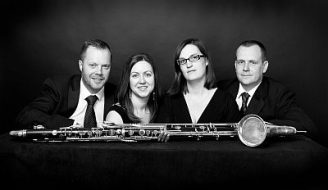
The next Music Society concert, on Saturday 23rd November, features the Fell Clarinet Quartet. Anyone who heard them when they last came to Arran some years ago will be eager to see them again, for they are a fabulous group, turning a hand to anything from Mozart to Klezmer, Beethoven to tango and jazz.
Clarinets comprise quite a large family of instruments, from the familiar Bb and its near-twin pitched in A to make some pieces more technically possible, to the higher Eb. The big, sonorous bass clarinet covers the bassoon range, but still with the clarity and sweetness of tone that makes the clarinet such a well-loved instrument.
Colin Blamey, Helen Bywater, Marianne Rawles and Keith Slade work magically together, with what the Scotsman called ‘ice-cool virtuosity and moody whispers that colour in equal measure.’ Their programme will include music from such diverse composers as Mozart, Gershwin, Piazzolla and Eddie McGuire, who is rumoured to be writing a new composition for them. All very exciting stuff.
The concert is in Brodick Hall and starts at 7.30pm. Tickets at £10 can be bought at the door or pre-booked at Inspirations (just across the road from the hall) or online through Arran Events on www.arranevents.com.

Corrie Film Club
Séraphine, directed by Martin Provost in 2008, will be shown at Corrie Hall on Sunday November 10th at 8.00pm. This French-Belgian film is the true story of a woman who found ways to do paintings, though she had nothing going for her at all, and it swept the board at the 2009 César Awards (the French Oscars), winning every section and walking away with the Best Film.
Set in pre-1914 France, it features Yolande Moreau in a stunning performance as Séraphine Louis, a lowly housekeeper with an extraordinary talent for painting. Entirely untaught, she follows what she regards as religious inspiration, derived from her daily walks to work where she gazes at trees and the things around her with wide-open awareness. She has no art materials, and collects soil and candle wax to make what she can. The red pigment for which she becomes know is in fact pig’s blood, through she does not reveal this.
The owner of the house where she works is Uhde, a noted art critic. He is startled to see her work and assures her she has a talent. He encourages her and promises to promote her work - but he is German and has to flee France when the 1914 war begins. In 1927, Uhde meets Séraphine again and begins buying her pictures, and selling them. She becomes successful and sought-after. Uhde encourages Séraphine to think of herself as a professional painter, but prosperity has thrown her into a kind of living dream that is not quite sane. She buys an expensive bridal gown and says she receives messages from angels.
In the Great Depression of the post-war years, Uhde can no longer sell Séraphine’s paintings. Her new status as a woman of means collapses, leaving her in confusion and distress. Her slender grasp on the rational world breaks down, and she is put into a lunatic asylum. Uhde visits her and learns that she no longer paints, but though he has finally sold some of her work, he is firmly advised not to contact her, as she would be upset. The best he can do is find Séraphine a room in the institution where she can go outside and look at the trees again. She died in 1942 and her art became famous and respected.
Corrie Film Club is open to all and there is no charge for showings, though a donation to the hall to help cover heating costs would be appreciated. Membership of the Club brings you a 3-fold programme of the year’s films and an opportunity to help choose future showings.
Save the Children Christmas Fayre
On Sat. 9th November from 10:30am to 1pm, Save the Children is running a splendid Christmas Fair - or Fayre, if it sounds more festive - in Brodick Hall. Treat yourself to home-made soup and sandwiches, home baking, tea and coffee, and find some nice things for presents. There will be a great variety of jewellery and craft goods, bric-a-brac to browse through in search of something intriguing, plants, tombola and a raffle. Everyone is welcome. All proceeds go to the Save the Children fund.

Where to go from the Co-op Bank?
Many of us felt bereft when the Co-operative Bank was rescued from disaster only through a take-over bid from an outfit with no interest in its ethical policy. Anyone who cared about that was left wondering how to find a harmless alternative home for such money as we have managed to save.
Far the best bet is a Credit Union. Every district has one, though it will not budget for advertising because it is not there to make private profit. A Credit Union is a strictly local co-operative bank that exists to help people in its area to meet their needs and run small businesses. They are not handers-out of charity, because their books have to balance like those of any bank, but they can be a godsend in the face of tough economic circumstances.
Arran’s Credit Union is in Kilwinning, but you don’t have to go there. If you happen to be on the mainland, you’ll find them at 147 Main Street, Kilwinning, KA13 7AG, but it’s very easy to contact them online at www.allianceayrshire.co.uk. If you prefer to phone them on 01294 557123, there’s no queue and they don’t play you dreadful music for half an hour. A real person answers and is friendly and nice. They offer online banking, so you can manage your account completely on your computer screen if you prefer. The contact box on their site works very promptly.
The Ayrshire Credit Union is part of a group called 1st Alliance and is, its website says, ‘… the leading community-owned financial service provider within Ayrshire.’ It continues, ‘We pride ourselves on a personal service that delivers, and never compromise on putting you, the member, first.’ It offers ‘secure savings, attractive loan packages, pre-paid debit card and a transparent bank account. We are first and foremost a member-based Ethical Community Co-operative, operating throughout Ayrshire.’
Sounds good to us.
Katy against the Bedroom Tax
The ‘bedroom tax’ will affect 105,000 households in Scotland. 79% of them “under-occupy” by one bedroom and so stand to have their housing benefit reduced by 14%. The 21% who “under-occupy” by two bedrooms or more are likely to lose a quarter of their housing benefit. 79% of these households have at least one adult with a recognised disability.
A Scottish Government Committee has been gathering evidence from all the affected parties on what this means in real terms to the people who are faced by these drastic reductions of income. Katy Clark is in no doubt about it. This week, she said, ‘As time goes on the disastrous impact that the bedroom tax is having on Scottish communities becomes more and more apparent. In North Ayrshire 71% of households hit by the bedroom tax are being forced into rent arrears.’ She continued, ‘As local authorities and housing associations see their budgets squeezed by this tax many could be forced into raising rents. Groups such as pensioners, who the Government claimed wouldn’t be hit by this appalling policy, could now end up worse off too.’

Flogging off the East Coast line
Despite the fact that the publicly owned East Coast line has been doing very well, the Government is still proposing to hand it over to the private sector. Transport Secretary Patrick McLoughlin said: ‘We want to see a revitalised East Coast railway, one that both rekindles the spirit of competition for customers on this great route to Scotland and competes with the West Coast on speed, quality and customer service.’
McLoughlin admits that since 2009, the East Coast franchise has been ‘stabilised’ under Government ownership (whereas no private company was able to do this) but insists that ‘management by Directly Operated Railways was never planned to be a permanent arrangement.’
We must ask why not. The fact is that the publicly owned East Coast Main line has returned £208.7 million to taxpayers, whereas privatisation, as we all know, has resulted in rocketing costs, poor services and worrying questions about safety standards. But the profit motive has to come first, so the rail services, rather than being a linked provision as they are in all sane countries, has to consist of competitors determined to make money. As McLoughlin puts it, ‘The Government believes a strong private sector partner, as an innovator and investor, will build on this stable basis and deliver a world-class railway for passengers and best value for the taxpayer.’

New app detects microplastics
Sally Campbell wrote a piece for the Voice last year on the damaging microplastics often contained in facial scrubs. Further research has turned up this article from Flora and Fauna International. It has been slightly shortened.
Any conscientious consumer is no doubt aware that plastic pollution is having a profound effect on the world’s seas and oceans. In recent years the media has been flooded with gruesome images of entangled marine wildlife, and the resulting public scrutiny has pushed governments and businesses to make a concerted effort to address the issue.
Much of the publicity and action has focused on the larger, visible pieces of plastic such as carrier bags and bottles. The far smaller microplastics are almost invisible, so are more difficult to tackle - but scientists are warning that their effect is just as serious. Seabirds, seals and several species of fish are being badly effected, as well as smaller species such as mussels and lugworms.
It is estimated that 95% of northern fulmars have accumulating microplastics in their stomachs that cause physical blockages, choking and eventual starvation, since a stomach full of plastic has no room for anything else, and the plastic can neither be digested nor excreted. Several studies have shown that some seabirds are regurgitating microplastics in the swallowed food they provide for their young.
These tiny plastic particles tend to accumulate toxic chemicals from the marine environment. Many of them are known to be endocrine disruptors or carcinogens, so there is a serious question about the extent to which these toxins being passed up the food chain and what implications this might have for human health.
What we can do
Microplastics can be the result of result of larger items, such as polythene bags breaking down, but they also deliberately created as ‘microbeads’ to provide the roughness in products such as facial and body scrubs. These beads are discarded in the waste water from shower or bath, and because they are so small, they cannot be filtered out during wastewater treatment. Inevitably, they end up in the marine environment, where they are virtually impossible to clean up. The only way to tackle the danger they present is not to use them.
Consumers have a huge amount of power. If we choose plastic-free products over those that contain microbeads, that choice will soon influence the manufacturers. Until now, it has not been easy to know which products contain these plastics (deliberately cryptic labelling does not help). However, conservation organisations have just launched two new guides that will make life much easier.
The Good Scrub Guide, from Fauna & Flora International’s (www.goodscrubguide.org), offers a clear, non-biased tool to help consumers choose products that do not contain plastic microbeads. This benign firm has joined forces with like-minded Dutch organisations Plastic Soup Foundation and North Sea Foundation, and together they have produced an international smartphone app called Beat the Microbead. Armed with this, you can that allows scan a product’s barcode and know at once whether it contains microplastics.
Beat the Microbead costs nothing. It is available in five languages on Windows, iOS and Android operating systems, and can be downloaded from www.beatthemicrobead.org. With Christmas coming up, make sure your gifts don’t pollute our oceans and kill our sea creatures and birds.
Yes or No?
The Scottish Independence debate is the most vital one that we have seen since 1707, yet it remains curiously muted, perhaps because there is the best part of a year to go. Our efforts to find a supporter of the No faction have again come to nothing, but David Donnison, an Emeritus Professor of Glasgow University who knows Arran well, has written the following thoughtful account of his position. Like many, he finds himself somewhere in the middle, which perhaps accounts for the title to his piece.
Referendum blues
A year ago I would have voted "No" to independence - and "Yes" to "devomax" had we been given the opportunity to do so. Among other good reasons for my "No" vote was my feeling that at the western end of Scotland's central belt (where I have lived for 33 years) we have suffered one of Europe's biggest industrial disasters, and now have the biggest concentrations of unemployment, sickness and poverty that follow such disasters.
Can we bring the people of this area - which includes Ardrossan - into Scotland's mainstream? Will they have the opportunities that every Scot should be entitled to? Those are the most important questions facing our country, whether independent or not. It should be easier to get the right answers if the resources of the whole of the U.K. can be brought to bear on them. Although I could give other good reasons for a "No" vote, that was the most important one for me.
But over the past year the English - or some of them - have swung to UKIP, and their main political parties have responded in a panicky way. If they elect a Tory Government, or a Tory-Lib-Dem coalition, there will be more cuts in the services on which our poorest people depend; more privatisations of public services; the building of a monstrous new prison; a referendum that seems likely to take us out of Europe; and the repeal of the Human Rights Act. Meanwhile there are to be tax cuts for millionaires, massive investment in the poisonous fracking industry, and the replacement of our pointless and hugely expensive nuclear submarine fleet. Even if Labour wins the next Westminster elections much of this programme seems likely to go ahead.
If that's to be the U.K. we have to live in, I shall want to get out of it.
Unfortunately, the referendum and the general election come in the wrong order. So I shall have to make my best guess at the UK’s political future as the referendum approaches without the evidence a general election would provide.
Until then, mark me down as a "Don't know".
Brodick’s New Pier
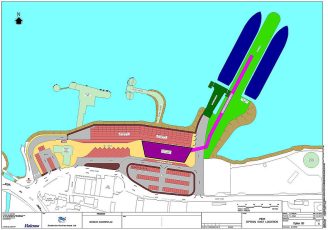
CMAL will be holding a further public meeting in Brodick Hall at 7:30pm on Wednesday 6th November, to discuss the final plan for the new pier and ferry terminal in Brodick. A copy of the latest plan shows that the bus stances have moved closer to the terminal building, allowing a lot more space for waiting passengers and the disabled parking spaces have moved to the main car park immediately opposite the main entrance to the terminal building. Also the "dog-leg" in the passenger access system has been straightened out.
CMAL have clearly listened to the concerns of the island residents and made the appropriate changes. If you see anything you still don't like then go along to the meeting and have your say.

An American dream of less stuff
With the dreaded festival of commercialised religion roaring up, it’s intriguing to see alternatives suggested. In the US, which we are apt to regard as the spearhead of consumerism. The So Kind registry suggests all kinds of alternatives to the gift-wrapped, worried-over offering. Have a look at sokindregistry.org and be of good cheer. Perhaps it isn’t humbug after all.

The continuing salmon saga
Two million farmed salmon in the Vikna district of Nord Trondelag are to be slaughtered because they have become resistant to chemical treatments against sea lice.
The Norwegian Government has taken this drastic step because wild smolts migrating through the fjords to the open sea next May and June will be at grave risk from the huge numbers of juvenile lice being released from salmon farms that cannot control their lice numbers. The Norwegian Food Safety Authority can levy significant fines of up to 200,000 kroner (some £20,000) per day on salmon farm operators where sea-lice levels on farmed salmon remain over accepted thresholds.
With this in mind, the Salmon and Trout Association (Scotland) wrote to the Scottish Government, drawing attention to the situation in Norway and asking what consideration it is giving to applying ‘similar punitive sanctions’ against salmon farm operators in Scotland who fail to keep sea-lice numbers below agreed thresholds.
Hugh Campbell Adamson, Chairman of S&TA, said the contrast between Norway’s responsible attitude and the prevailing one in Scotland ‘could hardly be more marked.’ He continued, ‘Here the salmon farming industry's own figures confirm that sea lice numbers have been out of control for many months on farms in areas such as West Sutherland and the northern part of Wester Ross - and yet the Scottish Government declines to take any action whatsoever.’
New salmon farm permitted despite protests
Highland Council has approved a salmon farm expansion in Loch Kanaird, Wester Ross, despite massive opposition. Don Staniford, Director of Protect Wild Scotland, said, ‘It beggars belief that Highland Council can approve this salmon farm expansion despite over a decade of pollution, 100% community opposition, sea lice infestation problems, no current planning permission and its proximity less than 1 mile to a salmon river.’
On October 8th this year, Protect Wild Scotland revealed that Wester Ross Fisheries (Salmon) have been breaching pollution limits for over a decade. In an email dated 26 June 2013, Highland Council declared itself so shocked at the state of affairs that they asked SEPA if it was correct that sea-bed pollution reports for the salmon farm operated by Wester Ross Fisheries in Loch Kanaird had been “unsatisfactory” for 11 years. The result, it seems, was a twiddling of the thumbs and a gazing at the sky. A Highland Council spokesman said it was ‘reasonable to assume that if seabed conditions on a site consistently fell below expected standards then SEPA would be taking some form of action against the developer.’ Pass the parcel.
Protect Wild Scotland will be seeking legal counsel with a view to a Judicial Review.
Arran shortlisted for £100,000 prize
News came through yesterday that Arran is on the shortlist of competitors for the Creative Place Awards 2014. Earlier this year, the Theatre and Arts Trust was busy compiling evidence from all the people on Arran involved in some kind of creative activity, from weaving to jazz, theatre to constructive use of open spaces, and the total was astonishing. Will it be impressive enough to win the award of £100,000? That remains unknown until the final judgement, which will be announced at a ceremony at the Palace Theatre, Kilmarnock, on Wednesday, 29th January.
There are three entry categories in this ambitious competition, run by Creative Scotland. The largest, for communities of up to 100,000 residents, offers an award of £150,000, and the finalists are Falkirk, Dumfries and Orkney. The smallest is for groups of under 2,500 residents, and the three finalists in this division are Kingussie, Ullapool and Helmsdale, hoping to win £50,000. Arran comes into the central group comprising communities of up to 10,000 residents, and the two other finalists in this section are Peebles and the large area that includes Cove, Kilcreggan, Rosneath, Clynder and Garelochhead.
Twenty applications were received from a range of organisations across twelve local authority areas. Rhona Corscadden, Senior Events Manager, EventScotland, a panel member, said: “The calibre of the applications for this year’s awards is extremely high, and they highlight the strength of the creative industries across Scotland. These awards showcase the breadth of creative talent we have in our communities and each of the applicants should be congratulated for their achievements to date.”
Heather Gough, Chair of the Arran Theatre & Arts Trust, said: “We on Arran are thrilled and honoured to be considered for the shortlist. The application was very much a team effort and the result of a great deal of hard work. No matter what happens now, the result of arts groups on the island working together to submit the application has been an extremely positive experience.”
The Arran application states that the Award would be used to engage professional arts practitioners to work with individuals and groups on the island; provide wide access to the arts for all sectors of the community; improve marketing skills and provide support for those with exceptional talent.
Bridge Challenge
South has to make four No-Trumps and West leads the Jack of Spades. How would you play it?
Romanians furious about fracking
Protest about fracking still rages in the US and has had a preliminary outburst in Britain, but now it is raging in Romania. In 2010, Chevron Romania obtained concessions for drilling in three onshore blocks in the Dobrogea area in southeast Romania. They border the Black Sea and cover approximately 2,700 sq km.
Chevron’s own website says it began establishing ‘a business presence’ in the capital, Bucharest’ in 2011, then goes on to say with some indignation that Chevron workers were sent to drill the company’s first test well, but were turned back by protests.
Romania’s government sold Chevron the rights to frack the shale beneath more than a million acres of Romania, but residents are worried about the environmental consequences. They accuse Prime Minister Victor Ponta of breaking an election promise to block drilling for shale gas.
Agence France-Presse gives more detail on the protests near the village of Pungesti. ‘The convoy was forced to turn around as protesters, some of whom had come in horse-drawn carts, called on Chevron to “go home”. One of the villagers, Gheorghe Hrum, a retired forest warden, said, ‘We will not let them drill here if we must die for this.’ He added, ‘They came with policemen and bodyguards to scare us but all we want is to be left alone, even if we are poor.’


Did the American Civil War never quite end?
Most of us have been baffled by the political row in America that forced the Government to shut down completely for 16 days and took $24 billion out of the U.S. economy. The financial services company, Standard & Poor (we rather like the name), said the shutdown reduced projected fourth-quarter GDP growth from 3 percent to 2.4 percent. Not, you would think, a Good Thing.
It came about because the loony fringe Tea Party, on the right wing of the Republican party, declared that the Government was insolvent and insisted that it must close unless it could immediately paid its debts. That is like telling Greece to shape up and pay up, right now - and of course, it couldn’t be done. International economics doesn’t run on real money, it’s an agreed balance of indebtedness. President Obama struggled to find a way out, and finally signed legislation that extended the credit limit until Feb. 7, 2014. But then what?
One would think that pursuing tax evasion cheats would be a first step towards accessing some funds, but the Congressional Budget Office is horrified by a casual admission that tax will not be pursued, although every form of social service will be drastically reduced. Offshore tax havens alone cost the U.S. Treasury $90 billion a year, all of it untaxed in the United States. Yet the myth of the undeserving poor persists, and millions of people in the US are facing an infinitely harder time.
Just to make things worse, a couple of weekends ago, low-income shoppers in 17 states were unable to use their electronic food stamp debit cards. Panic set in. Did the deadlock in Washington mean nutritional assistance was gone for good? In fact, the cause was a glitch at Xerox, the private company that provides computing services for the state welfare agencies. But the bigger picture is an ominous one.
Thom Hartmann said on TV that the Tea Party radicals in Washington today are rebooting ‘the same government obstructionist strategies that have been around since the early days of slavery.’ Hartmann would like to see the Tea Party and its home territory of ‘blue’ America secede from the rest of the United States. Without them, the US could return ‘fulfilling the dreams and visions that our Founding Fathers had. It’s time,’ he said, ‘to let small-minded bigots go back to their plantation-style economies and let them run their states like third-world countries.’
It seems the American Civil War never quite ended.

Crossword
Across
1 Triangle in C instead of G, morphs into another instrument! (8)
5 See 19ac & 13dn
9 Bread for an attractive woman (7)
10 Entertain a thought (5)
11 Beheaded guard on approach (5)
12 Mostly decorate movement of 30s style (3,4)
13 Escape bar (5)
16 Small European family includes the French (5)
17 Use the iron again to crush (7)
19, 13dn & 5ac Phoney gent fury misplaced in requests for donations in November (5,3,3,3)
22 Hospital on river dwelling (5)
23 Air-con, note, disturbs instrument (7)
24 Was born, then returned in the evening (3)
25 Dine out on American money? That's just vulgar! (8)

Why does my cat … ?
Linda Hartley of the Cats Protection League answers some of the questions that amuse or annoy or worry cat owners.
Why does my cat purr? What does it mean?
A cat purrs to show it is contented. When its tail is just gently flicking at the end, it means that cat is quite happy and doesn’t want to move from that position. A cat that is ill or in pain will sometimes also purr, and it is thought that this may help it deal with the pain. However, if you think your cat is in pain you should always take it to the vet to get it checked out. Cats tend to hide pain very well, sometimes so successfully that by the time the owner realises something is wrong it may be too late.
Why does my cat swish its tail?
Cats use their tails for all sorts of purposes. They use them for balance, as you can see when they are walking along a narrow fence or wall, but they also express pleasure or greeting, though they do not wag their tails the way dogs do. Instead, when your cat comes towards you its tail may seems to stand very high, often with the tip kinked over slightly. This is a greeting, and so of course is head rubbing. (We won’t go into scent marking here!) When you see your cat sitting on the arm of a chair with its tail is just gently flicking at the end, that, too, expresses contentment. However, if your cat starts to swish its tail when you holding it or it’s sitting on your lap, it’s a sign that the cat is undecided whether to stay there or move away. If the swishing gets stronger, then you’d better let it go at once, because it is signalling irritation.
Why does my cat hunt and bring mice home?
A cat is still a hunter whether it’s domesticated or not. Some are better at it than others. It takes a skilled cat to hunt for rats, as they are a tougher proposition. Your cat will make up its own mind whether to hunt or not, and it has nothing to do with how much you feed it. Hunting is an instinct rather than a need. Female cats will bring back hunted prey for their kittens to eat, and often bring it in alive for their young ones to practice their hunting skills on. When they bring a mouse in and let it go in the house, it is a present to you, there being no kittens around - though you may not always be suitably grateful!
Why does my cat scratch the furniture?
We all hate this one! A cat has many needs, including shedding the outer coat of claws and stretching their muscles after sitting or sleeping for a while. They also need to make sure their body scent is present in the house. To help prevent your furniture being subjected to this, you can buy the readymade cat scratching posts, or supply an old piece of clean carpet glued to a board.
Why does my cat blink its eyes slowly when it looks at me?
That’s a communication of friendship, like a smile. When we smile ourselves, it moves our cheeks up a little and half-closes our eyes. Try a slow blink and smile when looking at your cat when it is relaxed, and see if it returns the blink. If it does you have just communicated!
Why does my cat drink lots of water?
This is a warning sign. If you are constantly refilling the water bowl and the cat constantly drinks it all, then its time to consult your vet. Drinking a lot can be a sign of several things - the most common are high blood pressure, hyperthyroidism or kidney disease. It is important to know what is troubling your cat, as there are treatments of each of these that will drastically improve the cat’s quality of life.
Thumbs down for Monsanto
All over the world, people and governments are beginning to realise that the GM (Genetically Modified) seeds being peddled by chemical giants such as Monsanto do not ‘feed the world’ as claimed. Their purposed is to lock farmers into a dependency on yearly sowing of sterile seed that will not reproduce itself and often needs the back-up of the company’s own pesticides and herbicides if it is to succeed.
Last week, Mexico became the latest country to ban GM corn. Citing the risk of imminent harm to the environment, a Mexican judge ruled that companies like Monsanto will no longer be allowed to plant or sell their corn within the country's borders. European countries have declared themselves so opposed to GM that Monsanto has pulled out of its European operation.
The island of Kauai has passed a law compelling farms to disclose pesticide use and the presence of GM crops. The same bill insists on a 500-foot buffer zone near medical facilities, schools and homes. The much larger island of Hawaii has given preliminary approval to a bill that prohibiting open air cultivation, propagation, development or testing of GM crops or plants.
The biggest bombshell of all, however, is being primed in Washington state, where a public ballot is riding on evidence that 93% The mail-in ballot state's voters are already weighing in on Initiative 522, which would mandate the labelling of genetically modified organisms (GMOs). Knowing full well that 93 percent of the American public wants to see GM products labelled as such in the shops. The Grocery Manufacturers Association (GMA), a lobby for the junk food industry, has been fighting the requirement for labelling, but a lawsuit against it alleges that the GMA illegally shielded the identity of the contributors, who chipped in more than $7 million to defeat the labelling initiative. Surprise, surprise, these contributors turn out to be Pepsico, Coca-Cola, NestleUSA, General Mills and a few other junk food companies. And, worse, the lawsuit reveals that the GMA held a series of secret meetings to hatch a money-laundering scheme and illegally hide member donations from the Washington State voters now being balloted about GM labelling.
Monsanto didn't even bother to hide the more than $4 million it has given to beat the labelling campaign. Together with GMA and a handful of other corporate donors, a staggering $17 million has gone into their effort to stop Washington's GM labelling ballot initiative. The final ballots will be cast in Washington on November 5th. The pro-labelling side is ahead in the most recent polls, but a barrage of heavily funded and misleading ads may yet end hopes to see labelling made compulsory.
Why are Monsanto and the junk food industry spending tens of millions of dollars every year to keep you in the dark about the foods they supply? Clearly, there are things that Big Food doesn’t want us to know.
Meanwhile, Zac Goldsmith, Conservative MP, wrote a passionate Guardian attack on the Coalition’s Environment Secretary, Owen Paterson, who still believes that GM crops are the salvation of the world. ‘GM,’ Goldsmith thundered, ‘has never been about feeding the world … it is and always has been about control of the global food economy by a tiny handful of giant corporations. It’s not wicked to question that process [as Paterson had asserted]. It is wicked not to.’
Great stuff.

In The Right Place At The Right Time.
We wanted to let our Arran friends and supporters know about what happened to Ilir.
Remember last month we told you about this 14 year old Albanian boy who wanted to come to our centre. He had a problem with one of his legs and had already had two operations. His father believed that the only option was to amputate his leg and because this was such a terrible thing to happen, he’d decided not to tell Ilir. They would tell him about it after the operation. We were obviously shocked at the thought of this happening.
It just so happened that the Italian Hospital in Tirana where Vali has her physiotherapy, had an Italian orthopaedic surgeon coming to see patients a couple of days later. We arranged for Ilir to be seen by him and we paid for this visit, although the surgeon agreed to reduce his charge for us.
Ilir had a difficult breech delivery which left him with problems with his legs. One foot was badly displaced and he struggled to walk. As he grew the situation became worse but he just coped with it as do many Albanians. Many easily correctable conditions go untreated for years until it is too late to have any hope of a successful operation. It was difficult to get the full story trying to cope with a mixture of Albanian and Italian but basically we were told that Ilir could have an operation on his hip which would help him to walk more easily and of course without pain. The surgeon advised that this should be done soon as Ilir was growing and a good outcome was more likely if he had his operation before he reached adulthood. His father was so relieved and thanked us profusely for our help though we didn’t feel we’d done so much.
A couple of weeks later Ilir had his operation, giving him a new hip. Arber, our physiotherapist came with us to visit him at home. He was very cheerful and doing well. Some of the medical advice he’d been given was strange to us, more like medical practice thirty years ago in UK.We advised him about exercise to keep his circulation healthy and arranged to visit again to help with physiotherapy.
I shudder to think what may have happened to this young man if we hadn’t met him at just the right time. It cost us just 3,000lek (£18) not much to save a young man’s leg was it?
I’m sure this won’t be the last time we’ll see equally difficult stories but just hope that we’ll be in the right place at the right time again.
COAST urges Arran Marine Protected Area supporters to complete MPA response forms.
To respond to the South Arran MPA consultation click here.
It’s now less than two weeks till the end of the public consultation on the South Arran MPA, a crucial stage in the campaign for an Arran MPA. The Voice asked COAST’s Manager Andrew Binnie why it’s so important everyone’s opinions are counted. This is what he had to say.
‘COAST is well known nationally and internationally as a grassroots (in this case seagrass-roots) community group that fought hard to create a No Take Zone in Arran waters and in doing so started to change the way the Scottish Government thinks about marine management (a real testament to the people of Arran). The Governement is now beginning to realise our seas must be managed for everyone's benefit. They have to be productive and healthy and they can’t be managed solely for the benefit of scallop dredgers and prawn trawlers. Many people here remember the fishing festivals which once flourished on Arran. The South Arran MPA, if designated with robust management measures, will help to recover the sorely abused seabed and fish nursery grounds around the south of the island. With time we could see a return of adult whitefish stocks and, who knows, perhaps more dolphins and whales.’
‘Robust management measures mean excluding dredgers and bottom trawlers from the proposed MPA entirely. This would not stop more sustainable fishing practices such as creeling, scallop diving and sea angling. We should not accept Scottish Natural Heritage's current management recommendations to only exclude trawlers and dredgers from more fragile areas within the MPA. Surely the point of an MPA is to allow the whole area to recover? It’s not just about conserving a few relic species or habitats within the boundary line. 'Relic' management is not an option for COAST, we want to see the MPA underpin a flourishing marine ecosystem supporting sustainable fisheries and abundant bird life. Management of the MPA should also be linked to a properly regulated Clyde fishery. This is why we need everyone to show their support not just for the MPA but also for the total exclusion of trawlers and dredgers from the area. The more pressure we can bring on the government by showing a high level of local and national support, the more likely we will be to get the South Arran MPA designated. England and Wales have already shown how easily Governments backslide on this issue. Let’s not allow this to happen in here. Arran and Scotland have an opportunity to lead the way and we need to take the opportunity while it’s there.’
To respond to the South Arran MPA consultation click here.
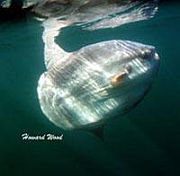
To watch Howard and Lesley Wood's mesmerising sunfish video visit the COAST website: www.arrancoast.com.
Inside Out
Inside Out, a theatrical production staged in Arran Community Theatre last week, was devised and performed by Ayrshire College HNC and HND Performing Arts Students. An earlier performance had been given to the 4th, 5th and 6th year Arran High School students, and the final one was for the general public.
Five nine-minute dramas explored everyday occurrences of mental ill health and its associated stigma. The experience for the audience was poignant and thought provoking. In Faded Lines, we watched two girls suffering from depression, one in denial and the other wanting to get help. Beauty and the Beast showed another girl struggling to cope with her parents’ separation as well as starting a new school and trying to fit in. She felt overwhelmed and things got on top of her. How was she going to cope and who would help her?
In Listen to me, a girl with depression and having constant ups and downs felt her friends did not understand her and made fun of her. She felt that nobody was listening to her, and she had nowhere to turn. Inbox showed Anna and Dan finding comfort in each other through the use of a chatroom. They were both dealing with difficult circumstances in their lives, but found solace through their laptops. However, things took a turn for the worse and they found themselves in a serious and deadly situation. The final drama, Together through Highs and Lows, showed how hard it is for a young person to live a full life when caring for an ill parent.
These dramas were challenging but at the same time heartening, as they showed that with the right support, people can and do recover to enjoy a good quality of life once more. The discussion afterwards was lively, with some of the young performers talking of their personal experience of depression, and how they had been helped.
This was a very worthwhile result of collaboration between NHS Ayrshire and Arran, Ayrshire College and two projects, See Me and Choose Life. It is being performed in other schools and also at the Gaiety Theatre and Arts Centre in Ayr.

Orkney Arran Saga
Orkney has the power to impress its visitors; a power which comes from the landscape, the remains of an awe-inspiring archaeological past, the glorious abundance of the flora and fauna and the tangible spirit of Orcadians past and present.
On our first visit to Orkney this year all this was manifest, but one of the most powerful impressions was a visit to St Magnus Cathedral in Kirkwall. It’s a magnificent red sandstone medieval edifice that has withstood the vicissitudes of time, religious turbulence and the Orkney weather and now stands in memorial to the patron saint of Orkney and following generations of its people. It is Britain's most northerly cathedral, known as “The Light of the North”, and was founded in 1137 by the Viking, Earl Rognvald, in honour of his uncle, St Magnus.
Chapter 45 of The Orkneyinga Saga describes St Magnus, the Earl of Orkney, as ‘a man of extraordinary distinction, tall, with a fine, intelligent look about him. He was a man of strict virtue, successful in war, wise, eloquent, generous and magnanimous, open-handed with money, sound with advice and altogether the most popular of men.’ He was a devout Christian but, sadly, none of his virtues could save him from the jealousy and treachery of his cousin, Hakon, who had Magnus murdered around 1118. Soon after his death, however, tales of miracles began to spread, and as a result Magnus was canonised as a saint and his nephew undertook to build a cathedral in his name.
Arran visitors to the cathedral are always surprised and delighted by the fourteen paintings on wooden panels depicting the life and martyrdom of St Magnus, for they were painted by young people from the Isle of Arran, as the inscription above them testifies. The paintings were gifted to the people of Orkney in 1980 to celebrate the St Magnus Festival, which takes place every June.
The fourteen pictures are true to the saga of St Magnus, woven through with what George Mackay Brown called, ‘the charm and innocence that belongs to youth; the dew is still on the grass, the first birds are still singing.’ He went on, ‘It's marvellous that children from another island should have been fired by this Orkney story. It proves that eight and a half centuries on, it is still valid and potent, and not just a weave of medieval miracle and fantasy.’
The project was led by Maureen Farquharson, art teacher in Arran High School at that time, who was inspired by the idea of the St Magnus Festival and the work of the founders of the festival, George Mackay Brown and Peter Maxwell Davies. She wanted her pupils to share in and contribute to the very special event that was being planned - the St Magnus Festival. Before beginning work on the panels, Maureen took her young students through a study of Orkney’s land and seascapes, its dramatic history and the story of St Magnus himself. Among them were Neil Currie and Lesley Craig, who are now in their forties! Maureen introduced them to the work of George Mackay Brown and Peter Maxwell Davies, because in addition to painting the panels, the young people would attend the Festival - which they did. They went to Kirkwall, attended various events and presented their work in person to George Mackay Brown and Peter Maxwell Davies
All this took place thirty-three years ago. Maureen has no idea whether any of the young people of that time have ever returned to Orkney, but she is certain that, as she says, ‘the experience of the panels, the saga of St Magnus and their visit to Orkney will always be with them’. The making and presentation of the panels was not the end of a project, but rather a beginning, for Maureen had become aware that Arran children also needed to become more aware of their own cultural past, so she began the Arran Heritage Project which continues today, a valuable legacy for Arran.
What a pleasure for us to re-discover these moving and delightful panels, giving us a real sense of unity with another island and its people!
Last Lochranza Choir concert before the big join-up
On Sunday November 17th at 7.30 pm, the Lochranza Choir gives its final performance as an individual group. After Christmas, it will amalgamate with the Rowan Singers, based in Lamlash, to form an all-island choir, similar to the old-established Arran Chorus that many people took part in. The pooling of all available voices was found in a couple of experimental practices to work very well, giving more strength to the male voices and providing an exhilarating ‘gutsiness’ to the whole ensemble. However, that lies in the future. The November concert promises to be a highly enjoyable one, with a mixture of composers and styles that should have something for everyone. As ever, the matchless team of Douglas and Diana Hamilton as accompanist and conductor, works its joint magic to produce singing that is always good to listen to and has moments of sheer inspiration. Don’t miss the final appearance of this deservedly well-loved choir! Come early to be sure of a seat - Lochranza Hall is likely to be very full. You may even get a chance to help the Saints along as they Go Marching In.