Issue 4

Alison Prince

Filthy lucre and me.

I’ve never achieved a reliable relationship with money – it’s always been an off-and-on affair, like a flirtation with a charming rogue. You know the kind. Fun, but never around reliably enough to contemplate being wedded to. Somehow, financial stability of a reliable, husband-like sort has utterly eluded me. It wasn’t for lack of trying. After I left college armed with a useless degree in Fine Art and found a strange dearth of buyers for my paintings, I worked at weekly jobs, I really did. For a whole three months.

The bar beside the Penguin Pool at London Zoo was one of the best. I loved grabbing the internal phone when it rang and yelling, ‘Penguin?’ It was always a dull query from Head Office about something like the stocks of plastic teaspoons, but it had me mentally tossing a raw herring in the air and doing that flat-footed dance that real penguins do when they think something is funny. (I watched them a lot during the lunch break.) I got the sack from Penguin for mistreating my hat. It was one of those chef’s hats with a headband and a sticky-out bit like a white cotton halo. I tucked the halo into the headband, turning it into a rather natty cap. it started a fashion trend, so they threw me out. Typing invoices for Ford’s blotting paper – slowly, because there weren’t enough of them to fill the day – was far worse. The boredom reached a point of obligatory madness.

If one is to give the precious minutes of one’s life to any occupation, it has to be either entertaining or interesting. The blotting paper shop was neither. Teaching turned out to be great, and the cheque for sixty quid at the end of each month seemed like a present rather than wages – but marriage and babies changed everything. Freelance work became a natural stepping stone in that tide of mother-work and wifedom. Getting paid for art and writing can be dodgy, though. Journalism is usually OK, but wringing money out of big corporations can demand a mental jemmy and the threat of a solicitor’s letter (even if you don’t have a solicitor.) The memory of a bitter tussle with Disney Inc over an un-paid-for story still causes me to close my eyes in horror. But that’s the nature of money, in my experience. It’s elusive and unpredictable, with the one benefit that it can suddenly smile on you when least expected. A royalties cheque for something long forgotten can light up your sky like a rainbow.

With such an absurd financial background, I look upon the current economic shenanigans with a mixture of interest and rage. The victims, of course, are the poor souls who put their lives into working for a regular wage and now find that their available cash doesn’t buy what it used to. This seems grossly unfair. The innocent earner has been comprehensively taken for a ride by the established system, though there is of course no official recognition of this fact. Rather the reverse – it’s looked at as All Your Own Fault. But is it criminal of some earnest wage-slave to light up with relief when the man at the building society says he can have a mortgage after all? ‘Let’s just put your salary down as double what it is, shall we?’ he says. Nudge, wink. ‘Oh, thank you, sir.’ Stupid, yes. But those of us who do not move with confidence among sums of money of more than four digits are in a shark-filled sea, hoping for help from some friendly lifeboat. Too often, the lifeboat turns out to be a painted-over pirate brig, with the skull and crossbones invisibly reefed and cutlasses at hand to defend the pilfered bullion.

Innocence, alas, is no excuse for gullibility. Blake’s vision of piping down the valleys wild as the state of perfect bliss is long blown – yet the law upholds innocence as the default state until a defendant is proved guilty. In my view, the British consumer has not been proved guilty, and the government is gunning for the wrong guys. Three cheers, then, for obstinate little Iceland, which is collectively holding up two fingers to those who invested in their banks from motives of greed and now expect to be recompensed. Icelanders number fewer than one million. It’s a small, independent nation, not part of the EU. Nobody was going to bail them out at huge interest, as has happened to unfortunate Ireland. What were they supposed to do? With perfect good sense, they have taken refuge in the unassailable position of Can’t Pay, Won’t Pay. There is no blood to be got out of the Icelandic stone. Our own North Ayrshire Council, along with all the other speculators, will whistle for its money. There is no point in screaming at the bookmaker when your horse falls at the first fence. He didn’t choose the wretched nag – you did.

What fascinates me here is the slow collapse of the whole assumption that debts must be paid. In global terms, money can be seen as a free-floating state of things rather like weather. The very vocabulary is similar, with depressions and swings and shifts of pressure. Perhaps it really is time to detach this vast, money-in-the-sky activity from the daily experience of people who just want to stay alive and pay their bills. The global money-men need to think about this, if only because the collapse of a vulnerable population will be extremely expensive in terms of policing, hospitals and reluctant hand-outs – but the dreaded coalition is too busy walking backwards to see any such thing. I rather miss the days of watching the penguins for light relief. But there are always seagulls.
The Jazz Café Band

John Baraclough

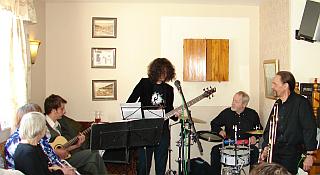
On a sunny Sunday in early April the Jazz Café Band’s entertained us with another stunning performance at the Lochranza Hotel. Not only were nearly all of the sextet’s loyal groupies present, but many local residents and vistors too. They received a great reception and plenty of appreciative applause. As always, the band’s signature number “Mama don’t allow no …” generated audience participation, if a little muted compared to other venues.

Saturday 23rd April dawned a little dreich and we wondered if the scheduled performance at the Lamlash Co-op would take place. However, we arrived and there they were giving it laldy to another appreciative crowd. On this occasion, being reduced to a quintet by the absence of their clarinet player, the programme was changed a little, but still as good as ever.

Your next chance to hear the swinging six will be at the Kildonan Hotel on the evening of Friday May 6th, starting at 8.00 pm. Come and hear Biff belting out the blues, before she gets discovered and famous. Before you know it, your grandkids will be saying, ‘You heard Biff Grey? Like, you mean, live? Wow.’

Another date for your diary is Tuesday 19th July, when the band will be playing aboard the paddle steamer Waverley as she plys her way from Brodick up the ‘Clyde Fjords’ - to the 15th Century Tower House of Carrick Castle. The cruise leaves Brodick at 11:30 and returns at 18:20.


An Ideas Box for Whiting Bay

If you want to get in touch with the Whiting Bay Improvements Committee with any query or suggestion, there’s a neat, clearly labelled postbox on the side of the Putting Green shed, just by the Village Shop.


Arran in the Square: Glasgow

If you happen to be in Glasgow on the weekend of the 14th-15th May, you’ll find George Square buzzing with excitement about Arran. As part of Scotland’s Year of Food and Drink, VisitArran has organised a feast of cooking, eating and music. You can watch top chefs cooking with Arran food and drink - and taste the results! You can also sample a huge range of Arran produce, and meanwhile, Radio Clyde will be on hand to keep the party going.

Live music from some great island musicians will be featured as well, and visitors can try their hand at rock climbing or play a hole of golf on a simulator. For those who prefer less energetic delights, a refreshing Arran Aromatics massage will be available, and some peaceful and beautiful culture at an exhibition of work by Arran artists. What’s more, there will be competitions featuring loads of great prizes, including more than a dozen all-expenses-paid short breaks on Arran. Too good to miss!

More details on the VisitArran website here.


The switchover — don’t get stitched up!

For most of Arran, the switchover to digital TV will start this month, on May 11th. It should be complete by the 25th. If your TV service is provided by satellite, you won’t be affected by the changeover, but everyone else will get no signal after the change unless they have a digibox enabling them to receive TV as before. People who live on the west of the island, where the TV reception comes from a different transmitter, will not have to change their system until next year.

The BBC’s Help Scheme is designed to make things easier for elderly people who may find all this confusing. If you are over 75 or registered blind or in receipt of Disability Living Allowance, or have been living in a care home for at least 6 months, everything you need for the switchover can be provided for no more than £40. It makes sense to take advantage of this, as some unscrupulous tradesmen are charging elderly people far more. If you know of anyone who comes into this category and is in danger of being ripped off, please tell them about this. The Help Scheme can be contacted by calling 0800 4085900.


Using your vote

On Thursday 5 May there will be an election to the Scottish Parliament. There will be two ballot forms, because there are two ways for parliamentary members to represent the people they serve. Of the 129 elected members, 73 represent a constituency. The other 56 are regional members, meaning they represent one of the eight electoral regions of Scotland. Each electoral region includes a number of constituencies.

Everyone in Scotland is thus represented by eight MSPs. One of them is the Scottish Parliament constituency, (ie. Kenneth Gibson in the preceding parliament represented Arran and North Ayrshire.) The other seven all represent the wider region, in our case the West of Scotland.

For this reason, when you go to the polling station you will be given two ballot papers, one mauve and one peach-coloured. The mauve one is to elect your constituency member, so it needs a single cross (X) in the box opposite the name of one candidate. It’s a straight ‘first-past-the-post’ competition, and the candidate with the most votes wins.

The peach coloured ballot paper is to elect your regional members.

Use this ballot paper to vote for a candidate to represent your constituency, but obviously it will be a different list of names and political parties. Again, mark a cross in the box beside your choice. The winners in this case are selected through a combination of individual votes and constituency seats won by the various parties.

You will also receive a UK-wide referendum form, asking what voting system you would prefer to elect MPs to the House of Commons.

If you want a preview of the ballot paper formats or any further information, go to www.aboutmyvote.co.uk.


Scottish Austin 7 Club Rally

After a successful Easter Rally on Arran last year, The Scottish Austin Seven Club returned to Arran this year for their 2011 Easter Holiday. This year they are stayed in Kildonan. On Saturday there was a line-up of the cars in the Visitor Centre car park at Brodick Castle.

Over the years, the membership has gradually increased as the club became better known and now boasts over 120 members from Scotland, the rest of the U.K. and several members from overseas. Cars in the club range from the very early Chummies to the late Jewels and Big Sevens, along with such rarities as A.E.W., Boyd Carpenter, Arrow and Swallow. No matter what Seven you have you are assured a warm welcome in the club.


Offshore Wind Turbine Testing

Anyone who saw a white cargo ship anchored in Brodick Bay last month, piled high with what looked like enormous, tapering tubes, may have wondered what was going on. In fact, the deck cargo was wind turbine blades, destined for an offshore wind energy testing facility to be installed in the sea near Hunterston.

Scottish and Southern Energy is currently working on the new testing facility as an extension of its Glasgow-based Centre of Engineering Excellence for Renewable Energy (CEERE). In partnership with Clydeport and leading turbine suppliers, up to three prototypes of the next generation of offshore wind turbines will be tested to see which gives the best results in terms of quietness and efficiency.

Kenneth Gibson, the Arran SNP candidate for the coming election, said, ‘This is excellent news for North Ayrshire.’ He pointed to the fact that Doosan Power in Renfrewshire has recently announced 1,700 new jobs in renewable energy, and revealed that Clydeport has sought a seven-figure grant from the SNP Government. Mr Gibson supported the application. He said, ‘Development of the Hunterston site is backed by Scottish Enterprise and has strong interest from a number of turbine manufacturers. The creation of such a manufacturing facility will provide significant gains for the local, North Ayrshire and Scottish economies.’ He continued, ‘CEERE is already attracting leading players in the renewable energy sector to Scotland and creating hundreds of new, highly skilled jobs. This new facility will establish North Ayrshire as a centre of expertise for offshore wind and play a crucial part in Scotland achieving its renewable energy goals.’

Mr Gibson gave an assurance that local communities will be fully consulted on the detail of these proposals, and added, ‘The continuous development of offshore wind technologies is essential to reduce the cost of establishing offshore wind farms and improve offshore operational efficiency. The new facility will ensure that the new generation of turbines will show a significant improvement on anything currently available.’


From Janet Baraclough’s garden

Helleborus x hybrids are in full flower just now, and their season last for months.

There is a spectacular range of hybrids developed by specialist hellebore breeders; pure whites, lime greens and yellows, and pink fading through purples to the very darkest slate blue. Some have a dark picotee edge, while others have spots; singles and doubles. The flowers hang two to three from a stem at about a foot or so, the leaves are handsome and evergreen.

Hellebores are completely hardy and ideal for growing under trees and large shrubs in a well-drained semi-shaded position in a humus rich soil. I mulch mine with homemade compost every year. Don’t rush to cut the heads off when at last they finish flowering; they will self seed freely, producing yet more variations of colours and markings, all irresistible.


Fight on for the fish

Although the EU is dragging its feet over implementing proposals to stop the discarding of dead fish into the sea, the Fish Fight Campaign, started by Hugh Fearnley-Whittingstall, has expanded into an active ‘seafood coalition’.

Major businesses selling seafood including Waitrose, Marks & Spencer, Morrisons, The Co-operative, Birds Eye, Young’s Seafood and several others have signed up to be the first members of the newly formed Sustainable Seafood Coalition (SSC). They perceive that part of the problem is that most UK consumers prefer only five species of fish. The result of this limited taste is to put unsustainable pressure on just a few species. The others get thrown away. As SSC members do not want to wait for the slow process of legislative reform, they have voluntarily decided to encourage consumers to eat a wider variety of sustainable seafood.

Hugh Fearnley-Whittingstall said: “If we’re going to sort out the discards disgrace, everyone in the business of selling fish needs to play their part. FishFight helped to amplify a clear message from ordinary people that they want to eat more sustainable fish. The Sustainable Seafood Coalition is about giving more people access to sustainable fish and I’m proud to be involved.” Richard Luney of Marks & Spencer agreed, saying he would like to see it ‘easier for our customers to make informed decisions regarding the fish and seafood they buy.’

Kate Jones for the Co-operative Group agreed. She said, ‘We believe the Client Earth Sustainable Seafood Coalition will be an important new force in helping to bring about a much-needed reduction in fish discards. The Co-operative takes this issue very seriously, and has a stringent Responsible Fish Sourcing Policy for all our own-brand fish, including canned and frozen, and all our own-brand products containing fish, such as sandwiches.’ She added, ‘The Co-operative tops the latest Marine Conservation Society (MCS) league table of supermarkets for supporting and selling sustainably-sourced fish.’

Essentially, it’s down to the customer. If you see unfamiliar kinds of fish being offered – try them! We’ve eaten all the cod and most of the haddock, so it’s time to think more broadly about the many delicious fish that are at present being caught and thrown away.


Textile Work with Young Children

Judith Baines

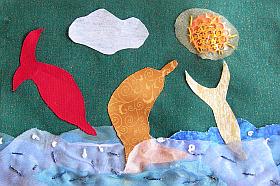
Once children are comfortable with basic stitching and can make collections based on colours or objects, such as buttons or shells they will enjoy making pictures with fabrics and threads. Sharp scissors are essential to this activity! Pieces of suitable fabrics can be cut out and applied. Bondaweb is very useful: it is a fusible web that comes on a paper backing. If the fabric is ironed onto Bondaweb first it is easier for children to cut, it prevents any fraying and the backing paper can be removed and the shape ironed on to the backing fabric eliminating the need for pins. Here is a five-year old`s dolphin picture, taken from her drawing, in the process of being stitched down.

This Christmas card was made in the same way.

The ten year-old who designed this split shape pattern pinned her pieces of felt into place and experimented with new stitches to hold them down and decorate the spaces.

Creating pictures in this way is very satisfying. Each of these has a clear starting point; a child`s own picture, a Christmas bauble and the child`s own design cut from a split circle. Found objects can also be used as starting points for sewing, thus harnessing children`s immediate interests.

Next month we will look at work from favourite shells, flowers, etc.


Greens draw red lines

The Scottish Greens, in with a real chance in the coming elections to increase their Holyrood numbers, have laid down the ‘red lines’ on which Green MSPs will not compromise. These are as follows:

  1. No new nuclear or coal-fired power stations are to be built in Scotland, and no extension of the life of existing nuclear plants will be permitted.
  2. Green MSPs will under no circumstances assist any government in the reintroducion of tuition fees or a new graduate tax.
  3. Green MSPs will not play any role in an administration which makes cuts to Scottish services that worsen inequality. The party is setting out a range of alternatives, including raising additional revenue from big business and the better off.

They must be doing something right, as a recent Ipsos-Mori poll found that the Greens are the preferred post-election partners for both SNP and Labour voters.


Powerful Chinese film in Corrie

On Sunday 8th May at 8.00pm in Corrie and Sannox village hall, the Corrie Film Club will be showing an extraordinary film from China. City of Life and Death, directed by Lu Chuan, is no little arthouse affair, though it is shot in black and white. It had a budget of 12 million US dollars, and within three weeks of its release in April 2009 (in 4 languages) it had earned 20 million dollars.

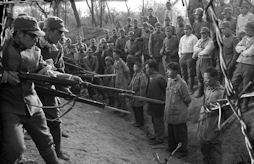
City of Life and Death, Lu Chuan’s third feature film, is set in 1937, during the Second Sino-Japanese War, and deals with what is commonly referred to as the Nanking Massacre. This appalling episode occurred after the Imperial Japanese Army had captured Nanking, at that time the capital of the Republic of China. For several terrifying weeks they killed massive numbers of Chinese prisoners of war and civilians.

The film’s plot centres on a Chinese Nationalist soldier, Lu Jianxiong, with his comrade Zhao, who have been keeping up a guerrilla resistance to the invaders but are themselves captured by Japanese Imperial troops. All the revolutionary soldiers are marched out to the beach to be killed in a mass execution, but Zhao survives, along with a young boy soldier called Ida Xiaodouzi. Both of them flee to the Nanking Safety Zone run Dr. John Rabe, a German business man (and Nazi party member) as well as other Westerners.

Dr. Rabe is ordered back to Germany because his activities with the safety zone are harming the relationship between Nazi Germany and Japan, so the refuge is closed. The Japanese begin to hunt down any men that look like soldiers. Kadokawa, who is in charge of the extermination squad, is undergoing a mental crisis. He releases Zhao and Ida, telling them that life is more difficult than death, then kills himself to escape from his guilt.

The closing credits to this brutal yet life-affirming film reveal that it is in no way fictional. In 2009, Ida Xiaodouzi was still alive. And in the memories of people in the Far East, the Nanking Massacre will never die.


Facelift for Rothesay library

Amazingly, bucking the trend of cuts and reductions to services, Argyll and Bute council has made big improvements to the library in Rothesay, which re-opened to the public on April 26th after being closed for two months of intensive improvement. New mobile shelving to make the space more flexible has been installed, as well as a new ceiling, flooring and lighting.

Pat McCann, Argyll and Bute’s culture and libraries manager, said the new library was a big improvement. ‘The people of Rothesay deserve a modern, user-friendly library, and that’s what they boast now,’ he said.

How does A and B do it? We’re baffled. But must admit, they are going ahead with ‘grouping’ Primary schools so that several of the smaller ones can be closed.


New Boat For Isle of Mull

John Kinsman - Marine Editor

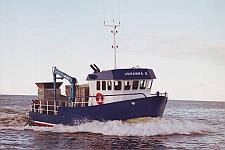
Scottish Boat builders MacDuff Shipyards have announced that they have secured an order to construct a 26.74m General Purpose Work boat for Inverlussa Marine Services, based at Loch Spelvie on the Isle of Mull.

In addition to a mussel farm Inverlussa Marine also operate other vessels, under the direction of Ben Wilson. It is the intention to operate the new boat for coastal cargo,civil engineering and renewable energy support and general towing work. The design of the new vessel as been developed by MacDuff Shipyards, and will provide the construction drawings and cutting information for the steel to be prepared by MacDuff Profilers, which is part of the MacDuff Shipyards.

The new vessel, a twin screw, shallow draft vessel will be able to carry 100 tonnes of deck cargo, but will also have a dry hold and facilities for cargo fuel and water transfer. A 100 tonne/metre combined knuckle telescopic deck crane will enhance the boat’s varied capabilities. She will be powered Two 530HP Doosan engines.

Preparation is now underway for a early start to construction, following the plan approval process. The new order is a welcome news for the continued employment at the Shipyard.


My partner and I have moved house and this can be a stressful time if you have a pet. Moving with a cat in tow can be a worrying time with you wondering if they will run away or be stressed out (just like me). Well moving homes is a stressful time for all concerned including your feline friend who is one of the family.

After the move, he or she will find themselves in unfamiliar territory with lots of strange smells and wonder what on earth has happened. It’s at times like this I wish they could understand English (or Scottish), so you can explain to them what is going on and not feel like a total villain by taking them away from everything they know.

The best thing we can do when moving with a cat in tow is to make the whole experience as smooth and un-scary as possible. So, the house is sold and you have a moving a date, you have booked the removals van and told everyone your new address. But hang on a minute, what about the CAT? What’s going to happen to them on removal day. On the day of the move the last thing to do before leaving your house is move your cat. Pop them in their carrier with a comforting blanket, I found by leaving him till the very last helped him to reduce the stress and also kept the trip as short as possible. But for me and partner Anne it was just a short trip of around ten minutes in the removal van, as we just moved to a new home in our village. And yes all went well and kitty is happy and so are we.


Do bees have more sense than humans?

Bee-keepers all over the world have been worrying about the unexplained deaths of bee colonies, and the loss of these busy insects is of course disastrous news for farmers, gardeners and orchard-owners, since the function of bees as pollinators is vital.

A strange clue was reported by Fiona Harvey in the Guardian recently. The US Department of Agriculture has found that bees are sealing up cells filled with pollen if they find them to be contaminated with pesticides. The pollen is normally used to feed young bees, but their elders are deliberately putting polluted cells out of use. Dr Jeff Pettis, an entomologist with a long track record of bee research accepts that bees must be sensing the presence of pesticides and ‘recognising that something is wrong.’ Sadly, their desperate measure often precedes the death of the hive, but it does seem to indicate that bees have identified a potential cause of their destruction. It just remains for humans to exhibit the same good sense.


The value of oldies

If you remember the WVS that was such a big presence in the war years, providing food and refuge for the bombed-out and catering for soldiers on leave, then you’re an oldie. And you probably have a spark of indignation about the way everyone moans on now about the ageing society, as though they expect mass hara-kiri to be carried out so as to leave the field clear for those in their supposedly successful young years. But the WRVS as it now is claims that oldies, far from being the drain that is conventionally assumed, actually add huge value to the British economy through the voluntary work they do. By 2030, a projection shows that this work will be worth £75 billion pounds.

Lynne Berry, WRVS chief executive, calls older people a ‘most extraordinary resource’. The ICM poll carried out for the current study found that 65% of retired people contribute voluntary work, and already benefit the economy to £175 billion. So let’s hear it for the oldies, who quietly work their socks off in the service of the big (or small) society.


From Arran to Canada

Jim Henderson

There are few people in today’s Scotland who could cope with the conditions endured by the group from Sannox in a Canadian winter at the end of the nineteenth century. Autumn was well advanced by the time they had been allocated land, and there was barely time to start clearing the forest and building log cabins before winter set in. Every man and woman had to work brutally hard. The terrain was rough, with no established roads, and in the first years the settlers had no horses or oxen. Everything had to be hauled and carried by hand. Their strength and determination to succeed and provide provisions for their families showed a physical prowess that would probably be impossible for our current generation to achieve.

Their settlement, called Inverness, was about 20 miles from Quebec, through rough scrubland and forest. The return journey of some 36-40 miles often took over a week but the need for basic supplies and trade meant it was essential, even in the depth of winter. In addition to provisions such as maple sugar, butter, and cheese, they needed crockery, clothes, slates and learning books for the children, calico, hardware, seedlings for the gardens and medicines. When they started to get some farming established, they took pork, home made flour, hides, poultry etc., to trade in the market - and it all had to be carried by hand. Often on the journey the only sustenance was boiled potato.

Even more local journeys were daunting by today’s standards, and the women often completed tasks that most people would find challenging. One of them carried a bushel of wheat to Lambie’s Mill 11 miles away, waited until it was ground and returned with the flour on the same day having completed a walk of 22 miles. A bushel is a cubic measure of 8 gallons.

John Sillars who emigrated on the ‘Newfoundland’ carried a quintal of flour (112 lbs) from Quebec via St Nicholas to the settlement at Lac Joseph. Mr & Mrs William McKenzie, who emigrated on the ‘Foundling’ in 1831, walked to collect a quintal of flour from the town of Leeds - a journey which meant fording a river called the Thames, which had no bridge. On their return the river had flooded and they were up to their chests in water as they forded it, each of them carrying 56 lbs of flour on their heads to keep it dry.

Altogether, the early months at Lac Joseph were extremely hard and not unnaturally, some of the Arran settlers did not survive the conditions, dying from catching fevers or the extreme cold. Their one advantage was that their background of sheep rearing meant they had brought with them good woollen clothing, which helped to ward off the extreme cold. Once they were able to begin raising sheep in Megantic County, the women with their spinning wheels were able to provide new clothing for the community.

Despite the desperate conditions in which they lived - or perhaps, because of them - religion was important. From the earliest days, the little community worked together to construct a church building approximately 8 metres square with a lean-to at the rear to accommodate the minister. The first minister was the Rev. Donald Hendry, who emigrated in 1831. His sermons were preached in the Gaelic and lasted for about 3-4 hours every Sunday afternoon with a short service on Thursday evenings. Having no horses or oxen in those early days, the congregation, who were regular attendees, walked to the church. Some covered a distance of 7 miles each way. Often the younger generation, dressed in their Sunday best, would walk barefoot, only putting their socks and shoes on when approaching the church. This was done to reduce wear on the shoes.

The Arran settlers were strong, hardy and practical - but they might not have survived without the help of the Abenaki Indians. There will be more about the Abenaki in next month’s Voice.


Today’s Canadians blast RBS over tar sands

Since its public bail-out in 2008, the Royal Bank of Scotland has raised more than £5.6 billion for companies involved in controversial Canadian tar sands projects, and Canada’s First Nations sent representatives to the RBS AGM in Edinburgh last month to insist that the bank must cease financing tar sands companies.

Many First Nations communities are fighting the extensive tar sands as well as the proposed 1,170 kilometre long Enbridge Northern Gateway pipeline from Alberta to the British Columbian coast, which will pass through the territories of 80 First Nations, all of whom are opposed to it.

The tar sands extraction projects on tribal lands in Alberta, have been described as the most destructive industrial project on the planet. An area larger than England is being excavated by the industry. The Athabasca river delta, once a pristine boreal forest with clean rivers and lakes, has become a devastated ecosystem of deforestation, open pit mines and toxic ‘tailings’ ponds. Fish in nearby waters regularlyexhibit tumours and birds landing on contaminated tailings ponds die. In neighbouring First Nations communities, where local people have hunted and fished for many years, abnormally high rates of cancer and immune system diseases are now being found.

Clayton Thomas-Muller, from Mathias Colomb Cree Nation, representing the Indigenous Environmental Network, said: “Banks in Canada and in the US have been put on notice for their dirty finance of the Canadian tar sands which is resulting in the destruction of First Nations Peoples’ way of life. The UK’s RBS, being a majority publicly-owned bank, should be under the greatest scrutiny for its involvement.”


Where can I see … ?

Red deer, red squirrels, seals, adders, otters where is the best place to see these animals on Arran? What is the best time of year to see basking sharks? How can I tell a buzzard from a golden eagle? What are the best months for wild flowers on Arran? What is the best weather to look out for common lizards?

“Where can I see … ?” is the latest publication from the Arran Natural History Society and has the answer to these questions and many more. This definitive guide produced by members of the society on where to find some of Arran’s best wildlife, is a must for anyone interested in responsible wildlife watching.

This excellent booklet, replacing the earlier leaflet with the same name, is available from Arran Active and many other outlets throughout the island. It is crammed full of useful information. Look out for the eye catching cover designed by Arran Graphics.

You can visit the “Arran Birding” website here.


Reader’s letter

John Sillars writes to point out that protests about the hike in concessionary fares have been misdirected.

In June2005, the Scottish Parliament passed the Transport (Scotland) Act 2005. This act allowed the creation of statutory Regional Transport Partnerships, and charged those partnerships with the production of Regional Transport Strategies - including ferry services. In January 2006, the new national transport agency, Transport Scotland, was then charged by Scottish Ministers with providing significant services including the national concessionary travel scheme.

Consequently, when SPT asked the then Transport Minister Stewart Stevenson on March 15th 2010 to incorporate lifeline ferry services into the National Concessionary Travel scheme and he refused, the writing was on the wall for Arran’s previously free ferry fares.

However, Scottish Ministers still had two choices, had they wished to keep fares free for the over sixties. They could have told CalMac to absorb the costs of retaining free fares - as Western Ferries did on the Gourock-Dunoon route - or they could have increased the subsidy to CalMac to cover the costs. As we know, they did neither and free fares were no more.

The buck for the new charges, therefore, rests not on Mr. McLellan’s desk at the SPT in Glasgow. It is lodged very firmly on the Scottish Transport Minister’s desk in Edinburgh.

Yours sincerely,
John Sillars,
Fasgadh,
Brodick.


Assja’s Green Space

Assja Baumgärtner contributes a regular column on whatever green ideas have tickled her fancy during the month.

Lent - and healthy eating

All cultures, regardless of their religious background, set aside a time of fasting and contemplation in their yearly cycle. In Europe with its Christian background it has been the time of Lent, though the same practices were well established before Christendom spread across Europe. The cynical may point out that the chosen period, at winter’s end, is a time when many foods were hard to come by, but there seems no harm in using a difficult period as a time for spiritual refreshment.

Lent is now generally seen as a time to give up something we usually depend on or love dearly. Groups of students in several parts of Britain have sworn, for instance, to observe the 6 weeks of Lent by abstaining from the use of Facebook or their ipods or gaming consoles.

I decided to be very traditional about it and go for 45 days of not eating meat. Since I am not a vegetarian, it seemed quite daunting, but I wanted to see whether it was possible to get through a month and a half of meatless days without having to endure salivating dreams about steaks and lamb chops. And, too, without an insurrection from the males in the family, a very carnivorous teenager and a hardly less meat-dependent husband.

The amazing thing is that there was not the slightest sign of a palace revolution. On the contrary, the family has discovered dishes they like and want again and again. And I certainly have surprised myself by becoming more and more adventurous in experimenting with the cooking ingredients available. And it really is fun. Don't get me wrong! I'm not spending exorbitant amounts of time in the kitchen trying to invent new dishes. It’s just that after the first five days I have finally overcome the weird idea that I have to replace meat by something that looks or tastes similar. And voilà, dishes like smoked mackerel paella, bean chilli fajitas, potato and apple curry, cabbage leaves stuffed with brown sultana rice on a herby tomato sauce or broccoli and cheese soufflé topped with roasted almonds are visualising before my inner eye and get served a bit later.

But the most amazing thing about the whole Cooking-for-Lent was my check up at the doctor’s this week. For more than a few years I seemed to have some problems with my digestive system and we were wondering whether there were any food intolerances. So I went to my regular check-up, ready for the proceedings of measuring blood pressure, pulse, the usual. Then my doctor asked: “How’s the stomach pain?” And I realised that for at least a week I hadn’t had any pain at all. The next question followed naturally - what had I done that was different? I almost said “nothing” before it occurred to me that I was actually on a different diet altogether. One with far more seasonal vegetables, lots of fruits and salad - and no meat or poultry. A diet rich in fibres, seeds, nuts and vitamins. All else apart, it’s made me feel much more energetic. So - maybe this whole idea of Lent and its predecessors is was not only a religious affair or the result of some foods not being available. It could also have begun as a deliberate cleansing of the body and spirit. Eating no pork in the Jewish and Muslim faiths is a religious requirement but it might well have been because wise men of that time recognised the connection between pork and trichinosis.

However, my butcher need not fear that I will become a complete vegetarian. Although I haven’t had any desperate cravings for mince and sausage, I am still looking forward to roast lamb for Easter. With lots of lovely veggies and a big salad, of course. But I think the idea of having meat every day may have gone for ever.


Website for Arran Community Council

The Arran Community Council has long wanted to establish a website that will enable the Arran public to keep in touch with what issues are being considered. The site will make it easier for people to get in touch with village representatives on the CC, and will provide a forum for questions and opinions. Thanks to the skilled and generous work of John Baraclough and Bill Calderwood, a splendidly flexible, easy-to-use site is being designed, and should be up and running within the next week or two.

Until now the minutes of the Arran Community Council meetings were available here on the Voice for Arran website. With the arrival of the new website an archive of the minutes, going back to October 2008, has been created and they can all be easily accessed on line.


Gardeners are powering up for a ‘blooming’ safe Spring

As the warmer weather lures people into the garden armed with their mowers, strimmers and power tools, Scottish Hydro is warning gardeners that their seemingly harmless pastime could be riskier than they think.

Latest government figures report that an average of 50 people in the UK are killed each year from garden accidents and 300,000 visit Accident and Emergency wards with gardening-related injuries – 6,500 of which alone are caused by electric lawn mowers!

Due to these shocking statistics, Scottish Hydro’s group safety manager Iwan Tukalo is urging local gardeners to take simple safety steps to avoid turning a day in the flowerbed into a week in the hospital bed.

Iwan said: “Using electrical equipment can take the backache out of gardening, but all it takes is a minor lapse in concentration to cut through an electric cable with a lawnmower or hedge trimmer, with potentially fatal consequences. Following our simple checklist should ensure that gardening remains safe and enjoyable.”

Ten simple steps for safer Spring gardening:

  1. Before you start, check that electrical equipment has been stored safely and for frayed cords, broken plugs and cracked or broken housings. If it’s damaged, don’t use it!
  2. Always use a residual circuit device (RCD), a protective switch which cuts off the electricity supply if a fault is detected. This simple piece of kit provides extra protection against electrical shocks – and for just a few pounds can save your life!
  3. Never use electrical equipment in wet conditions or when it is raining.
  4. Always wear gloves, stout shoes and eye protection.
  5. Never clean, adjust or check equipment while it is connected and DO NOT clear grass from a mower without switching it off and removing the plug from the socket.
  6. Do not leave electrical equipment plugged in while unattended.
  7. If the flex is cut, always remove the plug from the mains socket before touching the flex – even when a RCD is fitted.
  8. Never carry ladders in the upright position underneath overhead lines.
  9. Look up before you start cutting hedges or trees. If overhead power lines are nearby, contact Scottish Hydro for advice before carrying out any work.
  10. Before digging any deep holes in your garden, check where underground electricity cables are located. Scottish Hydro can provide plans of these for free.


Arran Visual Arts Summer Show at Kilmory Hall

As ever, this exhibition shows Arran’s incredibly active community of artists, working in a wide variety of disciplines. Inevitably, the enchantment of Arran’s natural scenery stimulates a large number of landscapes and studies of the beach and the sea, many of which would merit a place on any wall. These are under-represented in our photos because on a sunny day, glazed pictures reflect patches of light from the hall windows. Among them, David Penn showed atmospheric paintings from a wide travel experience, Helsinki Harbour featuring a working ship in all its rugged capability and Lyon in Winter showing a seductive warmth of stone architecture. Gus Smith has a lively appreciation of the patterns present in things commonly seen and so uncommonly thought about. His Invasion of the Cow Parsley was highly decorative, and in a completely different way, so was his interpretation of the stone patterning in Lerwick Loan, where a flight of narrow steps took on a marvellous brilliance of light and colour. Linda George showed a strangely poetic small picture in which a fast-moving black horse cut its own small pattern into a vast, empty landscape that reached to a high horizon. At the other extreme, Sharon Wedge used the bold technique of linocut to evoke a strong sense of wooded landscape.

Decorative art was, as so often in the AVA shows, a very strong element. The astonishingly talented Marjorie McDougall showed, among other lovely things, a painting on muslin called Nova, where muted faint colours found an intricate balance again a faint indigo background of great subtlety. On the embroidery stand, Betty McCormack’s sumptuous cushion with its soft mosaic of purple and violet and emerald was lit by the glow of metallic fabrics – a delectable thing. Just above it was a felt ring of dusky mauve flowers from Judith Baines, who also showed marvellously inventive combinations of embroidery and dyes to evoke the colours and fading warmth of autumn. There must have been many people who coveted Roslyn Gibson’s hand-spun and woven products, including a glorious wrap with a single pale stripe running through its delicious texture.

Ruth Mae’s little wire horses were so full of life that one felt impelled to give them a second glance in case their tails and manes had blown a little further in an invisible wind, and Susie Thompson showed tiny, delicate ceramic sculptures that held a group of visiting children spellbound. They stared in amazement at minuscule cygnets in a nest no bigger than a teaspoon and a mouse in a thumb-sized boot. At the other end of the scale were the lovely Shaker chairs made by David Samuels. He also made the beautiful musical instrument called a psaltery, with its bow. It lay there on the table in the silence of its potential music, and the evocative stillness of it somehow followed the viewer into the sunshine outside. Big congratulations to AVA for putting together such an enjoyable and stimulating show.

 
Visit the Arran Visual Arts website.

John Inglis

Paintings shown in Corrie

In the last 18 months, John Inglis has produced an impressive quantity of paintings. His show in Corrie Hall ranged through a great wealth of ideas, always showing a quirky sense of amusement and sometimes strangeness. From ships to derelict cars, these paintings are the product of a poetic eye. An Orcadian Mini-van stands abandoned in an indifferent landscape, and people watch a submarine slip by, inhabiting a different world. Someone looks past the pillars of what may be a church or a ruined temple. One of the most literal expressions of strange conjunction is the figure of a living girl lying beside the sculpted tomb image of a long-dead clan warrior.

Purely in terms of painting, Quirang Croft achieves the best clarity of colour and design, though the water-colour sketches piled on a table in the centre of the room have great freshness and simplicity. The oil paintings have the perceptive observation that illuminates the work of the great photographers such as Cartier Bresson, catching a moment of almost inconsequential significance, but the use of the medium sometimes poses a problem. It can on occasion be too heavy and muddy-textured to catch fully the lightness and clarity of the observation that lies behind the picture. However, this work is never less than interesting and intriguing. It rewards the viewer with fresh ideas and shrewd, often wry observation.

Click on either image to see more.


100% Renewables for Scotland

Is it possible?

Professor Stephen Salter and seven leading businessmen publicly backed the plans to supply all of Scotland’s electricity needs through renewables by 2020. Earlier this year Professor Salter was awarded the inaugural Saltire Prize medal recognising his outstanding role in the development of marine renewables. His endorsement comes on the back of the support the 100% renewables target received from industry leaders and environmental groups.

Professor Salter said: “It is right to say that Scotland can generate more electricity from renewable energy than it uses. We can also produce enough electricity to drive plant to synthesize liquid fuels and gas. We have vast renewable resources in Scotland, especially around our shores. Coupled with decades of engineering excellence and a strong industrial base, Scotland will become a clean green energy hub.

There have always been those who doubted our capacity for generating our electricity needs from renewables. I find that lack of ambition depressing and even a threat to this massive opportunity. Meeting the target by 2020 is ambitious. Success will depend on many factors, not least political leadership but they are achievable and exactly the kind of targets which should be set.

We are only starting to tap into the vast potential of our seas such as offshore wind, wave and tidal energy and should absolutely aim for the equivalent of 100% by 2020.”

Niall Stuart, Chief Executive of Scottish Renewables added: “We welcome the ambition and continued commitment to maximising renewable investment in Scotland. This pledge gives investors certainty and will help attract more developers and manufacturers to Scotland. It’s ambitious but can be achieved with the right market framework, investment in grid infrastructure and skills, and the right balance in the planning system.”

Ignacio Galán, Chairman and Chief Executive of Iberdrola, whose company owns Scottish Power Renewables said: “Scotland is at the forefront of the renewable revolution. It is entirely credible that Scotland will produce 100% of its own electricity requirements from renewables by 2020 as well as continuing to produce power from a range of other sources. Iberdrola will play a key part in providing the investment required to bring that power into production.”


Youtube and other videos

A musical phenomenon, …


… a word from one of our advertisers and …


… finally a selection of shots from the recent Mochara concert by Arran Events CIC.