

We find ourselves in a new political landscape. Our MP for the last ten years, Katy Clark, whom many thought an admirable constituency MP and a radical and principled member of the Labour Party, has been swept away in an SNP landslide that has changed the political face of Scotland. The island’s new representative in Westminster is Patricia Gibson. The Voice wishes her well and will be keeping a close eye on her effectiveness, particularly in all matters green.
Due to health problems, our usual editor has been able to contribute less this month, and everyone on the Voice is immensely grateful to Alan Bellamy, who has edited and compiled this issue.

Virginia Rushton
Many people on Arran will have fond memories of Virginia Rushton, who died of cancer last week. Virginia ran a community opera company called OperaHouse and came to Arran several times to work on creative projects that ranged from ‘instant opera’ to a detailed voice production workshop for adults.
Virginia herself had a glorious soprano voice but, characteristically, was more interested in sharing her knowledge and expertise than with solo performance. On Arran, together with the composer Andrew Keeling, she worked with children from all round the island to create and perform in a production called 'Arran Ferry Tales’ in a single week - a task that would have seemed impossible for anyone less talented and generous. In some miraculous way, Virginia shared her own energy and confidence with children who were often startled and suspicious at the beginning of the project but quickly warmed to her. She had an infectious belief that all human beings are inherently creative, and a practicality that over-rode all difficulties. On Arran, confronted by a rebellious girl who said she wanted nothing to do with the proposed project, she said, “That’s fine - you can be the person who wants to wreck the whole show - OK?” And it was OK. The girl ended up confiding that her family had only just come to Arran, and managed to join in and enjoy herself. Virginia never argued and never scolded, and managed to make the project in hand so fascinating that everybody ended up getting deeply and enjoyably involved.
Creating operas wherever she went, often in a ridiculously short time because of limited funding, Virginia had a magical ability to share energy and vision. I worked with her on many of these, including a piece called The Wind on the Moor, constructed by mostly Muslim children from schools in Bradford. They came to the Brontë village of Haworth with some suspicion, but in the end, gave a performance in the church that moved the audience to laughter and something close to tears.
Virginia was a magical person. I feel privileged to have worked with her on so many projects and to have enjoyed her company as both colleague and close friend.
Alison Prince
Guitarist at Music Society concert
Gordon Ferries is deservedly well-known as a player of early, almost historic guitars. On Saturday May 16th he gave a concert in Brodick Hall that was very unusual. The guitars he played were narrow-bodied, with a sweet, quiet tone that did not carry very far, so by the interval, listeners were shuffling forward like curious meercats.
The first half of the recital was based on early music of the 17th and 18th centuries, while after the interval Gordon played compositions by Johann Kasper Mertz, who lived in the early 19th century. Listeners agreed that it was fascinating to hear the guitar played in its historic early form, very different from the full-toned, broad-bodied instrument of our own time.
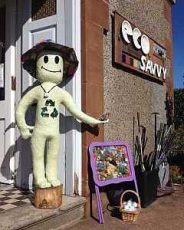
Eco Savvy’s first year
Just over a year ago, in April, a small group of people began to prepare a long empty shop in Whiting Bay for opening. This involved hours of cleaning, scraping, upcycling and painting. Thus began the Eco Savvy Community Shop, and the Eco Savvy Community itself: an Arran-based group, which aims to identify and accomplish environmental projects. These should benefit the community and support sustainable living, including working towards zero waste for Arran.
Start-up was achieved with a donation of £100 in the bank, a gift of a few rent-free weeks from the landlord and absolutely no grants or subsidy. The shop sells a wide range of donated goods as well as more valuable items to be sold as ‘second chance’, with a share for both Eco Savvy and the seller. Best of all the shop seeks to sell upcycled items; people all over Arran apply their craft and imaginative skills to unwanted or worn out objects, lovingly turning them into objects of beauty or with a new use.
The shop had a very busy summer with much appreciation from islanders and visitors. Members flooded in - currently over 350 - and new volunteers stepped forward. Slowly as the shop settled into its busy routine, other wider tasks were begun, such as outreach to schools, encouraging them towards environmental green flags, and Skills Sharing events. These have been held regularly, allowing anyone with a skill to share or learn - from knitting to bicycle repair - to meet with others, in a sociable atmosphere, accompanied by tea and cake. The emphasis here is on finding enjoyable ways of outwitting cultural pressure to buy, consume and discard. In Spring 2015, skills sharing focussed specifically on teaching crafts for the Woollen Woods project: knitting, felting, crochet etc, encouraging the use of old materials, aged jumpers and unwanted blankets.
Eco Savvy has held an evening of fun and glamour, but also a serious, waste reducing purpose, the Fashion Show, where previously hidden talents as supermodels were astonishingly revealed. There have been auctions, and a Pop-up Shop for second chance clothes and shoes. In all its work, Eco Savvy aims to support islanders to pass on, re-use or re-home items which might otherwise end up in landfill.
As the first year ended thoughts began to turn towards future developments. Discussions about developing a community garden on a field in the Arran Community Land Initiative led to Eco Savvy’s funding a 2 day Introduction to Permaculture course in late April, led by Lusi Alderslowe and open to both Eco Savvy and ACLI. Permaculture offers an ethos very much in tune with Eco Savvy’s waste nothing aims and its ethics focused thinking on Earth care, People care and fair shares. It is an approach which seeks to learn from natural processes,, working with the givens of climate, aspect, soil, and will serve Eco Savvy Community gardeners well as plans for the garden take shape.
Throughout this first year, volunteers have developed ways of working together, with a small working group forming to carry out the main tasks and regular Volunteer meetings for updating the wider group and shaping policy by means of discussion and forums. The working group at the heart of the project is open to anyone who wants to be involved and one of the most heartening aspects of the first year has been to discover what a diverse range of skills, talents and creative ideas are available when given space for expression. Eco Savvy is currently negotiating for recognition as a charity and three trustees are in place to take this forward, but the strength of the project lies in its wide base of enthusiastic and creative volunteers.

Christine Bovill’s Piaf Centenary Tour
Christine Bovill has built her reputation on her interpretation of classic 20th Century songs. The former Secondary teacher of English and French turned to a full-time career in singing and song writing with the release of Derby Street, her first album and BBC Scotland’s Album Of The Week. Always devoted to the power of the lyric, she was winner of Glasgow Songwright Festival with Lighthouse Keeper in 2007. Born in Glasgow to a family of musicians, a chance discovery of some old jazz vinyl would shape Christine’s beginnings in cabaret. She would go on to write two hugely successful shows based on the life and work of Billie Holiday and Edith Piaf.
Last week (23rd May) Brodick hall by candle light and BYOB were the setting for a magical evening with Christine Bovill and “Piaf”. A combination of narrative about Piaf’s life, loves and career, interspersed with a selection of her famous songs. Bovill’s beautiful, expressive voice held the audience for two hours, in a performance that was both intimate and powerful.
Whiting Bay Drama Club rides again
Zoe McGovern reports that several new members have joined the Whiting Bay Drama Club, and it is hoped to enter the one-act play competition early next year. If anyone is interested in joining this well-established and talented group, just give Zoe a call on 700406.
Kaspar Hauser at Corrie Film Club
The Corrie Film Club’s offering for June 14th in Corrie Hall at 8.00pm is Kaspar Hauser, made in 1974 in Germany by Werner Herzog.

Trident security concerns raised by whistleblower
Residents and visitors on Arran are used to seeing the chilling shapes of submarines passing the island, but now the defence secretary, Michael Fallon, has been urged to investigate a catalogue of alleged security failings around the Trident nuclear programme exposed by a Royal Navy whistleblower.
Brendan O’Hara, the Scottish National party MP for Argyll and Bute, which includes the Faslane submarine base, said that the security lapses described by Able Seaman William McNeilly appeared to be “extremely worrying” and merited further investigation.

COAST’s Howard Wood wins Goldman Environmental Prize
Howard Wood, chairman and co-founder of COAST has been awarded the highly prestigious Goldman Environmental Prize for his work with COAST promoting sustainable management of Arran’s seas. It is the first time this international award, the largest prize for grassroots environmentalists worldwide, has come to Scotland and only the second time it has been made to somebody in the UK.
Howard Wood moved to Arran with his family when he was a teenager. A keen diver, he witnessed first hand the impact dredging had on fragile marine habitats. In 1995 he established COAST with his friend Don MacNeish to champion sustainable management of marine resources for the benefit of all. The organisation has now grown from being entirely staffed by volunteers, to having two dedicated employees.
Co-Founders of COAST
Stop dredging and bottom trawling in Scotland’s MPAs
Dredging for scallops and bottom trawling for prawns destroys seabed habitats and fish spawning and nursery grounds which prevents fish stock recovery. This is similar to clear felling a rain forest for short term gain. Scotland’s newly created Marine Protected Areas deserve full protection from these destructive activities which many countries ban completely in their inshore waters. At present the Scottish Government is proposing to allow these activities within large sections of the MPA network designated last year. It is important the Scottish Government realises that this is not acceptable and takes action to prevent continued seabed habitat degradation. MPAs are an important first step towards this goal.
Click here to sign the petition.

Scottish Opera announces 2015/16 season
Scottish Opera has announced details of its vibrant new season, showcasing seven powerful operas featuring drama, romance, fairy-tale and comedy. Welcoming back a host of talented cast and creatives from recent years alongside some exciting new faces, and spanning four centuries in four languages, the season features ten shows, two world premieres, six new productions and 111 performances in 46 venues across 41 towns over the next 12 months.
As always, the Company will tour extensively as part of Scottish Opera’s commitment to bringing top-quality opera to communities across the length and breadth of Scotland. Throughout the Autumn, while Carmen plays for audiences in Glasgow, Edinburgh, Aberdeen and Inverness, a new production of Mozart’s Così fan tutte will roam to 19 smaller venues in the far flung corners of Scotland. Directed by Lissa Lorenzo, the piano-accompanied production will transport audiences to 1950s Italy in a stylish and romantic retelling of one of Mozart’s best-loved operas. Showcasing some of the best young singers around, this production features Emma Kerr and Jennifer France, both Scottish Opera Emerging Artists. In its 22nd year of touring, Opera Highlights will visit a further 18 even smaller or remoter venues across Scotland.

The drug that’s meant to save Salmon but is killing the creatures on the Ocean floor.
A disturbing recent report from Rob Edwards in the Sunday Herald.
A toxic drug fed to caged salmon in Scotland is due to be withdrawn from the market after scientists found that that it can leak into lochs and kill crabs, shrimps and lobsters.
Food pellets laced with a chemical called teflubenzuron have long been given to farmed salmon around the coast in order to control sea lice infestations. The lice eat salmon, killing them or stunting their growth, and can cause multi-million-pound losses for fish farmers. But salmon excrete the chemical, which then pollutes the seabed around fish farms at levels than can be lethal to marine wildlife. Shellfish are poisoned and prevented from making new shells to protect them as they grow.
Now the Scottish Environment Protection Agency (Sepa) says it has persuaded the company that markets the drug to withdraw it. Campaigners, however, warn that replacement drugs could do just as much harm, and are demanding a much broader legal ban.
The latest research on teflubenzuron was conducted by scientists from the Institute of Marine Research and the National Institute of Nutrition and Seafood Research in Bergen, Norway. They detected high concentrations in sediment around a salmon farm on a fjord north of the city. They estimated that it took 170 days for the teflubenzuron pollution to reduce by half, suggesting that it will persist in the marine environment for years. The drug was found in most of the wildlife they tested, including worms, crabs and fish. In a study published in the journal, Science of The Total Environment, the researchers concluded that the levels in king crabs, shrimp and two species of lobster were high enough to kill them as they naturally shed and replace their shells. Teflubenzuron is designed to prevent animals from making chitin, a tough cellulose material vital for renewing shells.
Teflubenzuron has been regularly used on salmon farms in Scottish sea lochs along the west coast and on islands for years. According to Sepa, environmental quality standards for the drug were breached once in 2011, six times in 2012 and six times in 2013.
Photo - © Richard Dorrell

Joint call on affordable homes
Four national charities, including Scottish Churches Housing Action, have written to Margaret Burgess MSP, Minister for Housing and Welfare, with a joint call to set an ambitious target for new affordable homes across Scotland. Shelter Scotland, Homeless Action Scotland, Rural Housing Scotland and Scottish Churches Housing Action all believe that the next Parliament, following the 2016 Holyrood elections, should see an upswing in provision of homes for those in need. This is a particular issue on Arran.
“During the Westminster election campaign,” says Scottish Churches Housing Action Chief Executive Alastair Cameron, “the First Minister called on the UK Government to set a target of 100,000 new affordable homes a year across Britain. This would imply about 10,000 new affordable homes in Scotland each year, creating employment opportunities as well as meeting housing need. Housing investment is a devolved matter, so Scotland’s contribution to meeting this target needs decisive action at Holyrood.
“We agree that austerity government is not the way forward; we look forward to seeing the Scottish Government build our way to a better future for young people seeking a home, for people who need to move to take up work, and for families and individuals stuck in homelessness”.
The Scottish Government’s current target for affordable housing in Scotland is 30,000 new homes - or 6,000 per year - over the five years of the current Parliament, 2011-16. The four organisations believe that targets set by the next Scottish Government should be more ambitious.

IMF says fossil fuel companies are benefitting from global subsidies of £3.4tn a year
Fossil fuel companies are benefitting from global subsidies of $5.3tn (£3.4tn) a year, equivalent to $10m for every minute of every day, according to a startling new estimate by the International Monetary Fund.
The IMF calls the revelation “shocking” and says the figure is an “extremely robust” estimate of the true cost of fossil fuels. The $5.3tn subsidy estimated for 2015 is greater than the total health spending of all the world’s governments.
The vast sum is largely due to polluters not paying the costs imposed on governments by the burning of coal, oil and gas. These include the harm caused to local populations by air pollution as well as to people across the globe affected by the floods, droughts and storms being driven by climate change.
Nicholas Stern, an eminent climate economist at the London School of Economics, said: “This very important analysis shatters the myth that fossil fuels are cheap by showing just how huge their real costs are. There is no justification for these enormous subsidies for fossil fuels, which distort markets and damages economies, particularly in poorer countries.”
Lord Stern said that even the IMF’s vast subsidy figure was a significant underestimate: “A more complete estimate of the costs due to climate change would show the implicit subsidies for fossil fuels are much bigger even than this report suggests.”
The IMF, one of the world’s most respected financial institutions, said that ending subsidies for fossil fuels would cut global carbon emissions by 20%. That would be a giant step towards taming global warming, an issue on which the world has made little progress to date. Ending the subsidies would also slash the number of premature deaths from outdoor air pollution by 50% - about 1.6 million lives a year. Furthermore, the IMF said the resources freed by ending fossil fuel subsidies could be an economic “game-changer” for many countries, by driving economic growth and poverty reduction through greater investment in infrastructure, health and education and also by cutting taxes that restrict growth.
Another consequence would be that the need for subsidies for renewable energy - a relatively tiny $120bn a year - would also disappear, if fossil fuel prices reflected the full cost of their impacts. David Coady, the IMF official in charge of the report, said: “When the [$5.3tn] number came out at first, we thought we had better double check this!” But the broad picture of huge global subsidies was “extremely robust”, he said. “It is the true cost associated with fossil fuel subsidies.”
Meanwhile, the University of Oxford has ruled out future investments in coal and tar sands from its multi-billion pound endowment, but said it would not divest from all fossil fuels as demanded by thousands of students, academics and alumni. Campaigners welcomed the move as a victory for the fast-growing fossil fuel divestment campaign, as it was the first time the university had made clear its position on the issue. “Many world leaders have studied under Oxford University’s spires,” said Andrew Taylor, at campaign group People & Planet. “They should be taking notes today. The lesson is: it’s time to phase out coal and axe tar sands.” The university follows over 200 other organisations who have banned some investments in fossil fuels because of their role in driving climate change.
However, Oxford University said it does not hold any direct investments in coal and tar sands and its announcement contained little on new investment policies. The university’s failure to commit to divestment from all fossil fuel companies means 70 alumni, including green energy entrepreneur Jeremy Leggett and journalist George Monbiot, will be handing back their Oxford University degrees.
Bridge Challenge
South to make seven clubs. West leads the ♠10.
Poem of the Month
Selected by David Underdown, who also supplied the footnote.
Toad
By Norman MacCaig
Stop looking like a purse. How could a purse
squeeze under the rickety door and sit,
full of satisfaction, in a man’s house?
You clamber towards me on your four corners -
right hand, left foot, left hand, right foot.
I love you for being a toad,
for crawling like a Japanese wrestler,
and for not being frightened.
I put you in my purse hand, not shutting it,
and set you down outside directly under
every star.
A jewel in your head? Toad,
you’ve put one in mine,
a tiny radiance in a dark place.
Scotland’s Charity Air Ambulance
Four women from Jura, who were badly injured in a car crash on the mainland last year, have raised nearly £19,000 for Scotland’s Charity Air Ambulance (SCAA).
The country’s only charity-funded air ambulance was among the emergency resources deployed to the accident near Inveraray on April 6 where Denise Rozga, Louise Muir, Deborah Bryce and Abi Beatall were all injured.
As the women recovered back on Jura, they vowed to show their appreciation for the emergency services teams who had helped save their lives - holding a fundraising thank you dinner dance on the island. Denise and Louise made the journey to SCAA’s Perth Airport base recently to present a cheque for £18,816 to the lifesaving team.
SCAA Chairman John Bullough said the charity was “overwhelmed” by the commitment and generosity of the four women and the people of Jura.
“This is by far the largest donation SCAA has had from any appreciative patients through a community fundraiser,” he said, “and for it to come from one of the country’s smallest and most remote communities is even more touching. This support will help SCAA to continue flying time-critical expert paramedic help where it is most needed and allow our team to fly patients to hospital with lifesaving speed - we can’t thank the girls from Jura enough and we’re delighted they are all recovering well.”
SCAA was launched in May 2013 and has responded to over 550 emergencies across the whole of Scotland.
SCAA receives no Government funding and is supported solely by the public, trusts, companies and foundations, who raise the required funds to keep the popular charity in the air.
Click here to visit the SCAA website.

Crossword
Across
1 No.1 best fruit (3,6)
6 Invite advance (3)
8 Officer loses heart with one eastern native (5)
9 Disney song about bird trapped between bricks (3,2,2)
10 Work in metal is not right. Just a thought.... (10)
11 Move her with my round, to get this like sound (5)
12 Novice in bed - blockhead! (4)
13 If returning, be initially prepared to make up (3)
14 Note setter’s reputation (4)
16 Best with top - without, it’s cut (5)
20 Everyone has six balls before covering! (7)
22 Transport company for Cockney fringe? (7)
23 Singer involved in some rotten oratorio (5)
24 Initially, a ‘Yes’ election? Yes (3)
25 No double hundred for bachelor (9)

Election 2015: MP thanks voter for penis ballot paper mark
The BBC reported that for some the phrase “put a mark next to one candidate” is open to interpretation, especially to one voter who drew a penis on their ballot slip - only for the vote to count.
Returning Conservative MP Glyn Davies held onto the Montgomeryshire constituency in mid Wales after getting 45% of the votes. But the 71-year-old said the best part of his election night was the spoiled ballot paper.
Mr Davies wrote on his Facebook page: “One voter decided to draw a detailed representation of a penis instead of a cross in my box on one ballot paper. Amazingly, because it was neatly drawn within the confines of the box the returning officer deemed it a valid vote.”
“I’m not sure the artist meant it to count, but I am grateful. If I knew who it was, I would like to thank him (or her) personally.”
Kidnapped baby elephant reunited with mother after years apart
Alicia Graef at Care2 reports that after being torn from her mother’s side for a life of slavery in Thailand, a young elephant named MeBai has finally been freed and reunited with her mother after more than three years apart.
Little MeBai was taken from her mother when she was just three-years-old to go through the “training crush.” National Geographic describes this brutal practice as a centuries-old ritual intended to domesticate young elephants through pain and fear, where they’re subjected to beatings and deprived of sleep, water and food to break their spirits and make them more submissive to their owners.
According to the Elephant Nature Park (ENP), when MeBai’s training was done, her owner hired her out to a tourist camp to be used in a mahout training program and used to give tourists rides. Sadly, she stopped eating and became too thin to work. Thanks to the efforts of the ENP and its founder, Lek Chailert, her owner decided to let her go to the organization’s Pamper A Pachyderm program, which takes in elephants from trekking programs for rehabilitation.
Soon after taking her in and helping her overcome her fear of humans, her caretakers discovered MeBai’s mother Mae Yui was at a nearby tourist camp and they then convinced Mae Yui’s owner to allow her baby to visit.
Workers and volunteers embarked on a four day journey escorting MeBai by foot to bring the two back together. Despite the years they spent apart, it’s clear that neither one forgot the other. In an update, Chailert said the two were shocked and stood quiet for half an hour before they began to touch and talk non-stop to each other.
Needless to say, everyone involved is thrilled with the outcome for these two elephants. ENP wrote:
Imagine her many nights filled with panic and fear, a child alone, injured and confused, for three and half years she stood in the rain and the sun without her mother, for three and a half years she entertained the human need for subservience.
Now she enjoys the companionship of her mother - she feels like the little baby again. She feels safe when she sleeps, because her mother stands over her. She sleeps deeply and snores loud in the jungle. Some times she wakes up and tries to drink milk from her mother’s breast. It is such a beautiful moment.