

The CalMac strike on Friday 26th June caused inconvenience and more to both islanders and visitors. It is a reminder, if ever we needed it, of how much we are reliant on the ferry. It is also a reminder of why good industrial relations, as they are traditionally called, are so important. We have got used to financial factors, such as high profits and low costs, being considered the most crucial aspects of running services. But if we forget that services are run by people, for people, we end up with exploitation. A strike is an indication of failed relationships. Everyone involved in this mess, from top to bottom, needs to reflect on that.

Dredger Ban for South Arran Marine Protected Area
and other west coast MPAs
The Voice and COAST congratulate Richard Lochhead on listening to coastal communities, marine scientists and economists.
In a broadly welcome statement Richard Lochhead, Cabinet Secretary for Rural Affairs and the Environment, announced yesterday that a Marine Conservation Order (MCO) will be put before parliament this week setting out conservation measures including banning the highly destructive practice of scallop dredging within the South Arran Marine Protected Area and other west coast MPAs. COAST has campaigned hard to end this damaging activity in Arran’s MPA which was designated in 2014 and we congratulate the Minister on listening to coastal communities, marine scientists and economists on this issue.
However, while Marine Scotland’s MCO goes some way to meeting the key objectives outlined by COAST for its community-led South Arran Marine Protected Area, it will still permit bottom trawling within significant areas of the MPA. They also propose to allow continued bottom trawling in the Upper Loch Fyne MPA. COAST will continue to press for an end to this practice during the one month consultation period and will also work with Scottish Environment LINK’s ‘Don’t Take the P’ campaign to ensure the best management possible for Scotland’s other 29 MPAs.
In collaboration with a number of other west coast communities the community on Arran is working incredibly hard to ensure local waters are effectively and equitably managed. For many decades now our inshore waters have been managed almost solely for the benefit of dredgers and bottom trawlers in one of Europe’s worst cases of regulatory capture (a situation in which a commercial vested interest effectively writes its own regulations with government acquiescence). This has been a disaster for the Clyde and the wider fishing community, particularly creelers, who represent the vast majority of inshore fishermen.
COAST’s Executive Director Andrew Binnie says: ‘Mr Lochhead and senior staff at Marine Scotland are to be applauded for taking one of the first concrete steps towards achieving a healthy and productive Clyde by 2020. The Clyde’s MPAs have a significant part to play in achieving this vision and the removal of dredgers from the Arran MPA is very positive. While we have real issues with the continuation of bottom trawling in the outer areas of the MPA and within Upper Loch Fyne we will be working with Marine Scotland to resolve these during the one month consultation period.’
Howard Wood, winner of a Goldman Environmental Prize and COAST’s Chair expressed surprise at the Scottish Fishermen’s Federation (SFF) sudden lack of support for the Marine Conservation Orders after earlier declaring themselves supportive of MPAs.
‘It is clear that all stakeholders have had to make compromises as we are being asked to do and we had expected the SFF to show enlightened self-interest at this late stage in the process. It should be obvious to everyone that healthy productive seas will be a huge benefit to all marine stakeholders.’

Mr Happy even happier: Howard awarded OBE
It has been quite an eventful few months for COAST chair, Howard Wood. Following on from the Goldman Environmental Prize he then featured in the Independent on Sunday’s Happy List. An anonymous person kindly sent Howard a tee shirt which says it all!!
Then, COAST was delighted and proud to hear that Howard had received an OBE in the Queen’s Birthday Honours list. Howard says, “It is a tremendous honour which would not have been possible without the hard work and effort of all the many, many colleagues and people who have been involved with COAST over the years and also the continuing support of the local community and farther afield. I would like to take this opportunity to thank everyone for their support and for their good wishes, often relayed via my wife, Lesley, who says I have no choice but to buy her a new outfit!
The recognition of the importance of the Marine Environment, by the establishment, is heartening and hopefully will further the objectives of COAST. It is also encouraging, that the voices of local communities are beginning to be listened to. After many years of frustratingly slow progress, we are now starting to see the Scottish Government make constructive changes and accept that they are managing the seas for everyone. This award strengthens the resolve to work towards achieving a healthy marine ecosystem which is properly managed and creating sustainable fisheries for future generations.”
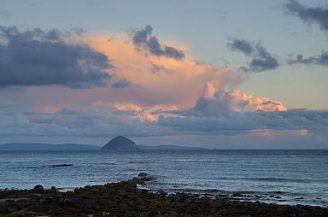
Unique mapping project to capture the sounds of the Scottish coastline
The public is being asked to record the sounds that shape and define our relationship with the coast around the UK in a three-month crowd sourced sound project – ‘sounds of our shores’ – being launched today by the National Trust, National Trust for Scotland and the British Library.
Sounds of the Scottish coastline can be uploaded on to the first ever UK coastal sound map, hosted on the British Library website. These might include the unmistakable calls of kittiwakes, the clamour of seals or the tidal echoes from sea caves. All of the recordings will be added to the British Library Sound Archive – capturing for all time soundscapes from the beautiful and diverse UK coastline that future generations will be able to hear.
Forestry extraction working group
At the Arran Community Council meeting on April 28th there was a proposal to set up a working group on Arran forestry activities. This was agreed, and The Voice has been asked to include the following statement:
“The group has been set up and the first meeting was held on May 21st under the Chairmanship of Ricky McMaster (Chair ACC). Other WG members are Neil Arthur and Liz Evans, both ACC members, Lorna Gunaydi and David Price, local residents, Gus McLeod of North Ayrshire Council and Jim Lauder and Andy Walker of the Forestry Commission.
The remit of the WG is to critically review and advise the Forestry Commission on its strategic objectives for timber extraction on Arran and evaluate all proposed options.”
Gillian Maitland at Brodick Hall
A fascinated audience met in Brodick Hall on Saturday, June 20th, to hear a recital on marimbas, both large and small. The large instrument was the length of two pianos side by side, with big keys made of Honduras rosewood, delivering a clear, ringing sound that was immensely attractive. Gillian Maitland, despite the results of a bad traffic accident that left her with a badly damaged leg, proved herself to be a stunning virtuoso.
With two drum sticks in either hand, she produced an almost choral sound of great richness, and delivered a varied programme that was much enjoyed. At the interval, she was besieged by people wanting to know more about the instruments, and was generous with her explanations. Both technically and musically, it was an intriguing and fascinating evening.
Ida at Corrie Film Club
The Corrie Film Club’s offering for July 12th in Corrie Hall at 8.00pm is Ida.

Imagine a feudal country where 432 families own half the land. Welcome to Scotland.
In a fascinating article in the Independent, Jonathan Brown has looked at land ownership in Scotland. He says “Their lineages date back to before the time of the Stuart kings whilst their farms and sporting estates sprawl across vast swathes of some of the most beautiful - and lucrative - landscapes in the world. Yet the Scottish Lairds have found themselves under attack after breaking their silence and fiercely opposing reforms which could see their historic lands broken up and offered for sale to small farmers and community groups.”
Scotland currently has the most concentrated pattern of private ownership in the developed world with just 432 individuals accounting for half of all non-public land. Submissions by the aristocracy and their representatives to the Land Reform Review Group, which was set up by the Scottish Government to consider the stalled question of redistribution, reveal deep-seated opposition to change.
Among those to challenge the proposals was an estate belonging to the 10th Duke of Buccleuch - a title created in 1663 for the illegitimate son of Charles II - who is now Europe‘s largest landowner with holdings valued at more than £1bn.
Land reform activists and author Andy Wightman said land ownership had become even more concentrated. “We need to work towards a true property owning democracy. We need many more people with a stake in the land,” he said. “It's the first time they have addressed head on the fact that so much land is held in so few hands. They are denying it's a problem but they are conceding it is one of the central issues which is very interesting because they cannot win in the long term,” he added. And, as we go to press, the Scottish government has published proposals aimed at widening the ownership of land across the country.
The Land Reform Bill will end tax relief for shooting estates and force the sale of land if owners are blocking economic development. Landowners on sporting estates stopped paying business rates in 1994 after being given an exemption by John Major’s Conservative government. The Scottish government had previously said the tax exemption was unfair and must end. It has proposed using the additional money raised by ending the tax exemption to treble the Scottish Land Fund - which is used to help support community buyouts of land - from £3m this year to £10m a year from 2016.
The introduction of the bill is a significant step forward in ensuring our land is used in the public interest and to the benefit of the people of Scotland, said Aileen McLeod, Scotland's Land Reform Minister.

One in six species faces extinction as a result of climate change
In a disturbing article in The Conversation, James Dyke, Lecturer in Complex Systems Simulation at University of Southampton, reports that Earth is on course to lose up to one in six of all its species, if carbon emissions continue as they currently are. This global extinction risk masks very large regional variations, and up to a quarter of South American species may be doomed.
California. It is considered the smallest and most endangered cetacean in the world. Paula Olson, NOAA.

The McLellan Arts Festival 14th August to 6th September 2015
Coming at the end of August is this year's McLellan Arts Festival and here is a wee peek of the treats in store!
The successful Arran Open Studios kicks it all off on the weekend of 14th August with over 30 artists' studios open and a bus to take you round!
Then on Friday 28th August the award winning, renowned and entertaining poet, Simon Armitage will read from his own work and present awards to the winning poets from this year’s McLellan Poetry Competition in the Little Rock Cafe, Brodick. Simon will follow this up with a workshop in Corrie Hall on Saturday 29th. ( If you want to take part in this you should book with David Underdown or Cicely Gill.) As a finale to this poetry fest, there will be an informal evening of music and poetry in Brodick Bar on Sunday 30th.
Also on Sunday 30st there will be an hour of wonderful sacred music in Corrie Church whilst on the evening of Saturday 29th is the Famous McLellan Ceilidh with the Taiko Drummers, Tim Pomeroy and the Jazz Cafe Band in Corrie hall.
On Tuesday evening, September 1st, there will be a joint event with the Saltire Society in Altachorvie, Lamlash with writer, Alan Riach and painter, Alistair Moffat. They will present an interesting and entertaining evening about Scottish painting.

Poem of the month
Selected by David Underdown, who also supplies the footnote.
We Sat at the Window
by Thomas Hardy
(Bournemouth, 1875)
We sat at the window looking out,
And the rain came down like silken strings
That Swithin’s day. Each gutter and spout
Babbled unchecked in the busy way
Of witless things:
Nothing to read, nothing to see
Seemed in that room for her and me
On Swithins’ day.
We were irked by the scene, by our own selves; yes,
For I did not know, nor did she infer
How much there was to read and guess
By her in me, and to see and crown
By me in her.
Wasted were two souls in their prime,
And great was the waste, that July time
When the rains came down.
Book Review
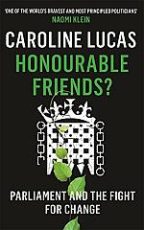
Honourable Friends? Parliament and the Fight for Change, By Caroline Lucas. (2015) Portobello Books £14.99.
In May 2010 Caroline Lucas won the seat of Brighton Pavilion for the Green Party, and became the first Green MP at Westminster. This book is a record of the challenges, setbacks, and successes that she experienced over the following five years in Westminster, and as she says “I hope it may have some value as the view of an outsider, inside; and in particular, how Parliament needs to change if it is to have any hope of re-engaging with the mass of people it is meant to represent, and rising to the serious social and environmental challenges we face.” Her effectiveness as an MP is shown by her having been named Ethical Politician of the Year three times and by winning the 2014 MP of the Year award.
The book is in three parts. In the first, Caroline describes how she strove to understand the workings of the arcane institution that is the Westminster Parliament (MPs are given a hook on which to hang their sword before parliamentary sessions even before they are allocated an office space), and in the second she describes her attempts to be an effective representative for her constituents in the face of austerity cuts, attacks on the NHS, education and the environment, and a government intent on increasing privatisation and corporate globalisation. In the final section she looks at how it might all be done differently, and better. Throughout she writes in an entertaining and engrossing manner, even if the litany of governmental attacks on the wellbeing of the ordinary person makes for depressing reading.
Now that we know the outcome of the recent Westminster election in English constituencies, Caroline’s hopes for the future may seem a little optimistic, but in her own concluding words “The years after 2015 will not be easy. Successive governments have taken us so far in the wrong direction, towards a society where citizens feel powerless in dealing with the state and with major corporations, where inequality is on the increase, and where public services are constantly undermined and meanwhile climate change takes further hold. …… We need new thinking and a new way of working together in politics to tackle the things that really matter. Despite the power of those intent on blocking change, I believe we can prevail. The Scottish referendum has shown that people want a say in their own futures and that once that passion and commitment is released, the result is inspiring …… and to see political parties, whether it is the SNP or the Scottish Greens, welcoming thousands of new members, demonstrates that if you can articulate a positive vision, and reject the cynicism of traditional politics, people will come.”
This is an honest, inspiring and empowering book, and also a shocking indictment of an arrogant and outdated political system.
Bridge Challenge
South to make six diamonds. West leads the ♣Q.

Red Squirrel road kill
The UK’s native red squirrels are increasingly under threat from disease and the spread of grey squirrels introduced from North America in the 19th century, but Arran is one of 19 strongholds for the species in Scotland where there are no grey squirrels.
In 2013 a team of vets and scientists from the University of Edinburgh’s Royal (Dick) School of Veterinary Studies trapped and examined 21 red squirrels on Arran, as well as looking at the remains of 16 killed on the roads. They found no sign of squirrelpox, a virus often carried by grey squirrels which is usually fatal to the red species. This research is ongoing.
At this time of year, squirrel pups are starting to leave the drey and have little road sense, so we are asking all drivers to be aware of the delicate state of the red squirrel population on Arran.
The Rangers at Brodick Country Park are continuing to collect statistics about the locations of red squirrel road kill. If you see one please contact them on 302462 and tell them where and when you saw it. The Rangers are also still collecting red squirrel road-kill for research so, only if it is safe to do so, collect the corpse put it in a plastic bag label it with the location and date and drop it in to the Rangers’ Centre.
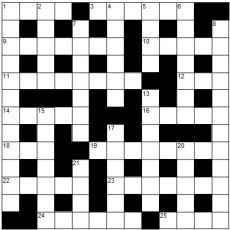
Crossword
Across
1 Be sure of genuinely losing heart (4)
3 Excellent and mostly vibrant cloth (6)
9 Chose the wrong ham (7)
10 Studies English, being thick (5)
11 Diary, which isn’t one of those Kindle types! (8)
12 ‘It’s over, shorty’ (3)
14 Acceptance of American time (5)
16 Change the final word (German)
18 Shelter returning swimmer (3)
19 Relative beheads English composer, resulting in another (8)
22 Albion Rovers, Everton, Norwich, Arsenal – all play here! (5)
23 Girl reheats curry (7)
24 He is to be included in Cameron’s ideology (6)
25 … otherwise I will leave girl (4)