Issue 91

On the same day, on Saturday 22nd September, at different ends of the country, people were walking and marching for very different causes, and with very different agendas. The People’s Walk for Wildlife that took place in Hyde Park in London and the anti-nuclear rally at Faslane on the Clyde, were both events that saw people come out to show support for some of the huge, and not necessarily unrelated, issues of our time. Also taking place that day was the opening of the COAST’s new Octopus Centre in Arran. So many causes to put our energy into, so many places to be on the same day! Which to support? Where to go? And what can we individuals do anyway?

Chris Packham, the famous conservationist, presenter of Spring Watch and organiser of the Walk for Wildlife said, “The greatest beauty of nature is that interconnectivity, is that balance, is that harmony”. But he continued, conservationists are “very often focused on the one thing that interests us, that passion. We lose sight of the fact that that single passion is linked to pretty much everything else.” Chris Packham is referring to the ecology of the natural world, which when left to function, free from too much human intervention, works in extremely complex and astonishing ways. He also refers to a natural human characteristic, not just something conservationists do, and that is to get driven by and motivated by one thing. People respond to issues relating to the thing they know about best. It is how a lot of great work gets done.

But could an ecological perspective be realistically applied to the social and political world? And would it help politicians to bring about a system change that is needed to help address each of these urgent concerns? From a so-called ‘activist’ view, if we see ourselves as part of a broader, more connected picture, then we may see that the part of ourselves that goes on an anti-Trident rally, is also the part of ourselves which would Walk for Wildlife, or attend the opening of a new community Marine Protected Area centre. It’s about caring for our planet, and it’s why there were, among the hundreds from CND and other anti-war organisations, folk from Badger Watch as well as gardeners declaring their hope for a nuclear free world at Faslane. And why in spirit the Voice was at all three events on that day.

We hope you have a great month and enjoy the Voice too!
A Walk for Wildlife

On Saturday 22nd September thousands of people went to Hyde Park in London to join the People’s Walk for Wildlife to demonstrate support for action to reverse the collapse in nature going on all around us. Organised by Chris Packham and others, the event was held in order to highlight that not enough is being done to stop the decline of hundreds of species and what Chris Packham calls the 'ecological apocalypse' taking place in our country.

By Tony Juniper, writing last month for The Ecologist, on the eve of the People's Walk for Wildlife


A March for Peace

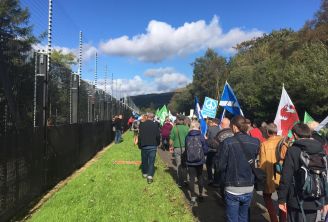
On Saturday 22nd September, around thirty people from Arran’s CND group joined hundreds of demonstrators at the naval base on the Clyde, for the international anti-nuclear rally organised by Scottish CND.      

A bus met us off the first boat in Ardrossan and drove first to Helensburgh and then onto the Peace Camp at Faslane. Here coaches arrived from all over Scotland, and further afield, bringing people from as far north as Cromarty and Inverness, and from Manchester and Reading south of the border. There were representatives from groups including the Quakers, and Badger Trust, and members from the Clydebank Trades Council. And there were individuals who came, including gardeners, who shared their wish for a  ‘Nuclear Free World for Fuchsias’. Folk came with flags and banners, with guitars and bagpipes, and with their hope for a world free of nuclear weapons.


Bogs are unique records of history – here’s why

First published in the online journal, The Conversation.

Peat bogs, which cover 3% of the world’s land surface, are special places. While historically often considered as worthless morasses, today they are recognised as beautiful habitats providing environmental benefits from biodiversity to climate regulation. However, they are threatened by drainage, land reclamation for agriculture and peat cutting for fuel, which has significantly reduced the extent and condition of these ecosystems on a global scale. Bogs are fragile and sensitive to change, whether by human hands or by processes such as climate change.


Climate Week Scotland

Climate Week Scotland is from 1st to 5th October

Climate Week is a national initiative designed to raise awareness and inspire action on climate change. There are lots of great ways to get involved and either host or attend an event. Organisations have run fantastic Climate Week events in past years. These include guided bike tours, bike surgeries, film screenings, and presentations from world experts in climate change. Public sector organisations, businesses, charities, schools and community groups have hosted activities.


20 Polluters that will have to radically change if Scotland is going to meet its climate goals

For the first time, Scotland has a carbon budget under the international climate agreement made in Paris in 2015. A new report by experts from the Tyndall Centre for Climate Change Research at the University of Manchester and Uppsala University in Sweden concludes that for Scotland to meet its global responsibilities it can only emit a total of 300 million tonnes more carbon dioxide – meaning it has to cut emissions by at least ten per cent every year starting now.


Nae Pasaran! How Scottish workers grounded Pinochet’s airforce

As Holyrood honours the East Kilbride engineers who refused to work on the jet engines of the Chilean dictatorship, CommonSpace looks back at the story of how Scottish workers stood against Pinochet’s regime.

Last month the Scottish Parliament heard a motion recognising the efforts of the East Kilbride engineers who in 1974 organised a boycott of the right-wing dictatorship of General Augusto Pinochet, and whose story has now been told in the award-winning documentary Nae Pasaran! SNP MSP Linda Fabiani won cross-party support for the motion, which recognises both the workers behind the boycott and the film detailing their exploits, on the 45th anniversary of the bloody military coup which overthrew the elected socialist government of Salvador Allende and brought Pinochet to power.


Charles Darwin and Kelp

SCOTTISH KELP and the proposal to industrially harvest up to 40,000 tonnes a year on the west coast

When British naturalist Charles Darwin travelled to the Galapagos Islands in 1835, he was amazed at the sight of giant kelp forests ringing the islands. He believed that if those forests were destroyed, a significant number of species would be lost. These underwater ecosystems, Darwin believed, could be even more important than forests on land. Recent research in California over 15 years has proved Darwin right. herehis siteLaminaria hyperboreaLaminaria saccharinakelp kelp's structurephysical aspects of the kelpstructural effects are important and far reaching Laminaria hyperboreaLaminaria hyperboreaWhat is the Economic Case for this Industrial Development?mustHow does Regulation of Scottish Seas work?in trustWhy use the Precautionary Principle?This principle is expressed in the Rio Declaration of 1992, which stipulates that, where there are “threats of serious or irreversible damage, lack of full scientific certainty shall not be used as a reason for postponing cost-effective measures to prevent environmental degradation.”Laminaria hyperboreaclick hereThe current oversight of existing Regulation and its effectivenessNephropsPrevious Consultation on Kelp Harvesting back in 2016small scale harvesting of kelp by handSteen, H., Moy, F.E., Bodvin, TLaminaria hyperboreaReport No. 4-2012


News from the Arran Community Land

Summer 2018 has been ACLI’s most productive yet! With volunteer days held every Thursday, successful open days, and school groups visiting to help out during term time, the community gardens have been bustling with life. Below are photos which highlight the success of this summer! Visiting Groups Groups from Arran High School and Whiting Bay Primary School have enjoyed learning…


Stories from Scotland’s Seabed: Flame Shell Beds

In the final part of the Stories from Scotland's Seabed series which highlights different marine creatures and their habitats, Open Seas tells us about Flame Shell beds.

Flame shells are small, cockle-like shells. Their stunning red tentacles emerge from their shell and flow in the passing currents like flames (hence the name). However, their colour is not the most remarkable thing about them. Far more amazing is the fact that these tiny shellfish build and live in huge nests on the seafloor.


Corrie Film Club Sunday 14th October

The film showing on Sunday 14th October at Corrie is Dancing at Lughnasa (Irish/British/American 1998. Directed by Julie Kelleher. 1hour 35 mins. Cert PG)

Based on the Brian Friel play, this is a story of the sisters of the Mundy family.

Five sisters are living in County Donegal in 1936. Kate Mundy (Meryl Streep) oversees the various conflicting personalities. None are married, but Kate has a job, and Christina (Catherine McCormack) has a young son called Michael.


Music Arran presents Sax Ecosse

On Saturday 20th October, the saxophone quartet, Sax Ecosse will play in Brodick Hall, at 7.30pm

Sax Ecosse is a vibrant saxophone quartet which has enjoyed considerable success as a chamber ensemble throughout the UK and Europe. Recent engagements range from The Edinburgh International Festival, The Usher Hall, Emerging Artist Series, Celtic Connections, and Cottiers Chamber Project, to recitals in Ljubljana, Slovenia, and the St Olav’s Festival, Norway, alongside concerts for music societies throughout Britain.


Arran Geofest 2018

This year's ARRAN GEOFEST 2018 is 12th - 14th October, hosted by Arran Geopark

Come and experience Arran's fantastic geology!

Programme is as follows:

Friday 12th

18:30—20:00 Talk: Introduction to Arran Geology. Tea and scones. (Heritage Centre)

Saturday 13th

10:00—12:00 Walk 1: Hutton's Unconformity (Lochranza)

11:00—16:00 Walk 2: Geology of North Arran (Lochranza)

11:00—15:00 Walk 3: King’s Cave to Drumadoon (King’s Cave Carpark)

13:00—16:00 Family event: Interactive geology activities (Brodick)


Marine News

Marine News from John Kinsman, at St Monans Coastguard, Fife.

Boat's Grounding Disrupts Ferry Services

A damaged boat prevented ferry services operating to and from Harris. The MV Fame which was carrying fish feed ran aground near Tarbert on Sunday morning 16th September. It was later refloated and has been tied up at the Caledonian MacBrayne ferry berth in Tarbert awaiting a full assessment of the damage. Ferry services were suspended and passengers told to travel via Stornaway.
Western Isles MP Angus MacNeil criticised the situation. He said the Maritime and Coastguard agency should have had the vessel inspected sooner and at another location. The Maritime and Coastguard agency said its efforts to deal with MV Fame had been hampered due to bad weather and a landslip that blocked the main road on Harris.