
People on the move
By Sue Weaver
The Refugee Community Kitchen in Calais produces around 500 meals a day for migrants living outdoors in Calais and Dunkirk. There is now no permanent camp – once known as le jungle – since the notorious French riot police, the CRS, demolished it several years ago. Refugees, migrants, would-be asylum seekers, people on the move now have nowhere safe to gather, cook, wash, share their lives and aspirations. This is one of the reasons that the Refugee Community Kitchen came into existence, taking nutritious meals like curry and rice out to various distribution points around the two channel ports, without judgement, to those fleeing war, poverty, persecution and climate change.
I like cooking and I love France and so when I was invited to join a group of volunteers over two weeks in January in Calais, I accepted without too much thought. Our organiser, Ella, had received an unexpected sum of money and wanted to pay it forward towards a cause she believed in. However much that was I never knew, but it paid for an excellent Airbnb in Calais for nine people for two weeks and all the food we bought while there.
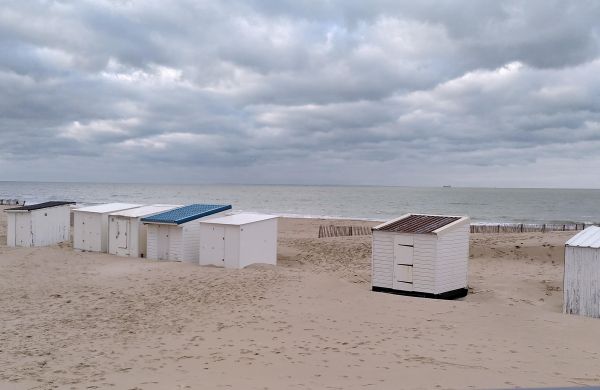
I knew none of the others before we met at the Eurostar London terminal on a day very early in January when train services were interrupted by floods. I finally made it across the St Pancras entrance barrier with two minutes to spare, to be greeted with warmth and hugs. Our bonds grew deeper day by day as we grappled with existential questions about just what we were doing there – and got to grips with the freezing realities of an unheated warehouse in temperatures of -5 degrees.
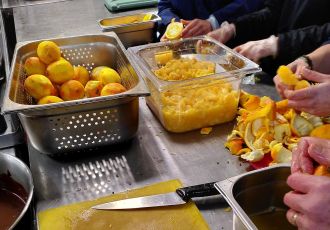
Each morning, at first light, we set out to catch the free bendy bus that wove its way through the Calais suburbs, to arrive by sunrise at 9.00 am in the huge kitchen that took up a corner of a vast warehouse. There were long rows of burners with pans so heavy I struggled to lift them when empty, arrays of sinks in the ‘dishpit’ and stainless steel tables for all the many veggie prepping jobs. Two washing machines and two driers were kept in constant use, washing the chef’s black tops we wore and the hundreds of towels for drying more washing up than I could ever have ever imagined.
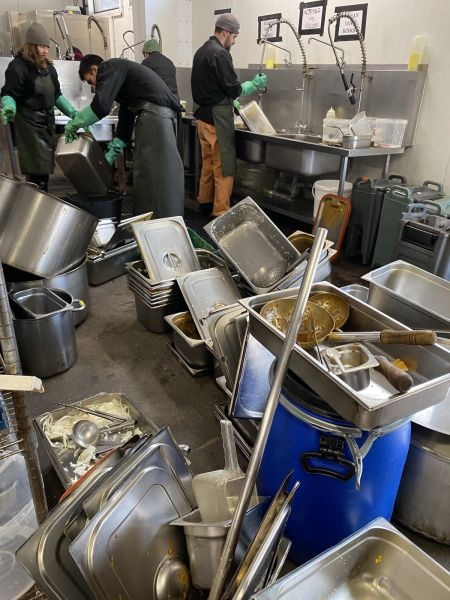
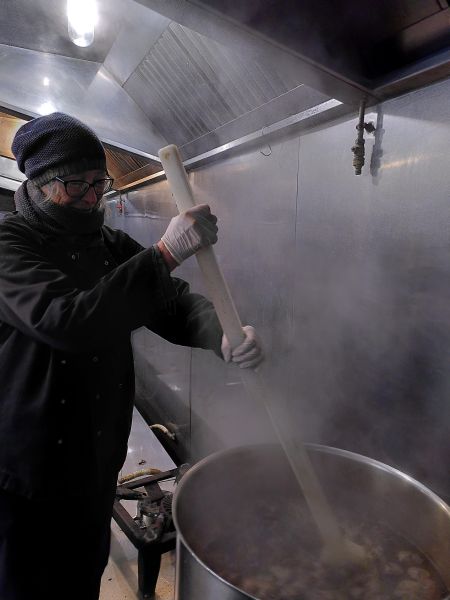
The Refugee Community Kitchen turned out to be quite simply the most fun workplace I have ever known. We started each morning in a great circle of 20-25 people, to introduce ourselves by name and pronouns, and to be told by that day’s prep co-ordinator what the day’s tasks were. After that we could do what we liked! It was self-organising and free flowing. We were encouraged to take breaks whenever we needed, although, as the kitchen was slightly warmer than the -5 degrees in the rest area with sofas and a kettle, I only took breaks when desperate. Lunch was a free hour, with food provided, just the same as that taken out on distribution.
One moment I’d be drying pans with a middle-aged British TV producer, then peeling onions with a Parisian neuroscience PhD student, or an Italian baker from the Veneto. I spent several happy hours chatting to Margaret, a middle-aged activist from Ayrshire who first came to Arran at 16, to work at the Corrie Hotel and later returned many times as an instructor at the Outdoor Centre. And all the while we worked and talked, the music would be pumping, selected by all of us, one favourite track at a time, all sorts of music I couldn’t possibly identify but also Abba, Paul Simon, Bob Marley, Skippinish … At the end of the day, all the jobs would be done, including heroic cleaning down of everything.
Everyone was a volunteer, some just more long-term than others. All ages and many nationalities were represented. What we had in common was a wish to offer humanitarian help to a large number of cold and homeless people, each of whom had been driven by something so powerful, that they had left their villages and towns to travel across mountains and deserts, often thousands of miles, over the dangerous Mediterranean Sea and up through mainly hostile European states in order to arrive at the Channel and the hope of England, sometimes visible just 20 miles away.
I went out on ‘distribution’ twice, taken by an experienced volunteer. We were extremely well briefed beforehand on how to do it, what to expect and what the safety procedures were. Both times I had the simple job of doling out rice or curry onto recyclable plates, to a long, long queue of hungry people, mostly young, almost always male, mostly black, muffled up to the eyes in scarves and hoodies.
In the evenings, my housemates and I grappled at length with the question of how to meet each person, how to stand in a place of respect and humility in the face of their courage and their suffering too. All in the 15 seconds it took to fill a plate and move on to the next person. I can’t say I got anywhere near good answers, but the second time was easier than the first, as I learned to ask ‘how are you?’ or just say ‘hello’ and try to meet someone’s eyes, if they were willing. We used sign language around how much or how little each person wanted, or if they were filling two or three plates to take back to others not present – probably women or children.
Once or twice a young man would laugh and say ‘thank you Mama’, a way of showing respect in many African countries. I fell to wondering about their real mothers back home. Where? In wars in Sudan, Syria or Afghanistan? In famine in Eritrea or flooded out in Chad? Would those mothers ever see their sons and daughters again, having sent them away through such dangers from people, climate, seas and deserts – because that seemed safer and wiser than staying put?
One of the ways I have found to make sense of what we were doing is a brief line from Buddhist teacher Pema Chodron: ‘True compassion does not come from wanting to help those less fortunate than ourselves, but from realising our kinship with all beings.’ From that place of kinship I could try to meet these brave young souls.
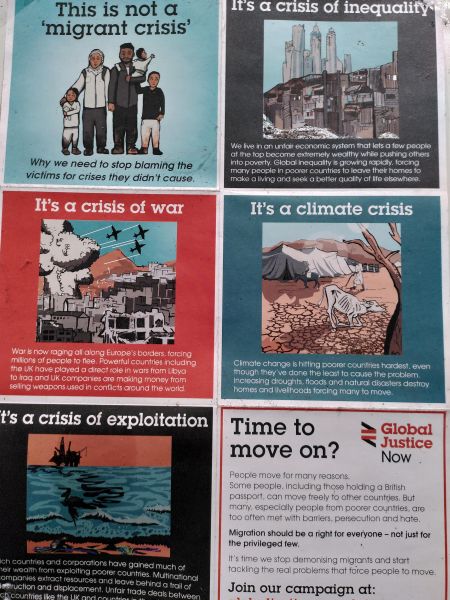
There are many other more obviously pragmatic reasons for supporting these ‘people on the move’. As Britons, living in comparative comfort, we have huge historic debts to almost all of the countries from which they come, which once we invaded, or stripped of assets, or enslaved. Or we could argue that the human race has always been on the move, and that helping each other along the way is how we have survived and spread out over the whole globe. In this way, we’ve shared ideas, knowledge and resources. The willingness to offer asylum goes deep in many cultures. And the incomers, the people on the move, bring with them their many gifts. For a deeper look at some of these issues, I recommend ‘Nomad Century’ by Gaia Vince, which foresees the need for massive migrations in the face of climate chaos. We are just now seeing the beginnings of this.
I will close with a poem by Sally, my Calais housemate, written while we were there and trying to deepen our understanding of the lives of the people who had moved so far.
Not a hungry mouth by Sally Jane Hole, January 2024
The thing is, you are not a hungry mouth to feed.
You are not a refugee to help.
You are not somebody who needs something so much as somebody who wants something.
Many things.
Like me.
Through dreams you move.
Like me.
Uncontainable, life leaks out
Of the edges of the humanitarian equation.
You cannot be reduced to food
+ water
+ sanitation
+ shelter.
No mathematical equation
Can capture
What it is
Your life.
You exceed all this.
Like me.
In myriad ways
Your life flows forth,
Like mine.
In your spirit,
Desires and hopes,
Joys and sadnesses;
In your friendships and family,
Jokes and banter,
Conviviality, community,
Yearnings and fears.
Your life, with your own style and quirks,
With your unique temperament, your character, your grace.
I am squinting from the sun when I glance up to meet your eyes.
It is difficult to see you,
But for a moment, I think I see something of your truth.
I hope you see mine.
In this machine of care we find ourselves in,
Here too the border lies.
You are number 267 in the queue.
I serve you pasta and a tomato and lentil sauce.
I serve you with longing and grief and shame.
In how many ways
Does this rupture curtail you, hurt you, imperil your life?
And how much does it sustain me?
And yet
It hurts me, too.
But through dreams you move.
Like me. And
I breathe in
To the ache in my chest, and
I wish for the world to unfold and embrace you, and
To tell you,
We need you.
A very big thank you to Sue for sharing her experience of working with the Community Refugee Kitchen with us. Formerly resident of Arran, Sue is now based in Wales, and dedicates her time, among other things, to living in peace with the earth. All image credits Sue Weaver.


