Corrie Film Club
The Corrie Film Club’s offering for November 8th in Corrie Hall at 8.00pm is Ida, held over from last July.
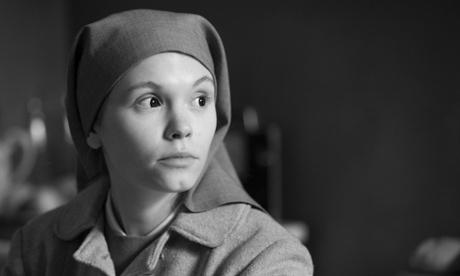 Directed by Paweł Pawlikowski, who made the 2004 BAFTA-wining British drama film My Summer of Love, Ida won the 2015 Oscar for best foreign language film, becoming the first Polish film to win the award. Accepting the award, Pawlikowski said: “We make a film about silence and withdrawing from the world and the need for contemplation – and here we are, at the epicentre of world noise and attention. Fantastic – life is full of surprises.”
Peter Bradshaw gave Ida five stars in his Guardian review, writing that “Ida, which pulls off the remarkable trick of looking as if it was made when it was set – the early 60s – feels more like a restored and rediscovered classic than a new movie. There really is a bitter, wintry cold here: it is illuminated by the stark, daylit whiteness of snow, and you can feel the chill in those barnyards and draughty churches.”
“Agata Trzebuchowska is tremendously mysterious as a 17-year-old novitiate in a remote convent: she has the impassivity and inscrutability of youth. This is someone to whom literally nothing has happened in her life, and now we will watch her react, or try to conceal her reaction, to an onslaught of momentous events. It is 1962, and Anna is about to take her final vows in the convent where she was left as an orphan baby in 1945 by persons unknown. But Anna has one surviving relative, and the Mother Superior – who has clearly guessed more about Anna’s background than she admits – insists that she contact this woman before she makes the irrevocable decision. The relative turns out to be her aunt, Wanda Gruz, tremendously played by Agata Kulesza – a worldly, hard-drinking woman who lives on her own. “They didn’t tell you who I am – and what I do?” she asks.”
Bradshaw concludes his review with “Ida is a compelling film that achieves a great deal in a short time. The performances are superb and the sense of location and period miraculous.” Meanwhile The New York Times review said that “with breathtaking concision and clarity Mr. Pawlikowski penetrates the darkest, thorniest thickets of Polish history, reckoning with the crimes of Stalinism and the Holocaust. Until the very end, the audience never hears music unless the people on screen hear it, too, and many of the scenes — at once austere and charged with an intensity that verges on the metaphysical — owe an evident debt to ’60s cinema heroes like Ingmar Bergman and Robert Bresson.”
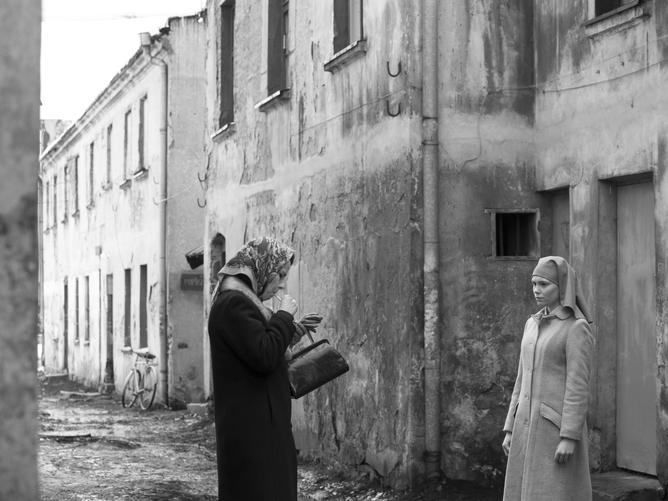
In an extended essay in The Conversation, Jeremy Hicks describes how Pawlikowski has addressed the issue of Poland’s repression of memory: “In the 1960s there were some very guarded attempts to hint at the truth of the occupation: that Poles rarely aided their Jewish neighbours and sometimes were complicit in their annihilation. In doing so, Pawlikowski has staged quite a coup. He has succeeded in making a film about repression, sexual and political, about memory and Polish identity. Most crucially, perhaps, it is a film about the Holocaust that doesn’t feature the Nazis.”
The director of Ida, Paweł Pawlikowski, was born in Poland and lived his first fourteen years there. In 1971 his mother moved with him to England. Ida was his first Polish film; in an interview he said that the film “is an attempt to recover the Poland of my childhood, among many things.”
Do come along to Corrie Film Club to see Ida – all are welcome, and a small donation is asked from visitors.