

History of Agriculture on Arran
by Jim Henderson
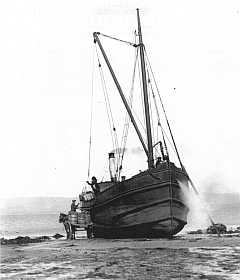 In the early 1880s, big changes set in. Until then, the use of nitrogen had not been understood, and although rotation of land had been practised so that arable years were interspersed with grazing animals, many farmers did not appreciate that the value of cattle waste was in its easily available nitrogen. When it was realised that this valuable fertiliser could be bought in a more concentrated form, there was immediate interest. Guano was imported from Chile as a potent source of nitrogen, and sulphate of ammonia and super phosphate began to be manufactured. Lime, too, was recognised to be of value. This was transported by the Clyde ‘puffers’, which often beached on sandy areas close to the farming community, who loaded the cargo on to carts at low tide. These chemicals increased productivity and met the demand for root crops and vegetables. Reaping and threshing machines became a new sight on Arran and the introduction of metal ploughs and drills improved the farm output.
Arran, though an island, has never been unaffected by national legislation, and the price of corn had been raised by the Corn Laws introduced at the beginning of the 19th century to protect British farmers. This resulted in disaster for Ireland, where the appallingly badly treated small farmers saw ships laden with the corn they had grown setting sail for the rich markets of England, but, though less well known, the same thing was happening in the Scottish Highlands. The Corn Laws had established profitable exports, while the people who produced the corn were trying to live on potatoes, a crop introduced for the table of the gentry but cheap and easy to grow. When Potato Blight set in, famine followed. Arran was not immune. The potato blight ‘Phytophthura Infestans’ is an air-carried fungus that causes the potato to turn into a mushy mess, completely inedible. It first began in a mountain range of Mexico and affected crops in America, then migrated across the Atlantic in infected ships and appeared in France. From there it came to the Isle of Wight before devastating the Irish crop in 1845. Ideal weather conditions had raised expectations of a bumper harvest, but the disease wiped out the entire crop – a disaster for Irish people, who had been reduced to total dependence on potatoes as the grain they grew was exported to rich markets in England. The blight struck the Highlands, including Arran, in 1846, and it was another 3-4 years before the crops began recovering. The disease is still prevalent, but in the present time it is controlled by the use of insecticides and crop rotation, and by planting varieties of potato that are blight-immune. James Allan was the first farmer in Arran to purchase 2 bags of ‘Champion’ potato seed,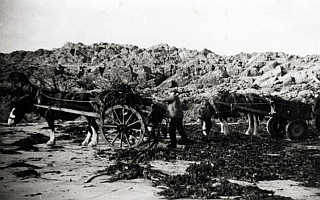 which proved to return a good crop and became very popular all over the Island. In 1879 the potato crop at the Clauchlands yielded 12 to 15 tons per acre, setting records of production. The best fields proved to be the ones adjacent to the shore, where seaweed is an excellent fertiliser. The potato crop was ‘pitted’ for storage and sale, and secured prices of £3.00 to £5.00 per ton at market. At that time on the Island the varieties of potato seed commonly in use were ‘Walkers Early’, ‘Red Bogs’, ‘Regents’, ‘Dalmahoys’, ‘Skerry Blues’ and the ‘Champion’. The famous Arran breeds came in the early 1900s, developed by Donald MacKelvie, a small farmer on the isle of Arran who also ran a general store. There can be few people who do not know of the Arran Pilot or of course of the Arran Banner, but there were other varieties as well, including the Arran Victory and the Arran Consul.
The Corn Laws were repealed in 1846 as a direct response to the potato famine. There had been international outrage over the indifference that had seen over a quarter of Ireland’s population dead, and the high price of wheat that had denied grain to the mouths of the people who grew it came to an end. The Corn Laws left a bitter legacy. Farmers never forgot from that time on that the international market dictates the product. Diversification, then as now, became a necessary strategy.
Sheep wool was losing its dominance of the clothing market with the introduction of imported cotton and textiles. The market for meat and milk was increasing, as was the demand for root crops. The Duke of Hamilton was keen to see the island’s cultivable land improved, and offered prizes for specific achievements, of which some follow. The cash inducements were, in the value of the time, substantial.
- To the tenant who shall have the first 10 acres enclosure finished in terms of the articles 5 guineas.
- To the tenant who shall have the greatest quantity and best quality of wheat upon enclosed ground, and after a thorough summer fallow of 5 furrows, sufficiently manured, and no less than 2 acres 2 guineas.
- To the tenant who shall have the greatest quantity of clover and rye-grass hay from at least 2 acres, sown with barley or wheat, after summer fallow, of 5 furrows, and properly manured, and not less than 100 stones an acre, and upon enclosed ground 2 guineas.
Amongst the prize-winners in the two years following this announcement were Angus MacKillop, Alexander Thomson, Patrick Crawford, Robert Shaw, John Currie, and Alexander MacKinnon.
The Duke also obtained the services of an experienced fisherman, one Andrew Wilson, to teach the art of line fishing to any of the islanders who applied to him. The whole approach to agriculture was broadening out.

-420x280.jpg)
