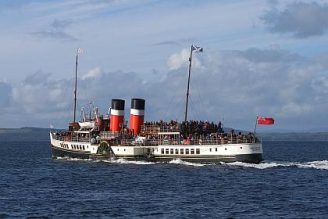
Heading south from Kildonan, we could get to the Isle of Man quite directly by sea in a reasonable boat, but as things are, the only way to get there is by air from Glasgow airport or by sea, courtesy of the Isle of Man Steam Packet Company. Its ferries run from Heysham, Birkenhead, Liverpool, Dublin or Belfast, but no longer, alas, from Ardrossan Harbour. All the same, it’s well worth making the trip, because the Manx way of life is highly enjoyable, as I found in a recent trip there with a friend. What’s more, as Scotland teeters on the edge of a more independent relationship with the Westminster government, the Manx way of life provides a fascinating example of independence at work.
Wherever you go, there are gentle reminders that the island is not part of the UK. The Manx post office issues its own stamps and runs its own delivery service. There are Manx banknotes, and the Manx telecom network is cheap and very effective. ‘The Government’ means the Tynwald, based in Douglas, not Westminster. In 1960, they abolished supertax in a move to attract off-shore businesses, a policy that paid off handsomely, but the big irritation at the moment is the rise in VAT. Because this is a tax added to goods at source, the Manx cannot opt out of it, and they are mightily annoyed. Quite a few shops displayed notices that say, ‘No VAT increase on our stock.’
I’d been prepared for a lot of conspicuous wealth, but it doesn’t seem to work like that. True, there are discreet office signs in Douglas about Wealth Management and Asset Control, but the community busies itself with charity shops and concerts just as we do, and people seem to get along cheerfully with no reference to big business. At the same time, it’s obvious that the Tynwald is not short of a bob or two. Social housing is developing at a vast rate on the plentifully available land on the outskirts of towns, and ‘recession’ seems to be an unknown concept. The Manx unemployment rate is 1.8%, which they tut over and regard as unacceptably high, but for the UK, it’s exactly the other way round, with 8.1% of its citizens jobless.
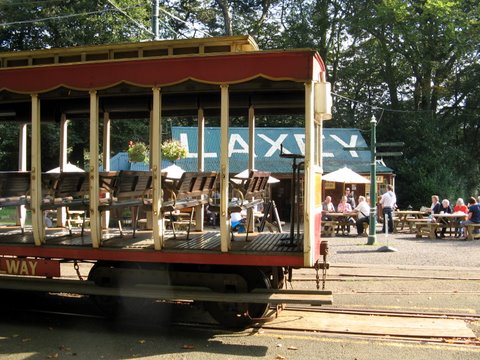
Whatever the economic background, the island has a relaxed, friendly feel about it. Nobody seems in a hurry, so conversation is easy to get into. Most people sound as if they come from Lancashire, with an occasional touch of Irish or Liverpool. Manx Gaelic is staging a big comeback and is being taught in schools. Most strikingly, the place is wonderfully clean and tidy, with no trace of graffiti anywhere. Travelling on the enchanting Vistorian steam railway that still provides useful service, there’s an inevitable view of the backs of buildings and occasional blank walls, but there is never a mark on them. Maybe any offender gets officially beaten to death with his spray can – it’s hard to guess how the general sense of willing conformity works. It seems more likely that the cleanliness from a very clued-up local authority approach, couple with a whacking great budget for cleansing services. There is absolutely no litter, probably because every shopping street has dozens of well-maintained litter bins only about 20 paces apart. What’s more, they are sensibly equipped with a perforated ‘stubbing out’ top that makes it ridiculous for smokers to tread out fag-ends on the pavement.
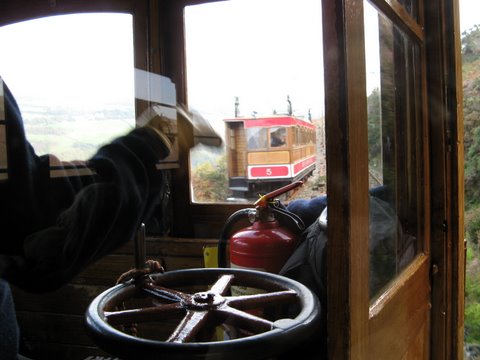
Manx buses, too, are beautifully clean, looking as if they get washed and polished every night. An all-week transport ticket worked brilliantly, giving us the use of all buses and trains, including the quirky electric railway that clatters its way to the top of Snaefell. The service is so comprehensive that the bulky timetable is generally regarded as incomprehensible, but it certainly works. Bus-routes link up smoothly, not only with each other but with rail services as well. It had its human quirks, though. A bus that turned up ten minutes late had simply run out of fuel. And in the tiny village of Port St Mary, a bus roared past a stop nearly quarter of an hour early, leaving us to set off somewhat glumly on a 2-mile walk in a high wind. The driver saw us on his way back - and reappeared after a few moments, having turned his bus round to take us on the two-mile journey, with apologies. We might of course have made a fuss at Fat Controller level, but all the same, he was nice about it.
An election was being held in the week of our visit, but posters for the various candidates did not indicate a political party. This puzzled us – but it turns out that parties don’t exist. ‘Liberal Vannin’ had nothing to do with the UK Lib-Dems, it was just a new group of broad outlook Manx people. (‘Man’ mutates to ‘Van’ in Manx Gaelic genitive case, hence ‘Vannin’). All candidates stood as individuals, though was told that anyone nominated must have at least £50,000 in the bank. There was some cynicism. ‘It’s who you know, isn’t it,’ one woman said. But then, the Manx community is a close one, and everybody did know the candidates, as they would on Arran, should we do the same thing.
I went to an imaginative AV presentation of Tynwald functioning in the Old House of Keys in Castletown, now a museum. We were invited to ‘participate’ in several historic debates, and also to vote on the current issue of whether the Isle of Man should secede completely from the UK and seek membership of the European Union.’ It was universally rejected, on the grounds that the EU was in far too flaky a state for any such move.
The Tynwald is more concerned with its own realities than external politics. It is looking at tidal power generation and plans a big off-shore wind farm, to start construction soon. At present, the island generates its electricity with natural gas, but they know that may not be sustainable. There’s a great practicality about the place, explained with clarity by the world class museum in Peel, the House of Mannanin, where emergence from prehistoric living gives way to the long fight for independence. Manx people have an inherited memory of the brutal past when English landlords used them as slaves and left them with nothing. It seems to have left a head of psychological steam that powers the island’s pride in its hard-won independence. Living on the island now is felt as a privilege, and the ultimate sanction against a wrong-doer from anywhere else is banishment.
What I loved most was the feeling of common sense. The Snaefell mountain railway, built in 1890 and still running, due to devoted maintenance, has one closed carriage and one open one, where there is nothing to stop you falling out from your wooden seat and down the tumbling cliff to the sea. Wonderful. Independence means you must take charge of yourself, your children, your dogs, your shopping bags and, in a small way, of the island where you live. If things go stupid, there is no-one else to blame.