

Reforesting Scotland’s (and Arran’s) Hills – Can we? Should we?
Alan Bellamy of Arran’s Natural History Society contributes this piece on Arran’s forests, how they came to be here and how to conserve them.
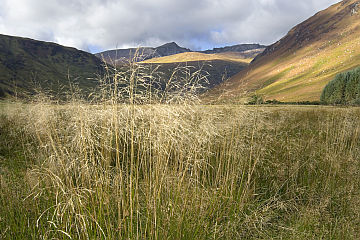 The broadcaster, John Humphrys, put the question in a nutshell when he said, ‘If we don’t care for our uplands, we don’t care for the environment and we deny our children a glorious heritage. It really is that simple.’
Trees for Life, Scotland’s leading conservation volunteering charity, whose vision is to restore a spectacular wilderness region of 1,000 square miles of the Highlands, supplies the following brief history of our forests.
The peak for Scotland’s woodlands was about 5,000 years ago, when tree cover and diversity was at its greatest extent. The ‘Caledonian Forest’ was not a dense blanket of pine woodland as was once thought, although native pinewoods were an important part of this forest, but a vast, primeval wilderness that spread across about 1.5 million hectares of the uplands. Pollen records and comparisons with wild forests in other countries help us to understand what this landscape was like.
It is probable that the structure of the forest was very varied, and included a mosaic of denser woodland, open ‘savannahs’ and different kinds of scrub, as well as open heaths and bogs, which were an important part of the whole matrix. Among the many tree species were Scots pine, aspen, birch, oak, rowan, willow and alder. There would have been a wide range of woodland types: pine woods, alder swamps, elm and ash woods, birchwoods and others. Each would have had unique communities of specialist wildlife. Open ground added to the diversity, and the woodland would shift and change with no fixed boundaries.
Around 4,500 years ago, a period of cold, wet weather began, encouraging the spread of peat bogs. The treeline became lower, and in the wettest areas pine retreated and was replaced by scattered broadleaves. It is not clear to what extent humans were involved at this point, although after this climatic fluctuation, some suggest that woodland would have regained old ground as the cold, wet period ended. Here on Arran our native woodland probably would have resembled the “rainforest” oak woodlands found in Argyll. Anyway, for whatever reasons, by the time the Romans arrived over half of our native forests had been lost.
 By the 18th century, Scottish woodland cover reached its all-time low. While many pinewood remnants continued to be exploited, the fragments were sometimes protected from overgrazing to ensure a supply of timber. These remaining fragments became really vulnerable when competition from Scandinavia and the Baltic states undermined the timber market. There was then little incentive to protect them from overgrazing, and with the rise of deer numbers for sporting estates, their deterioration continued. The rise in sheep farming, the increased numbers of deer for sporting estates, and the practice of muirburn on grouse moors in recent centuries have all pushed the upland forest into further decline.
At the Arran Natural History Society’s February meeting, the topic of restoring Scotland’s hill woodlands and montane scrub was explored by David Mardon, who arrived at Ben Lawers National Nature Reserve in 1979, working for the National Trust for Scotland. David soon established a programme of biological survey and monitoring that soon showed how some herb and tree species were in a terminal decline and their habitats in ‘unfavourable condition’. It quickly became clear that the limiting factor was not climate but overgrazing by sheep and deer. The experience gained at Ben Lawers, and the four thousand hectares already replanted by Trees for Life, offer a unique demonstration of the potential for reforesting the uplands with native species. Here on Arran, however, we still suffer from very limited biodiversity in our hills because of sheep and deer grazing, and exclosures on the island have not promoted regeneration as effectively as was hoped. Perhaps this is because our fences are not good enough and are not maintained sufficiently? An example is the Scottish Natural Heritage exclosure for whitebeams at the north end of the island, but even on Ben Lawers it has been difficult to find fencing that can do the job.
Many questions are raised by all this, about such issues as land ownership and usage, and whether existing and new forests should be commercial or recreational resources. Here on the island the voluntary group, Roots of Arran, is working hard to transform clear-felled commercial forestry land into a broadleaved forest resource for all the community to enjoy and learn from. All over Scotland local groups of The Community Woodland Association are working on inspiring forest-based projects.
 Mention of people learning from and enjoying upland forests leads on to thinking about the benefits and potential problems brought by ecotourism to an island such as Arran, and the land management policies that might increase the benefits and reduce the problems. Add into the mix the increasing influence of climate change and we have challenging times ahead.
It may be salutary to bear in mind the words of Gus Speth, a US advisor on climate change, here: “I used to think that top environmental problems were biodiversity loss, ecosystem collapse and climate change. I thought that thirty years of good science could address these problems. I was wrong. The top environmental problems are selfishness, greed and apathy, and to deal with these we need a cultural and spiritual transformation.”
To go to the ANHS website, please click here.
Next month, Alan will be writing on the much-debated question of deer management.


