

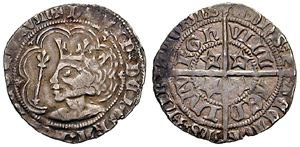
 Gets our groat
In Westminster, sabres are being rattled (or maybe it’s the sound of chattering Cabinet teeth) at the idea of Scottish independence. Among their threats is a warning that the pound may be closed to us as a currency, which is ludicrous. There’s no patent on the pound, or on the dollar, rouble, yuan, rupee, dirham, ringgit, quetzal and the rest. Money is not a product, it’s an exchange system, and we can pick whatever unit we choose.
We might well go for the Scottish groat. It did us very nicely from 1367 onwards, from the time of King David II right up to the 20th century. The groat was worth four pence – but hey, we understand Quantitative Easing. We’ll subdivide it into a hundred grains and give it what value we choose. All we have to do is notify Poundland that it is now Groatland and we’re away. We’d have to swap groats for dollars at airports, of course, but we do that already, since Scottish pound notes alarm everyone south of the Watford Gap.
Mr Osborne should bear in mind that it takes two to haggle. If we stick around, it could be on the strict condition that the joint kingdom will in future be known at Groat Britain.
Dazzling Djordje in Brodick
On Saturday 15th March, the utterly magical Djordje Gajic will be back to enchant audiences with music played on the piano accordion in a way that few people have ever heard. Born in Hungary, Djordje (pronounced ‘Georgie’) trained in Russia, where the accordion is taken as seriously as any other full-range classical instrument. His repertoire is vast, stretching from Bach to a café waltz, Debussy to a Gypsy dance that will set your feet tapping. His technical mastery is awe-inspiring, but above all this music is immense fun, moving easily between evocative classics and tunes to fill you with nostalgia, take your breath away and make you laugh. At its most sonorous, this massive instrument sounds like a church organ, but it can have the light easiness of a concertina. Those who have heard Djordje before can’t wait to come again, and for those who have missed him - you have a treat in store.
Tickets at £10, including a free prize draw programme and refreshments at the interval, will be available at the door or can be pre-booked at Inspirations or online from www.arranevents.com. Don’t miss this one, or you’ll be kicking yourself forever!
An additional treat
The annual Music Society programme comes to an end in March, but more delights are in store. On Friday 26th April, a brilliant duo called Karmana will be appearing in Whiting Bay Hall at 7.30, to play fantastic music from all over the world on guitar and cello. They have managed to fit in a visit to Arran between a vast range of international performances, and we are lucky to have a chance to hear these stars on stage. More detailed information in next month’s Voice, but make a note of the date - April 26th. A Friday, not a Saturday, and Whiting Bay, not Brodick. This concert is, in every way, a Special. More details in the April Voice.

Dead Man in Corrie
Not a corpse found on the Sandstone Quay, but the arresting, extraordinary film to be shown by the Corrie Film Club on Sunday March 9th. Written and directed by Jim Jarmusch in 1995, Dead Man stars Johnny Depp and Robert Mitchum (his final film role) in a post-modern take on the Western genre that is curiously disturbing. It is shot in black-and-white, with a guitar sound track improvised by Neil Young as he watched the footage.
Depp plays William Blake, an accountant from Cleveland, Ohio, who is going by train to the frontier company town of Machine, where he has been offered a job. Arriving, he is told the post has been filled, and Mitchum as the ferocious boss of the firm drives him off at gunpoint. Blake meets Thel Russell (Mili Avital), a former prostitute who sells paper flowers, and goes home with her, but the pair are surprised in bed by Thel's ex-boyfriend, and Thel is killed when she tries to shield Blake. He escapes on a stolen horse, but the boy-friend’s father is the angry company owner, and he wants Blake brought in ‘dead or alive’.
Blake was also shot, and wakes from near-coma to find an American Indian calling himself Nobody investigating the bullet lodged in his chest, too close to Blake’s heart to remove. Nobody regards Blake as the walking dead, and thinks he is a reincarnation of William Blake, a poet whom he idolises, so he takes it on himself to escort Blake to the Pacific Ocean, where he will find his place in the spirit-world.
In their journey west, Blake learns of Nobody's past, marked both by Native American and White racism, and Nobody is certain that Blake must undergo a ‘vision quest.’ During what follows, Blake experiences visions of nature spirits, but kills two U.S. Marshals. It all catches up with him at a trading post, where a bigoted missionary attempts to kill him. Wounded again, he is close to death, and Nobody takes him to a Makah village, where the tribe give him a canoe for Blake's ship burial. It’s a strange, harsh tragedy with the inevitability of Macbeth, yet it contains a spirituality that remains in the mind.
The showing begins at 8:00pm in Corrie Hall. All are welcome and there is no charge, though contributions towards the cost of heating the hall would be very welcome.
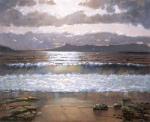
Patterns in the Landscape
Arran Visual Arts offer a weekend workshop on landscape painting with Ed Hunter, one of their favourite tutors, on Saturday and Sunday 29th/30th March at the Rangers’ Centre in Brodick Castle grounds. He works with oil paints, so you will need a board or canvas (available from the Book an Card Centre) and your brushes.
If you need to top up paints, these will be available at the Centre. Ed
Lesley Riddoch comes to Arran
On April 25th, the well-known broadcaster, Lesley Riddoch, will be in the Community Theatre at 7.30pm to talk about her new book, Blossom. The event is being organised by the Arran Yes Campaign, (AYE) but Lesley stresses that she does not want the event seen as part of any campaign. She is a very engaging speaker, and her book is is a powerful comment on how Scotland can flourish, so it should be a great evening. There is no charge, and all are welcome.
Click on the picture on the right for more information.
30 trees for ‘community copse’
Juliette Walsh writes to say the Woodland Trust is sending thirty trees for the ‘community copse’ that she and Roots of Arran members are creating. They hope to hold a great tree-planting on Sunday 9th March, and will be delighted to welcome helpers. The young trees will include silver birch, rowan and wild cherry.
The group will meet at the view point car park between Brodick and Lamlash at 11am. The recently acquired new set of loppers, pruning saws and saws will be used to cut back any unwanted invasives such as rhododenron and sitka. Juliette warns that they will be very sharp, but she is also providing new leather gloves for volunteers.
If you are willing to help, Juliette asks that you wear waterproofs and stout footwear and bring a packed lunch. She hopes to make their famed and very popular hot fruit punch to warm the cockles of kind volunteers’ hearts!

A boat that became a forest
Sarah Laskow, writing on the Daily Grist site, posted pictures of a derelict boat that slowly turned into a small forest.
The SS Ayrfield was built in 1911. She became a supply ship for American troops in World War II and then was used to transport coal for many decades. In 1972, she was sent to a ship breaking yard in Homebush Bay, not far from Sydney in Australia. There, she was left to rust.
The bay was a general dumping ground, very polluted, though Australia cleaned it up around the time of the Sydney Olympics. The hull of the SS Ayrfield, along with a few others, was still not moved, and over the years, it grew into a forested island. Somehow, you can’t keep a good ship down.

Reforesting Scotland’s (and Arran’s) Hills – Can we? Should we?
Alan Bellamy of Arran’s Natural History Society contributes this piece on Arran’s forests, how they came to be here and how to conserve them.
The broadcaster, John Humphrys, put the question in a nutshell when he said, ‘If we don’t care for our uplands, we don’t care for the environment and we deny our children a glorious heritage. It really is that simple.’
Trees for Life, Scotland’s leading conservation volunteering charity, whose vision is to restore a spectacular wilderness region of 1,000 square miles of the Highlands, supplies the following brief history of our forests.
The peak for Scotland's woodlands was about 5,000 years ago, when tree cover and diversity was at its greatest extent. The 'Caledonian Forest' was not a dense blanket of pine woodland as was once thought, although native pinewoods were an important part of this forest, but a vast, primeval wilderness that spread across about 1.5 million hectares of the uplands. Pollen records and comparisons with wild forests in other countries help us to understand what this landscape was like.
It is probable that the structure of the forest was very varied, and included a mosaic of denser woodland, open 'savannahs' and different kinds of scrub, as well as open heaths and bogs, which were an important part of the whole matrix. Among the many tree species were Scots pine, aspen, birch, oak, rowan, willow and alder. There would have been a wide range of woodland types: pine woods, alder swamps, elm and ash woods, birchwoods and others. Each would have had unique communities of specialist wildlife. Open ground added to the diversity, and the woodland would shift and change with no fixed boundaries.
Around 4,500 years ago, a period of cold, wet weather began, encouraging the spread of peat bogs. The treeline became lower, and in the wettest areas pine retreated and was replaced by scattered broadleaves. It is not clear to what extent humans were involved at this point, although after this climatic fluctuation, some suggest that woodland would have regained old ground as the cold, wet period ended. Here on Arran our native woodland probably would have resembled the "rainforest" oak woodlands found in Argyll. Anyway, for whatever reasons, by the time the Romans arrived over half of our native forests had been lost.
By the 18th century, Scottish woodland cover reached its all-time low. While many pinewood remnants continued to be exploited, the fragments were sometimes protected from overgrazing to ensure a supply of timber. These remaining fragments became really vulnerable when competition from Scandinavia and the Baltic states undermined the timber market. There was then little incentive to protect them from overgrazing, and with the rise of deer numbers for sporting estates, their deterioration continued. The rise in sheep farming, the increased numbers of deer for sporting estates, and the practice of muirburn on grouse moors in recent centuries have all pushed the upland forest into further decline.
At the Arran Natural History Society’s February meeting, the topic of restoring Scotland’s hill woodlands and montane scrub was explored by David Mardon, who arrived at Ben Lawers National Nature Reserve in 1979, working for the National Trust for Scotland. David soon established a programme of biological survey and monitoring that soon showed how some herb and tree species were in a terminal decline and their habitats in 'unfavourable condition'. It quickly became clear that the limiting factor was not climate but overgrazing by sheep and deer. The experience gained at Ben Lawers, and the four thousand hectares already replanted by Trees for Life, offer a unique demonstration of the potential for reforesting the uplands with native species. Here on Arran, however, we still suffer from very limited biodiversity in our hills because of sheep and deer grazing, and exclosures on the island have not promoted regeneration as effectively as was hoped. Perhaps this is because our fences are not good enough and are not maintained sufficiently? An example is the Scottish Natural Heritage exclosure for whitebeams at the north end of the island, but even on Ben Lawers it has been difficult to find fencing that can do the job.
Many questions are raised by all this, about such issues as land ownership and usage, and whether existing and new forests should be commercial or recreational resources. Here on the island the voluntary group, Roots of Arran, is working hard to transform clear-felled commercial forestry land into a broadleaved forest resource for all the community to enjoy and learn from. All over Scotland local groups of The Community Woodland Association are working on inspiring forest-based projects.
Mention of people learning from and enjoying upland forests leads on to thinking about the benefits and potential problems brought by ecotourism to an island such as Arran, and the land management policies that might increase the benefits and reduce the problems. Add into the mix the increasing influence of climate change and we have challenging times ahead.
It may be salutary to bear in mind the words of Gus Speth, a US advisor on climate change, here: “I used to think that top environmental problems were biodiversity loss, ecosystem collapse and climate change. I thought that thirty years of good science could address these problems. I was wrong. The top environmental problems are selfishness, greed and apathy, and to deal with these we need a cultural and spiritual transformation.”
To go to the ANHS website, please click here.
Next month, Alan will be writing on the much-debated question of deer management.
Feline Friends
Kate Hartley of Cats Protection does a great job in finding homes for lost Arran cats, but sometimes she needs a bit of help. Her tale of two lonely cats called DJ and Rosie follows.
DJ arrived as a stray quite some time ago. He is a nervous soul who is frightened of people but just needs someone to be gentle and patient with him. He does not like other cats and has been known to attack them, even though he has no teeth! He comes when called and would love to have the freedom of being an indoor /outdoor cat. Rosie, on the other hand is outgoing, talkative and has a mind of her own. She was an indoor kitten and does not know much about the outside world, but she, like DJ, would so much like the chance to explore it.
Dental news not all bad
On Monday 10th February, a Herald report warned that NHS Ayrshire and Arran is one of four health boards being required to close or privatise salaried dental practices in a bid to cut costs. Pat Kilpatrick, director of the British Dental Association (BDA) is worried about what this may mean for vulnerable patients, and whether some practices would be financially viable. As he said, ‘If a practice was viable there would have been an independent practitioner in it already.’
Graham Smith, deputy chairman of the Scottish Salaried Dentist Committee, said centralising specialist services would increase dental health inequalities. He said that a broad spectrum of specialised care is best achieved when it is ‘“embedded” within care for the rest of the community.’
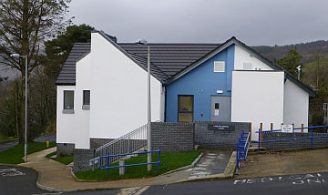
Arran’s dental services are already privatised in effect, since dentists work under contract to the NHS but are not directly employed by the national service. However, they have no defence against reduction in hours and scope. Anyone rash enough to have a dental emergency at the weekend or at any ‘after hours’ time now has to go to the mainland in search of emergency help. Meanwhile, our hospital at Lamlash has new provision of splendid dental facilities, so we have much to be thankful for, even while keeping a wary eye open for any sign of downgrading.
Salmon – and Salmond – heading for the crunch
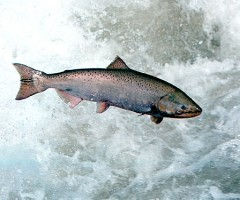
In the middle of last month, the national press woke up to the long-simmering question of how salmon farms are damaging the survival chances of the revered traditional wild Scottish salmon. A strongly worded letter from Orri Vigfusson, chair of the North Atlantic Salmon Fund, accused Holyrood of systematic fish-farm mismanagement that was causing a catastrophic, rapidly increasing decline in wild stocks.
Alex Salmond, who is already proposing an independent review into the management of fish farms, is caught between a desire to satisfy the lucrative Chinese demand for sushi and the increasing fury of traditional anglers and high-quality producers, who have watched with dismay as the population of wild salmon dwindles.
There is no doubt that their accusation is justified. Anyone who has walked across the duckboards of a fish farm and seen the sluggish movement of big, over-fed fish with barely room to pass each other will know it is true. So will anyone who has seen binfuls of dead salmon carted away for disposal. Even without these insights, there can be hardly a living person now who does not know about the constant infestation of sea lice that demands massive use of toxic chemicals. Underwater footage shows only too clearly the build-up of excrement, surplus food and chemical dosage that spreads far along the seabed from the ‘footprint’ of a fish farm.
Mr Salmond has to understand that the only way out of this insoluble conflict is to rear caged salmon in a land-based system of linked tanks that have no direct connection to the sea and rivers in which wild salmon live their complex lives. There is no other way to avoid an ecological disaster that will in turn wreck Scotland’s most valuable export industry.
Welfare state ‘dead in a generation’? Most people think so
Theos, the religion and society think tank, has produced a weighty volume called The Future of Welfare, and it shows the British public taking a cynical view of the future. A quarter of us think the welfare state will have vanished completely within 30 years. 87% feel it is already facing ‘severe problems’. Not surprisingly, people n less wealthy areas are the most pessimistic. 64% of Scots and 71% of people think the principle of welfare will be dead within 30 years.
The interesting thing is that while a small majority blames politicians for the collapse, 20% blame false benefit claims and 16% see ‘benefits tourists from other countries as the scapegoats. 15% blame the European Union, for ‘opening up borders’.
With admirable restraint, Elizabeth Oldfield, Director of Theo, said, ‘This research shows that we need to think carefully not only about specific welfare policies but also about the bigger picture, about what welfare is for.’ Contributors to the book came from a wide range of political perspectives, but as thinking people, they had agreed that ‘We do have a moral responsibility for each other, not just ourselves.’
There was agreement, too, that people need to be able to connect what they put into the system with what they get out. This had been lost over recent decades, and is it, Elizabeth said, ‘the key task facing politicians.’ Whether they are even aware of the task must at present remain in doubt.
Hard copies of The Future of Welfare can be ordered online or downloaded as a free pdf from theosthinktank.co.uk.
Theos is at 77 Great Peter Street, London SW1P 2EZ. Tel 0207 828 7777
Sack Paterson, Greens say
Owen Paterson is a grossly incompetent Environment Secretary, the Greens claim, and they want the Prime Minister to sack him. His handling of the flood situation is just the most recent of a string of what Professor Molly Scott-Cato calls ‘ill-judged policies’, and it is time he went.
Paterson is head of the Department for Environment Food & Rural Affairs (Defra), whose declared remit is to ‘improve the environment and safeguard animal and plant health’. However, in addition to the massively inept handing of the badger cull, Paterson has shown what Scott-Cato calls ‘incredible complacency’ over climate change, agreeing to a 41% reduction in support for ‘climate change initiatives’ in the current financial year. He has said he wants to see fracking ‘all over rural parts of the UK.’
Dr Scott Cato, South West Green Party European candidate, said, ‘Rather than protecting the natural world [Paterson] only visits the countryside to look for opportunities to exploit and profit from it.’ She went on, ‘Since he is unconvinced by the science behind climate change he is unlikely to be the right person to develop policies to address this most significant problem we face.’
Last September Owen Paterson accused anti-fracking protestors of scaremongering and in October the BBC reported him calling opponents of genetically modified rice ‘wicked’ and blamed them for child blindness. Ah, what it is to be a true son of Monsanto.
Bridge Challenge
Can South make four spades if West leads a diamond?
Clean natural gas? Er – hang on a minute
A study by Stanford University called Methane Leakage from North American Natural Gas Systems, published in the Feb. 14 issue of the journal Science, has shown that methane leakage is much higher than official estimates have admitted.
Does this matter? Well, yes. Methane is a potent greenhouse gas - about 30 times more potent than carbon dioxide. Adam Brandt, the lead author of the new analysis, is an assistant professor of energy resources engineering at Stanford University, and his finding is unarguable. ‘Atmospheric tests covering the entire country indicate emissions around 50 percent more than EPA (Environmental Protection Agency) estimates,’ he states. ‘And that's a moderate estimate.’
Perhaps surprisingly, the analysis finds that powering trucks and buses with natural gas instead of diesel fuel probably makes the globe warmer. For natural gas to beat diesel, the gas industry would have to be less leaky than the EPA's current estimate, which the new analysis finds quite improbable. ‘Although running trucks and buses natural gas may help local air quality and reduce oil imports … it is not likely to reduce greenhouse gas emissions.’
Previous estimates of mission rates were based on voluntary reports from operators of wells and processing plants, and these were significantly few. One EPA study asked 30 gas companies to cooperate, but only six did so, or even allowed the EPA on the site. Hardly surprising, then, that the figures were wrong. Bang goes another myth.

Fracking explosion blown you up? Have a free pizza. But Special Combo only
If a fracking well near you exploded in flames, killed one person and went on burning for five days, you might feel some compensation was due. Residents of Greene County in Pennsylvania certainly did.
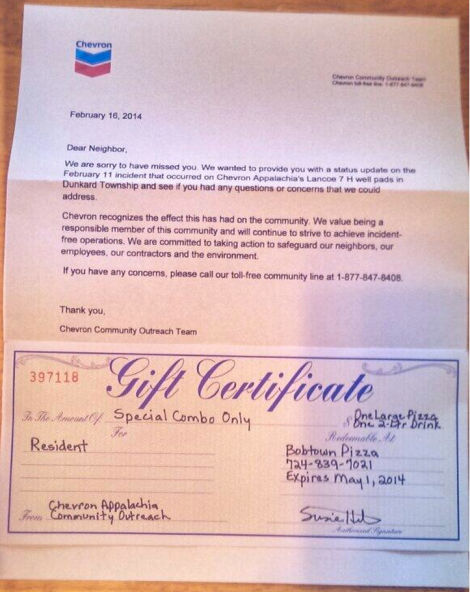
Chevron Appalachia, owners and operators of the well, wrote a letter to each of the hundred upset residents who had been affected, enclosing a gift certificate redeemable at Bobtown Pizza for a ‘Special Combo Only’. Its cash value was twelve dollars - the cheapest thing in the house.
Some enquiries were made in response to this, but Chevron demonstrated unflappable blandness, saying they wanted to ‘support Bobtown Pizza, a local business that has been providing meals to our first responders and workers at the well site.’
Kinda neat, huh? Can’t be too careful about new neighbours, specially if they start digging.


Crossword
Across
1 Enemy of eternal youth in need of a hand? (7,4)
9 Shelter for mostly warm salt (7)
10 The Spanish say yes to First Lady's basket (5)
11 Father's attempt at pie crust (6)
12 Freak trendy tart (6)
14 European thoroughfare where cheesy samples are regurgitated (6,7)
16 Stuff and nonsense and a German broad (6)
17 Fish is to turn up around barracks (6)
21 Cloth for birds with a speech defect? (5)
23 Immortal alien has renal problem (7)
24 How a musician might perform 'Lobe den Herren?' (4,2,2,3)
Hearing Aid Drop-in Clinic
Action on Hearing Loss Scotland runs monthly drop-in clinics for hearing aid users at the War Memorial Hospital in Lamlash. The next two clinics are on the following dates:
- Tuesday, 25th March
- Tuesday, 22nd April

A feisty Glasgow thriller
Seven years ago, when Cicely Gill started writing a gripping and entertaining crime novel called Ivory, nobody could have known that it would put a timely finger on one of the most pressing issues of the present day. With news that the Minister of Education has at last agreed to take action on FGM (female genital mutilation), a book that has this topic deeply buried at its heart is indeed timely. But Ivory is in no way a treatise. It’s a tense thriller, set in a very recognisable Glasgow.
Anyone who has walked through the Botanic Gardens and paused to stare down through the bars at the remains of the low level railway that runs deep below the lawns and flower beds will recognise the territory of Cicely’s book. The hidden network of tunnels is a world of its own, dark and dangerous, with only occasional access to air and daylight through drain covers or distant, disused openings. When Zara takes her young godson, Ben (and Ness, the dog) for a picnic on the riverbank not far from a tunnel opening, she is horrified when Ness digs up a bone that, though broken and partially burned, is clearly part of a human pelvis. As a cheerful young freelance journalist, Zara is not easily alarmed, but there is something about this partially charred, roughly buried remnant that makes her skin crawl. What’s more, a derelict-looking man lurches up when he sees them marking the place of their discovery with a circle of stones, and mutters an incoherent story about fire and something lost.
Zara, by nature reckless and somewhat slap-happy, is an irresistible sleuth. Prone to forgetting things and apt to leave windows unlocked against ominous burglars, she does not so much plan an investigation as tumble into it. Very quickly, a criminal network centred round one ruthless man starts to defend itself against her blundering, risky investigations, and things become more dangerous. Despite threats and a nasty mugging, Zara knows she must keep on. A friendly museum curator has told her that the bone Ness found is that of a 12-year-old girl who may have been the victim of a botched ‘cutting’ that killed her. This awful fact powers the book through to its ending, and a denouement in the final line is, though grim, well worth waiting for. The plotting of Ivory is intricate and requires close attention, but the author’s knowledge of Glasgow and her depth of human understanding make this a gripping book - a thoroughly good read.
Internet publications do not go through any editorial process, but only the most dedicated nitpicker will tut over a scatter of small slips such as missed inverted commas. Ivory shines through such minor matters with its great integrity and its beguiling, page-turning persuasiveness.
Ivory can be bought from Cicely Gill’s website, www.cicely.co.uk. Printed copies have also been produced for sale on Arran, and can be found in local shops at £7.99
Ivory by Cicely Gill
ISBN 978-0-9531014-50
Mallard Publishing
£7.99