The Science behind the Clyde 2020 Summit
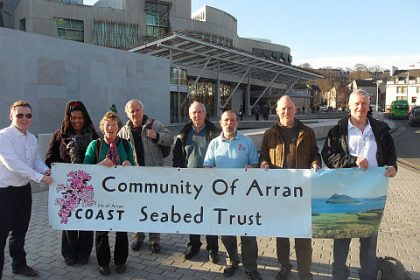
Last month, the Community of Arran Seabed Trust (COAST) were heralded as ‘trailblazers’ by the Cabinet Secretary for Rural Affairs and the Environment, Richard Lochhead, during the Clyde 2020 Summit in Glasgow.
While very welcome, this kind of recognition for COAST’s work has not always been forthcoming. More often than not throughout our almost 20 years of campaigning for better management of our marine environment, COAST has occupied the position of ‘thorn in the side’ of the Scottish Government and Marine Scotland.
 The accolade for COAST is indicative of a potentially significant change in the approach of the Scottish Government and Marine Scotland to the way our seas are managed. While partly driven by EU legislation, there does appear to be a realisation that the Scottish people and electorate are the main stakeholders in a well-managed marine environment rather than any particular vested interest. It was encouraging to be present at the Clyde 2020 Summit last week where there was consensus that the Clyde ecosystem needs drastic improvement to make it a healthier more diverse fishery and stronger economic resource for all who rely on it.
This consensus was not always the case. It has taken quite some time, and substantial bodies of supporting research to reach this point, and it is worth considering the recent history that led to the Clyde 2020 Summit and COAST’s role in that journey.
COAST has been campaigning for sustainable fishing and protection of Clyde waters since 1995. In 2008, after 13 years’ campaigning, the Lamlash Bay No Take Zone (NTZ) was put in place – a zone which celebrated its fifth anniversary last year with results from York University showing increased numbers of juvenile cod and haddock and a 40% more complex and healthier seabed than in the area outside of the NTZ, as well as higher densities of scallops, crabs and lobsters, both older and larger, being recorded.
While significant, the Lamlash Bay NTZ is only a small segment of the Firth of Clyde and COAST has for many years pointed out that the wider Clyde ecosystem is in a tragic state due to overfishing and poor management. In 2010, Callum Roberts and Ruth Thurstan’s paper ‘Ecological Meltdown in the Firth of Clyde, Scotland’ was published in response to COAST and others’ concerns and brought this issue to the fore. The paper showed a collapse in white fish landings related to the end of the three mile limit on trawling in 1984. This in turn stimulated the Heath and Speirs paper in 2011 which showed that while there were still fish in the Clyde, they were mainly very small whiting.
Following these papers, COAST asked the Environment Minister for a thorough review of all available science and relevant facts on the Clyde marine environment and fishery. This led to the Clyde Ecosystem Review, published by Marine Science Scotland in 2012 which concluded that the Clyde ecosystem was like ‘used agricultural land in need of restoration’ with no viable white fisheries.
However, none of these findings were accepted by the Clyde Fishermen’s Association who then claimed that different trawl survey methods would show larger fish did exist in commercially viable numbers. In response to this, additional surveys were undertaken and the results were previewed by Bill Turrell of Marine Science Scotland at the Clyde 2020 Summit last week. The figures confirmed exactly what had been found in the 2012 Clyde Ecosystem Review – that the Clyde is dominated by small whiting with no commercially viable white fish stocks.
There is still much work to be done to understand exactly what is happening in the Clyde. COAST will continue to drive this debate and will be conducting baseline studies within the proposed South Arran MPA as we wait for designation (expected this summer). In the meantime we want to thank everyone on Arran, and beyond, who have worked tirelessly to support our vision of a healthy and productive sea around Arran.