The Facts on Wind Turbines
Following the heated Arran debate on wind turbines, we decided to run a series on renewable energy of all kinds, with as much factual research as possible. We begin with wind farms.
Inducements to invest
A quick trawl through the Internet shows an eagerness to offer finance that sometimes verges on the incoherent. ‘Project finance; a stack pound notes!’ (sic) one firm burbles, while offering to ‘provide an integrated package to develop suitable wind sites … with no capital outlay from the landowner.’ Another promises ‘a regular index-linked annual income based on the energy generated by the wind turbine.’ Even more attractive are offers of 100% unsecured wind turbine project finance for farms and businesses. One outfit offers ‘100% of project costs (post planning) without the need for security’ and adds, ‘This can be an extremely attractive.’ A telephone number is provided. Hardly surprisingly, landowners are keen to climb onto what sounds like a profitable band-wagon.
The costs
With wind energy, the fuel is free. Once the project has been paid for, the only expenses to be met are operation and maintenance, plus fixed costs such as land rental. However, the capital cost is high, between 75% and 90% of the total for onshore projects.
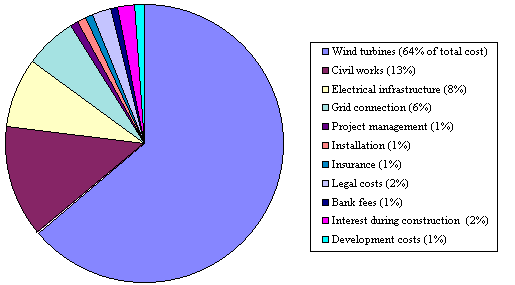
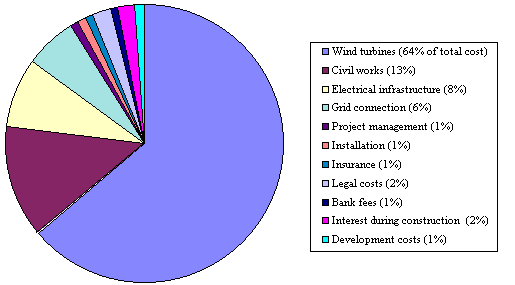
The capital cost breakdown of a typical 5 MW onshore project is shown below. The big blue section is the cost of the hardware involved. Add in the three next-to-largest sections, which cover installation work, and you are left with very little else to find.
Public authorities and energy planners require the capital to be paid off over the ‘technical lifetime’ of the wind turbine, currently estimated at 20 years. Hence, projects such as the small windfarm on the Isle of Gigha’s three turbines can pay off the construction costs quite slowly, while enjoying a handsome income for the island. The private investor, however, will have to recover the cost of the turbines during the length of the bank loan, which will probably be a considerably shorter time. He or she will also have to pay a higher interest rate that the one available to public authorities.
Is wind efficient?
Basically, yes – and improving quite quickly. Between 1990 and 2002, world wind energy capacity doubled every three years. Each doubling saw prices for wind energy fall by 15%. A report commissioned from the European Wind Energy Association by the EEC in 2004 showed a drop of over 50% in production costs during the preceding 15 years. It remarks: ’As a rule of thumb, manufacturers expect the production cost of wind power to decline 3-5% for each new generation of wind turbines they add to their product portfolio.’ Future cost reductions will depend largely on how the market grows, but a doubling of total installed capacity will see the cost of new turbines falling by between 9% and 17%.
Wikipedia points out that there is far more extractable power available from the wind than from all other sources. A comprehensive study done in 2005 found the potential of wind power on land and near-shore to be 72 TW. The TW is a terawatt, or a trillion watts. 72 of these work out at 54,000 million tons of oil equivalent per year. That is over five times the world’s current energy use in all forms.
The alternatives
A report commissioned in 2004 from BP by the Royal Academy of Engineering makes interesting reading. If the planet-threatening output of CO2 is ignored, then coal and gas are the cheapest forms of energy generation. However, all countries are being forced to put a levy on technologies burning fossil-fuels, and BP admit that this will change the picture. ‘The lower efficiency of steam plant, combined with the greater level of carbon found in coal compared with natural gas, means that the gap between CCGT plant and other coal-fired technologies will widen as the cost of CO2 increases. The cost of nuclear and other renewables (deemed to be carbon neutral) remain unchanged and, therefore, become more competitive as the specific cost of CO2 emissions increases.’ With a carbon tax of £30 per tonne, the cost of all fossil fuels doubles, from 2.5 pence per kilowatt hour to 5.00. Wind power remains unchanged at a level estimated by BP as 3.7p. Seven years later, this will be considerably less.
Problems
The main difficulty for the wind power industry is the intermittent nature of turbine generation. When the wind doesn’t blow, the turbine blades don’t turn. Electricity is very difficult stuff to store. Battery technology has always been bulky, heavy and expensive, relying as it does on metals such as lithium that are in short global supply. ‘Flow’ batteries, using two tanks polarised differently to induce a constant movement of current, may be a way to meet this difficulty, but at the moment, it puts wind power at a definite disadvantage. There is, too, the question of visual intrusion. Typically, wind farms are sited on exposed and windy places, which are apt also to be wild and beautiful. In 2011 we are much closer to a crisis of fossil fuel supply, and the whole question of renewable energy is moving into a state of some urgency, but it does not remove the need for scrupulous care about the use of wind energy technology.
Advantages
As Maria MacCaffery pointed out in the Guardian recently, the sector employs 10,000 people and in 2010 it contributed 10bn units of clean electricity, the equivalent of 4 million tonnes of coal. Germany, not always recognised as a big wind-power user, has 80,000 people working in the wind energy sector. However Britain, perhaps because its relatively late entry into wind power meant it started with better technology, is more efficient. A single turbine here returns more than 40% more electricity than a similar one in Germany. As an island where wind is apt to blow for most of the time, we have a natural advantage when it comes to generating fuel-free power.
The environment
An EC-funded project conducted by ExternE was commissioned by the EU in 2010 in order to calculate the cost of any environmental damage involved in power generation. The resulting report stated that existing estimates of the cost of producing electricity from coal or oil would double if external costs,in the form of damage to the environment and health, were taken into account. By the same criteria, and the cost of electricity production from gas would increase by 30%. The study further estimates that these costs amount to 1-2% of EU GDP – in other words, between €85 and €170 billion. This does not including the potential cost of global warming and climate change. It points out that if those environmental costs were levied on electricity generation according to the impact it causes, many renewables, including wind power, would appear as the best alternative.
The outlook
Things have moved very fast in the last two or three years. We are faced by incontrovertible evidence that the era of easily-available fossil fuel is ending, and the battle between the big power interests and the environmentalists is hotting up. At present, wind farm infrastructure is a product of the petro-chemical industry, which itself may be looking at a shorter life than anyone expected, but there are some possibilities that turbines could be built using fine timber for their blades rather than steel. There has to be a question mark over their sustainability in an Armageddon age where conventional manufacturing is impossible, but we are not there yet, and wind energy cannot be discounted. Nobody has put much thought into the idea of micro-generation, in which every building has a small turbine making its contribution to the national grid and to local use. The main problem is electricity storage, and it is to be hoped that engineers are working on new types of battery. Once wind energy can be kept and its use spread across slack periods, it will be far more useful. Meanwhile, each application must be judged on its individual merits. And we must not be seduced by the lure of the quick buck.
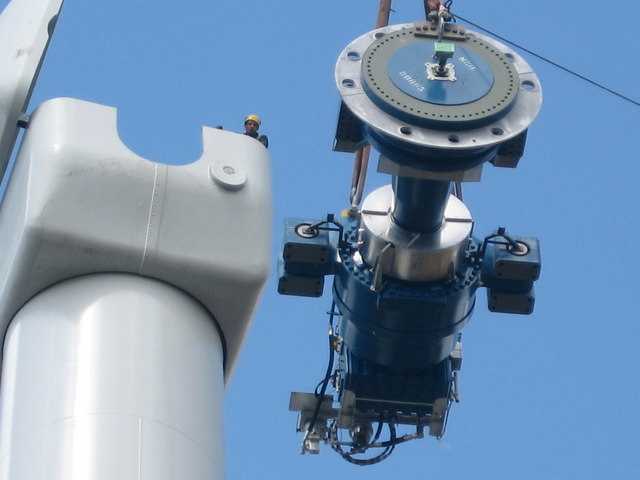
of a wind farm on Scout Moor in Lancashire.