
The New Year has seen a good number of new people asking to be added to our Send list, including several from other countries – and for the cynical, no, these are not robots but genuine human beings! We welcome new Voice readers warmly.
We are also seeing an increase in take-up for our amazingly good-value advertising. Where else can you buy individually designed, full-colour publicity for your product or service, for only £35 for a run of six? Even better, if you are a small local business, we charge only £5 for each insertion. If you are represent a charity and make no money from the event you seek to publicise, there is no cost at all. An enquiry to info@voiceforarran.com will bring you help and consultation about designing your advert – it couldn’t be easier.
Voice for Arran is a genuinely voluntary community online newspaper. It seeks to help all island people to make a living and enjoy the wide variety of Arran activities – and there’s a lot of lively writing on a dizzying range of other stuff, together with brilliant pictures and videos. We have no corporate sponsorship of any kind. Everyone who helps to produce it works for nothing. Inevitably, there are some expenses to cover, and if you can make a small donation, it would be a big help. (Just hit the Donate button above, or send us a cheque c/o Aorangi, Whiting Bay, Arran.) If that’s a tough request in the present strapped-for-cash times, then could you help increase our readership by asking your friends if they would like to be on our Send list? This simply means they get the Voice in their inbox on the first day of every month, free and with no effort from them. The magazine goes out blind copied, so nobody’s e-mail address is revealed. Anyone who would like to join this big family of readers just needs to drop us an e-mail on info@voiceforarran.com. We do the rest.
Marvellous cello and guitar at Music Society concert
At lunchtime on Saturday 14th January, 72 people gathered for a recital given by Robert Irvine and Allan Neave on cello and guitar respectively, and were thrilled. This was one of the most enchanting performances the Music Society has ever put on, with a mingling of modern and mediaeval sound that was both pure and exciting.
Robert Irvine, born in Glasgow, won a scholarship to the Royal College of Music when only 16, and his shining talent has matured into a mastery that makes any audience feel in the presence of something extraordinarily special. With the equally brilliant Allan Neave, who teaches at the RSAMD and is invited regularly to all the leading music colleges of Europe, he had the listeners enraptured from the first note on his fine Venetian cello, made in 1725. The singing tone of the instrument blended perfectly with the often lute-like guitar, and the two players ranged easily from Vivaldi to contemporary composers.
The programme included well-loved pieces such as Fauré’s Après Un Rêve and The Swan by Saint-Saëns, but the Seven Short Pieces by Carlo Domeniconi were a delight in their contrasting speeds and rhythms, from a cat-and-mouse chase to a mysterious reflection then a languorous melody that used sliding notes on the cello to intriguing effect. Both players contributed notable solos, Allan performing a modern piece based on an octave motif that demanded re-tuning of the guitar and Robert giving a clear, highly intelligent rendering of Bach’s Suite No 1.
The relaxation and good humour of the players, combined with technical and artistic mastery, made this an outstanding experience for all those privileged to be present
A Night at the Opera
On Saturday 11th February at 7.30pm, Opera Highlights will burst forth in Brodick Hall. Four young singers from Scottish Opera will be coming to Arran to perform arias and ensembles from well-known operas including Bizet’s Carmen, Mozart’s Don Giovanni and Puccini’s Madama Butterfly. Among the well-loved songs are Where e’er You Walk, from the opera Semele – but there will be some exciting work by Britten and Rimsky-Korsakov as well. As if that were not enough, the Arran audience will be among the first to hear Dance ‘til the Sun Sets by Gareth Williams, Scottish Opera’s first-ever composer in residence. Scottish Opera’s Head of Music Derek Clark has been selecting the Opera Highlights programme for over a decade, but he is particularly excited about Gareth’s work. The composer worked closely with the four singers in revising the piece for this cameo performance, and says, ‘It’s been an exciting challenge for them, and will make for a real treat for audiences.’ He adds, ‘It fits beautifully into the programme too, which is a real mixed bag of familiar favourites and lesser-known gems, so even if you’ve never tried opera I’m sure you’ll find something in there to love.’ Opera buffs, of course, will need no enticement – this promises to be an evening of sheer delight.
Gareth Williams is a lecturer at the RSAMD and has composed works for the Hebrides Ensemble, the Paragon Ensemble, Symposia, the Black Hair Ensemble, and the London Sinfionetta. He was the winner of the British Conservatoire Composers Forum 2000, and in 2004 won the Dinah Wolf prize for composition. Dance ‘til the Sun Sets has a libretto by Marjorie Chan and was developed during an intensive week-long project for writers and composers.
The four singers who will be performing on Arran are baritone Marcus Farnsworth, soprano Anita Watson, mezzo-soprano Rosie Aldridge and tenor Robert Anthony Gardiner. Susannah Wapshott, who will accompany them on the 5 week tour is at this moment packing her own piano to bring.
Tickets from the Book and Card Centre in Brodick.
& online at http://www.ents24.com/web/event/Opera-Highlights-Brodick-Hall-2751121.html
For any further details, see www.scottishopera.org.uk
Arran to India and Nepal
Sounds. Sights. Smells. Nothing quite prepared me for landing in Kolkata on a first journey outside the familiarity of European cities. Immediately the profusion of colours of the women’s saris; the cacophony of horns; the countless yellow taxis; the sweetly acrid smells; the sights of people living and working on the streets; rich and poor mingling in complete acceptance of one another and the sheer vitality of this chaotic and dilapidated city were all completely mesmerising. It would have been enough to sit in our minibus all day just observing lives which are so different from ours and yet so dignified, no matter what the living conditions.
The experience continued to be enriching and life enhancing, whether it was in Kathmandu amidst the temples, tourists and thousands of motorbikes, gazing in awe at the Himalayan ranges at 8,500 feet, being thrilled by drifting in dug out canoes past open mouthed crocodiles, travelling up breathtaking roads to Darjeeling, enjoying the steamy delights of the famous toy railway or being enchanted by the wonderful singing and innocent simplicity of the children at Doctor Graham’s Homes, the school set up for poor Anglo Indian children in 1900 by Reverend Dr. John Anderson Graham which is still dedicated to the education of some of the poorest children from Kolkata.
No one could fail to be humbled by the extraordinary grace and dignity of the Indian and Nepalese people. Of course there is the dark side – the poverty and wretchedness of many of those who live and work on the streets of the cities and the contrast of this with the wealth of the new India. Of course there is indignation on the part of a western visitor, privileged to live in an affluent society, at a government apparently not dividing the new wealth sufficiently, but there is an optimism about India and Nepal which suggests that corruption will be overcome, children will not continue to be exploited and poverty will be dealt with because these are countries where tolerance, compassion and humanity are dominant.
John Webster of King’s Cross is organising a tour to India and Nepal in November of this year. (See advert)
To view the slide show below without Flash or on an ipad or iphone please see here.
Corrie Film Club – the risks of rearing ravens
Cría Cuervos, to be shown in Corrie Hall on Sunday February 12th, won the Special Jury Prize Award at the 1976 Cannes Film Festival, for good reason. It is an extraordinary film about an eight-year-old girl thrown into a state of half fantasy by her father’s death – not macabre but with a strange, allegorical poetry. The title comes from a Spanish proverb, ‘Cría cuervos y te sacarán los ojos’, meaning, ‘Bring up young ravens and they’ll peck out your eyes.’ In other words, children treated as if they are fierce birds will turn out to be exactly that. Directed by Carlos Saura, it features Ana Torrent as the child of the same name though Geraldine Chaplin takes over the part as Ana grows older. Chaplin was Saura's partner and inspiration, and appeared in ten of his films. In Cría Cuervos she speaks Spanish with an English accent as the child’s mother, but when playing Ana as a young woman she is dubbed by actress Julieta Serrano.
The story begins with eight-year-old Ana’s overhearing of her father in bed with a woman who dresses quickly and rushes out of the house. Ana goes into the room and finds her father dead, apparently from a heart attack. She carries a half-full glass of milk down to the kitchen and washes it carefully. Her mother, unaware of what has happened, scolds her for being up so late and sends her off to bed – or does she? Reality and fantasy mingle. Ana’s mother is already dead. She has blamed her father, a Fascist military man, for her mother’s death, and the glass of milk she gave him contained a white powder she believed to be lethal, which is why she washed it so carefully.
Aunt Paulina comes to supervise Ana, her two sisters and a wheelchair-bound grandmother, helped by a house-maid called Rosa. Ana takes refuge in the basement, where she keeps her 'lethal' powder, and where she finds an apparition of herself from twenty years in the future. This adult Ana, looking exactly like her mother, recalls her childhood as a long period of time, ‘sad, full of fear, fear of the unknown'.
Ana rebels against her aunt's authoritarian style. Though diverted by the presence of her two sisters, Ana's only true companions are the family maid, Rosa, and her pet guinea pig, Roni. When she finds Roni dead in his cage one morning, she feels there is nothing more to live for. She goes to see her grandmother and offers her a chance to share in merciful death through a spoonful of the lethal white powder that killed her father. The old woman knows the powder is simply bicarbonate of soda. Ana’s mother had told her, perhaps to warn her that it was not sugar, that it was a poison so powerful that one spoonful would kill an elephant. But the grandmother does not explain this, and Ana tries to poison her aunt with a glass of milk containing the same powder. But in the morning, Paulina is still alive. Ana goes to school with her two sisters, for the first time seeing the vibrant and noisy city that has never previously been part of her ghost-ridden world.
This film was made during a period where Carlos Saura was considered one of the great opponents of the Franco regime. He took refuge in the obvious smoke screen, saying that childhood ‘is one of the most terrible parts in the life of a human being. … you've no idea where it is you are going, only that people are taking you somewhere, leading you, pulling you and you are frightened.’ The film can be seen this way, but it has a double layer of allegory. At a time of intense political repression, its contrasting of reality and mistaken belief were seen by sympathisers as a powerful criticism of fascism. It was shot in the summer of 1975, as Franco lay dying, and was a huge international success. It’s now considered a classic of Spanish cinema.
Screening at Corrie Hall starts at 8.00 pm. All are welcome, and there is no charge, though a voluntary contribution to the hall’s upkeep would be gratefully welcomed.
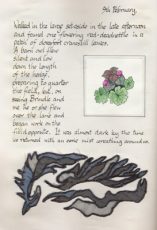
Judith Baines
One of the projects I was given to do for my City and Guilds course in embroidery and design was to make a diary wherein I responded to things that interested me in a variety of different ways – with written descriptions, drawings, paintings, pieces of textile work, photographs, etc.
This suited me down to the ground and when, some years later I decided to record the wild flowers that grew on a favourite dog walk throughout a year I used the same format.
Because I enjoyed calligraphy I decided to start each month with a loved poem and decorate them with appropriate border designs.
Later I photographed two very different thistle rosettes and interpreted them in embroidery by stretching old tights in a ring and machining the leaves. When the fabric was released the tights sprang back so the rosettes scrunched up satisfactorily when cut out. I mounted them on a sponged silk background.
The little piece of textile work depicting the mist is three layers of crystal nylon machined then cut away to reveal the different colours.
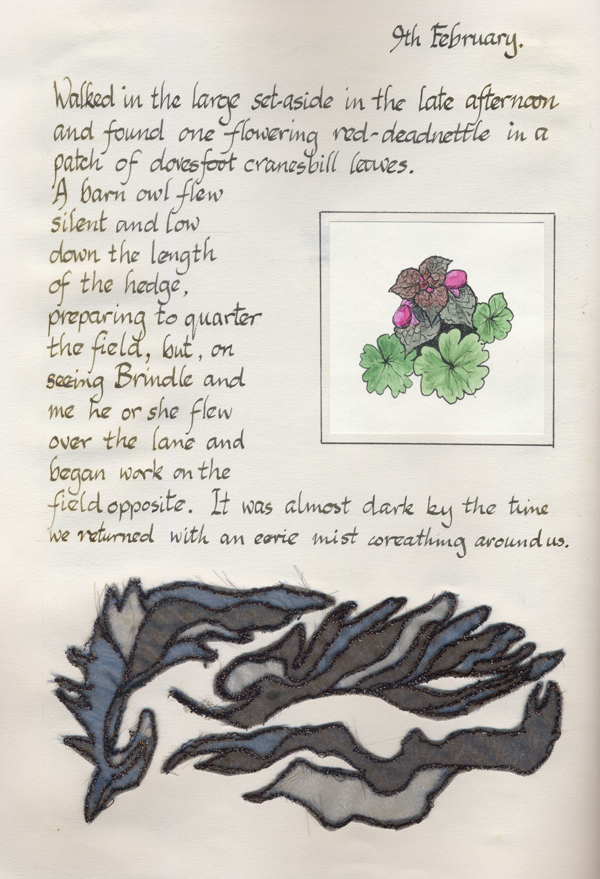
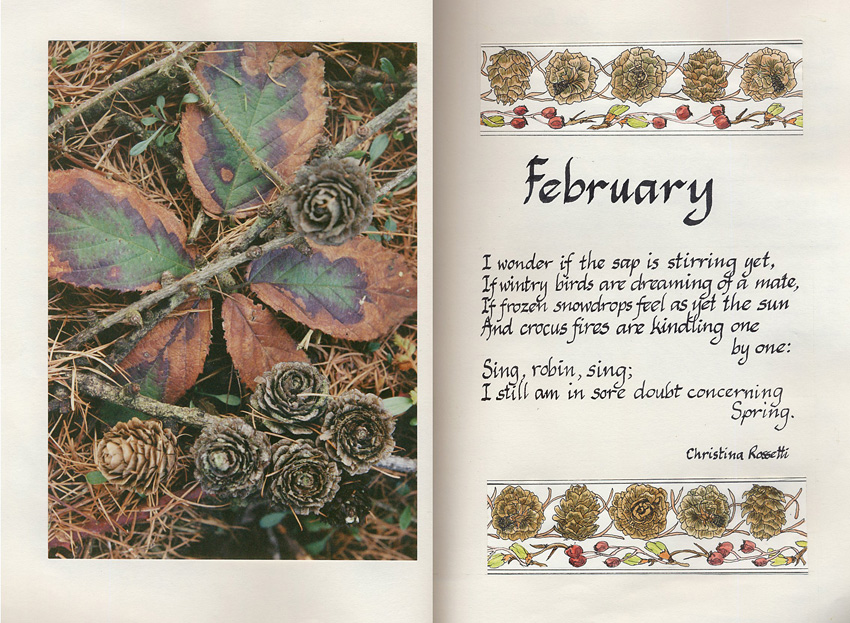
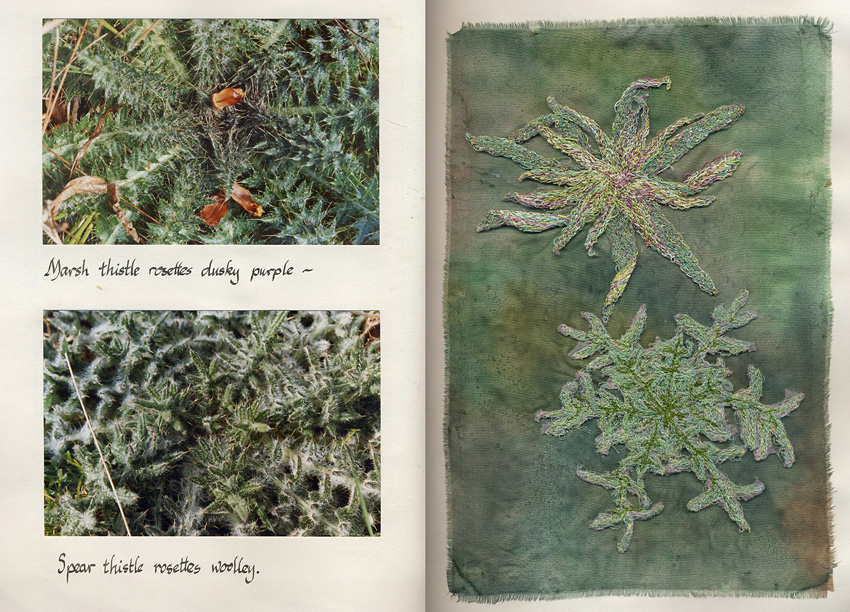
Click on the pictures above to see larger versions.
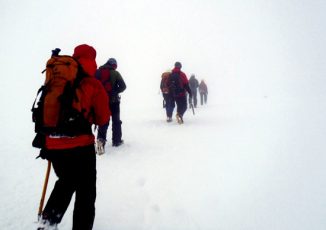
Walking on the Wild Side: The White Room
There is no doubt about it, white-outs in the mountains are scary, but they are not dangerous on their own if your navigation skills are up to scratch.
In the White Room there is nothing. You can blink, strain your eyes and try to shake the dizziness from your head but the blank screen in front of you will not flicker. Looking down at your rime encrusted compass you watch the needle settle on North and take a few stumbling steps forward on a surface that your eyes don’t register. Your quads pump. Your legs at least tell you that you are walking uphill. Ahead, a scrap of windblown lichen tumbles across the snow and helps your own internal compass to settle.
Being the navigator on point in a “white-out” is a lonely business. You can turn to look at your friends in bewilderment who will in turn offer words of encouragement, but while they have your reassuring footprints and rucksack to look at, they can’t fully comprehend the dizzying vertigo that comes from seeing nothing. The experience goes from bizarre to hellish when strong winds and stinging spindrift are added to the mix. A cocktail of agony and blindness only slightly eased with ski goggles (now you enter the marginally cosier “Pink Room”).
To experience the true White Room you need a thick blanket of snow, removing any sign of surface details. All rocks, blades of grass and footprints are erased and the horizon mingles freely with atmospheric mist and snow. It is impossible even to see which way the ground dips, and I’ve seen people rolling snowballs out in front of them just to judge the gradient before they step on it. The disorientation of navigating in a full white-out can lead to compelling urges to lie down on the floor to confirm that gravity and the earth still exist.
Knowing how to navigate in Scotland’s mountains at any time of year is very important, as our weather is so changeable and bad visibility or lack of concentration can easily lead to route finding errors. In winter, white out conditions make navigation exceptionally difficult and the stakes are increased with more hazards and greater consequences for mistakes. There is no doubt about it, white-outs are scary, but they are not dangerous on their own if you know how to deal with them when they overtake you, and practice your micro-navigation skills regularly so that when you need them they are right there at your fingertips.
Learn how to walk on a bearing. Sighting on objects such as rocks or tufts of heather just in front of you will work in summer and even in the dark, but in the White Room you have nothing to sight on so will have to take it really steady. Try sending people out in front of you and using the compass to sight on the line ahead rather than staring blankly in to the mist. You can also turn around and take a back bearing along your snowy footprints to check how well you are doing.
Calculate the distance you have travelled using timing. Calculate your speed, and add about a minute for every 10m vertical height gained. If you can’t do the maths with a cold brain, try laminating a little cheat card with timing calculations already worked out for everything from 100-1000m, and at 2, 3, 4 and 5km per hour, and attach your cheat card to your compass.
Count every pace. Pace counting is very useful for distances under 500m. Experienced navigators know how many paces they take when walking for 100m on easy ground. Usually each double pace is counted, for example, every time the left foot hits the ground. Experience helps you learn how many extra paces to add in deep snow, uphill or with a heavy pack.
Avoid Hazards. Avoid cliff edges, gullies and steep ground. These are often concealed by deep snow and cornices, and could be invisible in a white-out.
Don’t skimp on equipment: A map, a spare, a compass, a head torch and ski goggles are essential winter equipment, and should be included along with your ice axe and crampons.
If you are new to navigation, you may wish to start with a book to introduce the basics. There are lots of great ones on the market, but my favourite is a small publication called Mountain Navigation by Peter Cliff, which has been in print for a while but is still widely available. There is also no substitute for practical experience, and while the winter days are claggy and dreich, there is certainly plenty of that to be had on Arran’s hills!
The good ship Lord of the Isles
Of the various replacement vessels sent to Arran while the Caledonian Isles goes for her annual refit, surely the best must be our current one, the Lord of the Isles. Comfortable, roomy and remarkably steady, the boat was designed sensibly, with the passenger in mind. The Observation Lounge has windows from knee level to ceiling, with upholstered benches that positively invite comfortable relaxation in front of the changing vista. A walkway outside is perfect for summer weather, and last week it was providing access for a couple of crew-members who were cleaning the big windows with lots of soapy water.
It is one of the mysteries of CalMac that, having built such a splendid boat in 1989, four years later they produced a ferry for Arran that nobody can see out of and that has so much freeboard as to be particularly vulnerable to side winds. But of course, the Caledonian Isles carries 110 cars, as against 56 on the Lord of the Isles, and double the number of passengers. With Arran’s heavy tourist trade in the summer, a bigger boat was obviously needed. Right now, with a new proposition for two smaller boats being considered, all possibilities are on the table. (See the following feature, Daft ferries review?) But, carrying capacity and harbour negotiability apart, it would be nice to see out of the windows.
Daft ferries review?
On December 21st, the Scottish Government issued a “Draft Plan for Consultation” on the Scottish Ferry Services, drawn up by Transport Scotland. The draft plan is available online here and is open for public comment until 30th March. It covers the whole of Scotland but the section of interest to Arran starts on page 21 and is reproduced here:
- Arran currently has two ferry routes; the principal route is from Ardrossan to Brodick, and the secondary route is between Lochranza and Claonaig on Kintyre.
- Currently a typical service day on Ardrossan to Brodick would run from early morning to early evening, with the first sailing to the mainland around 8.30 am and the last sailing around 7.30 pm. The Friday service offers an additional sailing later in the evening. There are around 5 to 6 sailings per day Monday to Saturday, less on a Sunday.
- Our needs based assessment for Arran suggests increasing the service provision on the Ardrossan to Brodick route so that the new operating day runs from very early in the morning (around 7 am) through to much later in the evening (at least 10 pm). We also suggest increasing the frequency of the service so that it closely matches a shuttle service. This proposal would substantially increase the connection between Arran and the Scottish mainland.
- There are no low cost practicable options for how we might increase the service provision on Ardrossan to Brodick. Currently the route is served by one large vessel. To double-crew this vessel so that we could extend the operating day would be extremely expensive.
- A better long-term option would be to replace the existing vessel with two smaller vessels. These vessels would be more fuel efficient and each vessel would require a smaller number of crew than the current vessel. So while there is a substantial initial investment, the increase in running costs is significantly less. We may be able to achieve this change during the next CHFS contract (2013-2019) or it may be that this change is only possible as part of the vessel renewal programme to be published as part of the Final Ferries Plan.
- We recognise that the current harbour infrastructure at Brodick acts as a capacity constraint and that this needs to be addressed prior to the introduction of RET on this route. Major investment is planned at Brodick to replace the ageing harbour infrastructure. That work will be taken forward by CMAL over the current Spending Review period 2012/13 to 2014/15. In addition to addressing the current capacity problems, the improvement work will improve the operational resilience of Brodick for existing and future vessels.
Claonaig to Lochranza
- Claonaig to Lochranza largely fulfils a specialist function in the movement of dangerous goods. In terms of passenger and vehicle numbers it is very much a secondary route to the Ardrossan and Brodick service – for every passenger travelling between Claonaig and Lochranza, there are around 16 passengers travelling between Ardrossan to Brodick. The figure for cars is around 9 to 1 in favour of Ardrossan to Brodick.
- It would be our intention to review services between Claonaig and Lochranza following the upgrade to Ardrossan to Brodick.
- In summary, our proposal is (a) for the Ardrossan to Brodick service to be upgraded to a two-vessel service operating a more frequent shuttle service through to the late evening and (b) services between Claonaig to Lochranza would be reviewed following these changes to the Ardrossan to Brodick service.
- The community is asked for their views on these proposals.see http://www.surveymonkey.com/s/QZ25CFT
Good times for the pop-shop
At a time when most of us are groaning under increasing costs and decreasing services, Uncle is doing nicely, thank you. A announcement from a firm called H&T Pawnbrokers is a tad smug about its virtuous work in helping people to ‘release value in unwanted assets.’ Its services expanded considerably in 2011 and it won the Investors In People Silver Award. The current year is looking so rosy pop-wise that H&T will be hiring 250 additional staff.
At last we get some glimpse of economic policy. The country is in hock and that’s just fine. No action needed - just dish out an occasional gong.
b-328x210.jpg)
Agriculture on Arran
Despite the attempts of the Arran estate to increase productivity throughout the 19th century, most of Arran’s farms remain relatively small to this day. In the North of the island, granite sand is common, so the largest farms are in the Southend or the Shiskine valley, where the best loam is found. When the old run-rig system ended, some of the new farmers divided their arable land into fields by fencing, some grew thorn hedges and others built the dry stane dykes that can still be seen. Hedging was easier, but it had the disadvantage that until it was substantial enough to be stock-proof, animals had to be tethered to avoid straying. Only six farms were big enough to incur a rent of £100 a year or more. Eleven paid between £40-£100, thirty paid less than £40, but the vast majority paid only of £20.
The construction of the roads that cross the island were needed when horses and larger wagons came into use. An elderly inhabitant of the Island recorded that in his lifetime, he’d seen big changes. Around 1820 when he was young, there were little or no road system on Arran, and no wheeled carts. The usual pony was a small breed, six or seven of them being used to pull a wooden plough. The produce of the fields was transported in creels slung over the pony backs or trailed on a wooden sledge. Often, working the fields was a family affair, with the man controlling the plough handles, women leading the ponies and children driving them. ‘Today in 1880,’ he said, ‘conditions can better be explained by the improved wage structure of the farms.’ By then, dairymaids received between £8.00 and £12.00 for 6 months, with board. Ploughmen were paid £12 to £15.00 for 6 months with board, but they were often expected to work 10 to 12 hour days, six days a week, starting from 6.00 a.m. At harvest time casual labourers (some men but mainly women) received 2 shillings and sixpence to four shillings per day, but had to bring their own food. During the planting of potatoes or turnip thinning the same workers received one shilling to one shilling and sixpence per day. Shepherds were engaged on an annual basis of £40.00. In addition, they had a free house, an allowance for coal or supply of peat, grazing for up to 2 cows and an area planted with potatoes – which goes to show how highly valued sheep had become.
Apart from the new roads, the main thing that made a big difference to island life was the construction of piers to serve steamer traffic. The original Brodick Pier was built in 1872. Lamlash Pier followed in 1884 and Lochranza four years later in 1888. Whiting Bay got its pier in 1899. The paddle steamers ran a daily service of one return journey and changed the lifestyle of the residents, enabling them to think about the mainland as reasonably accessible.
Lamlash was considered to be the leading village then, with a branch of one of the Scottish Banks (probably the Clydesdale) located at Seafield. It had been built around 1770 on a 99 year lease from Arran Estates, for the Croil family. The metal safety bars on a window were still there in the 1960s, but the site of the window has now been bricked up. There was a branch of the bank in Brodick but only open 2 days per week, whereas the Lamlash bank opened every day. The village also contained the Coastguard station [Marine House].
Clyde paddle steamers called at Corrie, Brodick, Lamlash, Kings Cross and Whiting Bay on the island’s east coast and Lochranza, Pirnmill, Machrie, and Blackwaterfoot on the West, en route to Cambeltown. With no piers there, small local rowing boats were used to ferry passengers and goods ashore. The influx of holidaymakers began to have a big influence on the Arran scene. New buildings were put up to provide hospitality and the standard of accommodation that visitors expected. Local and sporting events were laid on. Some holidaymakers brought sports gear with them and expected to be able to practise their chosen pastimes, which led to the first 9-hole golf course being formed at Lamlash in 1889. Mr James Allan, formerly of Balnacoole, had broken new land at the Clauchlands Farm Lamlash and increased it to some 260 acres, and he also leased Blairmore Farm and agreed to release part of the arable land to form the golf course.
The tourist view of Arran people was expressed by one visitor, slightly condescendingly: ‘The Islanders are a quiet, inoffensive race, many live for the maximum life span. Churches and schools are evident throughout the Island and altogether the Islanders register few complaints.’
Perhaps the same is true today.
This is the final episode in Jim’s series on the history of Arran’s agriculture, and we are most grateful to him for contributing it. Happily, he is now researching some of the background to Arran’s unique geology, and we look forward to publishing a further series of articles.
Newsletter from Katy Clark
Our busy MP includes the following items in her monthly newsletter.
Unemployment in North Ayrshire
With unemployment continuing to rise in North Ayrshire I met with the Scottish Secretary, Michael Moore MP, just before Christmas to discuss unemployment and the Ayrshire economy. Mr Moore has agreed to visit North Ayrshire in the near future to discuss what more can be done to assist the economy of North Ayrshire and Arran.
Trade Union Activities
I voted against the Trade Union Officials (Refund of Pay to Employers) Bill which was brought by Tory backbencher, Jesse Norman MP and was pleased that the Bill was defeated 211 votes to 132. This Bill would have meant that unions would have to pay back wages which has been paid to public sector employees while doing union work.
The Welfare Reform Bill
The Government took a triple defeat on their plans to overhaul the benefits system in the Lords last week. Peers defeated plans to means-test employment and support allowance (ESA) after just a year for disabled people including those suffering from cancer or recovering from a stroke. The Government was also defeated on plans to time limit ESA for people going through cancer treatment and limiting access to ESA for young people. Whilst the Government have said they will reverse the defeats when the Bill returns to the House of Commons I am pleased that this will mean there will be more votes in the Commons and more chances for the Government to be defeated on their plans.
Meeting with Palestinian Leader
On Monday I took part in a meeting with the President of the National Palestinian Authority Mahmoud Abbas and MPs in the House of Commons. Mr Abbas is on a visit to the United Kingdom as a guest of the Government to discuss peace talks which are currently taking place between the Israeli Government and the National Palestinian Authority. Last year Mr. Abbas tried to secure recognition for Palestinian as an independent state at the United Nations but this bid has been put on hold due to a lack of support from members of the Security Council, including the United Kingdom.
Equality for Veterans
I have agreed to Chair the new All-Party Parliamentary Group on Equalities for Veterans’ Pensions which had its inaugural meeting this month. Veterans from HM Armed Forces who left service before 1975 are not entitled to a military pension unless they served 22 years in other ranks or 16 years as an officer. Hundreds of thousands of veterans today, therefore, are not entitled to a military pension. The group seeks to debate and discuss the existing discrepancies in pension rights for veterans, to raise awareness and to encourage the Government into action on the issue.
Pub Companies
In a recent report by the Business, Innovation and Skills Select Committee, of which I am a member, concern was expressed about the contracts between pub companies and the tenants who run the pubs. The contracts mean tenants are forced to buy beer at inflated prices from the pub company compared to on the open market. CAMRA estimates that between Dec 2010 and June 2011 14 pubs closed a week and of them 9 were beer-tied pubs but disappointingly the Government have said they will not take action on this matter. I am very concerned that this trend will continue and welcome the debate in Parliament on this matter.
Fish-farm sues activist
A fish-farm company called Mainstream Canada has brought a lawsuit against Don Staniford, who lives in British Columbia but has been on Arran and is a great supporter of COAST. Mainstream alleges that Mr Staniford used ‘defamatory and false statements’ intended to damage the salmon-fishing industry. Mainstream, which is part of the vast Oslo-based company, Cermaq, has been particularly upset by graphics similar to the health warnings on cigarette packets and pointing to the same kind of dangers from fish-farming. Staniford points out that the tobacco industry over the last 30 years used tactics that ‘smear the science and deny the scientific impacts of smoking’ in an effort to defend their product, and holds that the fish-farming industry is guilty of exactly the same thing.
The trial is expected to run for 20 days at the BC Supreme Court in Vancouver. With costs running at approximately $3,000 dollars a day, Mainstream probably assumed that Staniford would back down. However, the public has risen magnificently to help him, and money is flooding in through the gofundme.com website and through PayPal and cheques. A Norwegian fishing group, The Wild Salmon Warriors of Norway, has kicked in 60,000 Norwegian Krone ($10,000 CAD) of its own.
Damien Gillis, a journalist and film-maker who worked with Staniford on the documentary, ‘Farmed Salmon Exposed’, summed up the situation in a piece for the Pacific Free Press called Salmon and Goliath. Staniford, the former director of the global Pure Salmon Campaign, has travelled the world to bring together an international alliance of over 30 groups and coalitions working for the defence of wild salmon. Although a single voice against a vast industry, Staniford is well known in Norway, Scotland, Ireland, Iceland, Chile, the United States and Canada.
The Canadian Press states that the company is seeking ‘$100,000 in general damages, $25,000 in punitive damages and a permanent injunction to stop Staniford from writing, printing or broadcasting defamatory words against Mainstream.’ On his youtube video, Staniford makes it very clear that the battle ‘about justice for wild salmon and freedom of speech.’ He says he is ready to ‘go all the way’ to defend wild salmon against the damage done to them by the disease and parasites allegedly spread by the farmed fish industry.
Watch the youtube video -
http://www.youtube.com/watch?v=y2eHF38C4wQ&context=C323da8fADOEgsToPDskI--XvS8kd8gju_J9RqAGH0
or see Pacific Free Press
http://www.pacificfreepress.com/news/1/10694-salmon-and-goliath-the-case-of-don-staniford.html
Scottish fishermen exceed limits by £8m
Four skippers of fishing boats admitted last month in the Edinburgh High Court that they had exceeded their quota of fish by a level that made them more than £8million. The charges relate to illegal landings of mackerel and herring at Peterhead between 2002 and 2005, when the skippers falsely declared the quantity of fish they landed as a means of evading the allocated annual fishing quota.
James Duthie, master of the Sunbeam, had made 56 landings worth £1,936,546.
Ian Buchan, master of the Quantus, had made 49 landings worth £4,495,568.
John Macleod, master of the Charisma and the Prowess had made landings worth £1,159,761.
Michael Macleod, master of the Charisma CY88 had made 34 landings worth £907,840.
Sentence was deferred until March 23, 2012, but the Crown commenced confiscation proceedings under the Proceeds of Crime (Scotland) Act 1995 and the Proceeds of Crime Act 2002 against the skippers.
Cephas Ralph, Head of Compliance at Marine Scotland said: ‘Illegal fishing is a crime committed against the marine environment and the many honest fishermen who abide by the regulations and fish responsibly.’
The post-Christmas storm
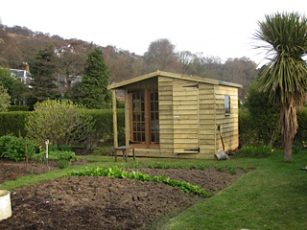
Arran got away relatively lightly in the gale that blew up on the Thursday after Christmas. Apart from the total demolition of David Underdown’s shed (pictured) and of a caravan (also pictured) we were able to carry on as normal. Just across the water, Argyll and Bute was having a terrible time. The Isle of Bute was without power for five days and cold and hungry householders were reduced to trudging to the Rothesay Pavilion, where soup and 9,000 households were left without power. The A&B Council responded rather heroically, putting out an emergency telephone number for people to ring and setting up community rescue centres.
We take our hats off to the teams, both on Arran and worse hit areas, who turned out at the New Year to clear fallen trees and debris and make things as secure as they could.
Bright news for Oban
As if to compensate for a tough winter, Argyll and Bute looks forward to big improvements in Oban this year. A massive regeneration programme is designed to start soon, with major improvements to the bay and harbour area and new pontoons at the North Pier that will cater for cruise ship tenders. Drivers will be glad to hear that traffic should move more easily through the town, as the upgrading will get rid of some of its ‘pinch’ points and provide better parking and easier access to the ferry.
Tobermory Lifeboat Finds Missing Diver
On January 10th a scallop diver, missing for over four hours, was found on a remote shoreline in Ardnamurchan after an intensive search by the Tobermory Lifeboat crew. The alarm was raised when the diver failed to surface close to the Red Rocks in the Sound of Mull, and the
Tobermory all-weather lifeboat, Elizabeth Fairlie Ramsay, was launched at 4.15pm, when the winter daylight was already fading. The lifeboat was joined by coastguard rescue teams from Tobermorym Salen and Kilchoan, who scoured the adjacent coastline, and the Stornoway Coastguard Rescue Helicopter was also deployed.
At around 6.30 pm Grant Carmichael, a lifeboat volunteer member, was put aboard the scallop diving vessel at the request of the missing diver’s fellow crew-men to help them in the search. Both weather and visibility were rapidly deteriorating – but shortly afterwards, a voice was heard shouting in the darkness from the shore, close to an area known as Maclean's Nose. The Tobermory lifeboat stood by with its Y boat (a small dinghy) ready to be deployed whilst the diver was airlifted to safety by the rescue helicopter. The rescued diver was taken to hospital in Oban for a check up, but was found to be safe and well.
Tobermory Coxswain Phil Higson said: ;When the light faded, hopes began to fade too and we feared the worst, but all the search teams involved carried on. This was a tremendous result for everyone concerned.’
John Kinsman has just become an honorary agent of The Shipwrecked Fishermen and Mariners' Royal Benevolent Society (or the Shipwrecked Mariners for short.) This national charity was founded in 1839, and John sends us the following note about its history.
The Shipwrecked Mariners society (SFMS) operates throughout the United Kingdom and Ireland in order to provide help to former merchant seamen and fishermen and their widows and dependants who are in need. Mr John Rye, a retired doctor, and his servant Charles Gee Jones, a former Bristol pilot and landlord of the Pulteney Arms in Bath, founded the charity after a storm in November 1838 engulfed the Clovelly fishing fleet, with terrible loss of life. Aided by Sir Jahleel Brenton, at that time Governor of Greenwich Hospital, Mr. Rye went from house to house in Bath collecting half crowns as a start to setting up the SMFS. The portrait of Mr Rye and Mr Gee Jones shown here was painted to commemorate the founding of the Society, and it now hangs in the boardroom of the Society's Headquarters in Chichester. It shows them discussing the Clovelly disaster.
The first president of the SFMS was Admiral Sir George Cockburn, who was in Chesapeake Bay in the War of 1812, and captured and burnt Washington. (Not, perhaps, a popular man in the USA.) Queen Victoria became the society’s first patron, and it has had a royal patron ever since. Today that duty has passed to HRH the Princess Royal. The society was for a few years operating its own lifeboats, but in 1854 it decided to concentrate on helping survivors and/or bereaved families, so its lifeboats were transferred to the RNLI.
The SFMS, which operates through a national network of volunteers known as Honorary Agents, deals with over 2,000 cases of need a year and is based in Chichester, West Sussex. Many people will have seen the 2nd World War mines now harmlessly deployed as big piggy-banks at harbours where locals and visitors drops in the coins for which the SMFS is so grateful.
Requiem for Kay
Many people on Arran will have known Kay Carmichael, who died at Christmas two years ago. Some may have stood with her to protest at Faslane, others may know of her outstanding work in prisons and on behalf of people in need and difficulty of every kind. Her husband, David Donnison, has produced a small collection of poems written for Kay, and they are so moving and so wise that they may speak for anyone who has suffered a grievous loss and struggled through the process of somehow continuing to live.
David himself is no stranger to Arran. He has visited the island often, and took part last autumn in the Kilmory Concertina Weekend. There are at present just 200 copies of his book of poems for Kay, but they are for sale at £5.00, with 50% going to the Medical Foundation for Victims of Torture, a charity that Kay supported. If you would like one of them, drop us an e-mail on info@voiceforarran.com and we’ll put you in touch. Two of David’s poems appear below.
FROM BEYOND THE GRAVE
Catastrophic loss, you said,
impales us like barbed wire.
Turn your back upon it – pull away –
its teeth will rend your soul.
Embrace the pain and face it
then gently disentangle –
grateful for memories
that will some day make you whole.
ANOTHER FROZEN CHRISTMAS
Listening alone to carols I hear
of gold and frankincense and myrrh –
symbols of the season.
What symbols speak for you and me
on this your anniversary –
devotee of reason?
For you perhaps the blazing beauty
of the frost. For me the call to duty
of the returning sun.
The Queen’s Diamond Jubilee sparks Brodick celebrations
Brodick Improvements Committee has decided to coordinate a street party all the way along Shore Road on Tuesday 5th June to celebrate the Queen’s Diamond Jubilee. Looking back 60 years as it does, the theme will be a nostalgic one, with a nod to the style of the ‘50s. Activities are being planned for all ages, with children particularly welcome, and all Brodick businesses and organisations are being invited to come up with their own suggestions as to how they might participate.
‘Fare and Flare’ will be part of the theme, with speciality food and drink on offer all day and then a beacon being lit on the top of Goat Fell, while a bonfire will blaze on the shore. Following the street party, revelry by night will continue, accompanied by music from the ‘50s.
The Committee is keen to involve as many individuals and local groups as possible, so if you would like to participate in any ay, please contact Harry Davidson on 302 036 or e-mail admin@arranblackgrouse.com .
Crossword
Bedtime Story at Lamlash theatre
If you’ve ever lain awake at night, longing for sleep to overtake you, here’s a play that casts new light on that old problem. On Saturday 11th February (which unfortunately clashes with the Opera Highlights in Brodick Hall) a play called 2h:9m:37s will be staged at the Lamlash Theatre, Arran High School, starting at 7.30pm.
For some unlucky people, insomnia is a way of life, and this forms the basis of a comedy by Paisley playwright and performer Kris Haddow. Kris himself has for years only slept an average of 2hours 9 minutes and 37 seconds – hence the title of his play. Originally written and staged for the Scottish Mental Health Arts & Film Festival in 2011, 2h:9m:37s explores the world of the insomniac through a motley collection of people met in sleep clinics and Kri’s own experience of sleepless nights.
The play is written in a mixture of English and Haddow’s own “mither tongue”, Lallans Scots, and is currently touring Ayrshire. Tickets can be bought at the Book and Card Centre in Brodick.
Argyll and Bute discusses its budget plans
Our neighbouring authority, Argyll and Bute, does consultation in a big way. From October 13th to December 6th 2011, residents were encouraged to participate in events and activities designed to produce real public involvement in discussing what plans should be made for the 2012 budget.
An online budget simulator allowed respondents to devise budget scenarios and leave comments, and the budget consultation web pages recorded more than 1,200 hits during the consultation period. Webchats with the council leader and the senior management team were facilitated. Those without computers were not forgotten, and postcards and comment boxes were provided in the public areas of 63 council-run facilities. Emails were sent to 54 community councils, and the council commissioned Argyll Voluntary Action (AVA) to carry out a consultation on the budget with ‘hard to reach’ groups. Information was sent to all the local press, generating articles in every one of the main local papers, and A&B were sending out three tweets every day of the six-week consultation.
Councillor Dick Walsh, leader of Argyll and Bute Council, said: ‘Our aim was to engage with the widest possible cross section of the Argyll and Bute community, and we took on board people’s suggestions as to how we might reach the maximum number of residents. We set out the financial challenges we face as a result of the reduction in overall public sector finance, and asked our residents for their views and responses to various questions.’ He continued, ‘Our job is to ensure that – wherever possible – we safeguard and invest in the areas which people have told us they most want to protect, while at the same time identifying the necessary savings to ensure we can balance our budget. I believe the draft proposals published later this week will provide a solid basis on which to achieve that. We have listened to what people have said to us, and will continue to consider how best to take account of their views.’
The budget papers were published on Thursday January 26th – and at least nobody can say they weren’t consulted. Hats off to Argyll and Bute.
Jazz goes like hot cakes

Corrie’s bright day in the dark
Corrie Hall Last Saturday showed one film after another from morning until night, stopping only for refreshments and the setting up of the next transmission. Everyone had a great time. It was like sharing in a warm family occasion, specially when sitting at a long table to tuck into delicious soup and in the evening a fabulous mixture of chilli con carne and curries. The unofficial Corrie Caterers should definitely go into business!
The films were loosely connected by the theme of childhood. The day kicked off with a number of Tom & Jerry shorts, and the reaction was slightly strange. The adults laughed, but children gazed at the frantic antics in astonishment rather than amusement, which raised questions in the mind. Was the action too riotously inventive for them to understand? Too fast? Too surreal? Have times changed? Well, yes, of course they have. A black-and-white documentary called Singing Streets showed children in Edinburgh five decades ago, before TV or video. They played peevers and skipped with fantastic skill in a shared turning rope – and sang fluently in countless circle games. Boys and girls were very separate, and it was the girls who dominated the scene. And how energetic they were, how lean and fit! Some, admittedly, had pinched faces that spoke of hunger, but there was no obesity then.
An animated French film called A Cat in Paris was an absolute delight. A cat burglar (accompanied by a burgling cat) leapt and crept through evocatively drawn Parisian roof-scapes, while the main theme was the abduction of a little girl whose mother was a high-ranking police detective. The faces of both humans and cat were reminiscent of Modigliani’s painting, stylised and slant-eyed yet full of feeling.
In total contrast, we were back to black-and-white for The Kidnappers, where a rigidly Presbyterian Scots-Canadian grandfather gives his orphaned grandsons a terrible time until their innocence and his wife’s gentle, enduring wisdom bring him to see the error of his ways.
The Kite Runner is of course a modern fable about intolerance, well worth re-seeing for its stunning sequences of Kabul among its snowy mountains, the sky full of fluttering, diving kites being flown with lethally competitive purpose.
A very sensitive Swedish film, My Life as a Dog, was about a boy shattered by his mother's slow and unpleasant death from a lung disease. He was also grieving for his dog, which he believed to be still alive, taken into care elsewhere when the household fell apart. The film had an interesting take on the unorthodox approach of a likeable man who ran a refuge for such children with inventive battiness, but was unflinching in its conclusion – that truth has to be known, even if it comes with brutal directness from among the children themselves.
The final film, Padre Padrone, was set in the rough hills of Sardinia, where a young boy is forcibly removed from school by his father, who wants him to help tend the sheep. The boy’s life changes when a couple of itinerant musicians mooch through the rough fields, playing an accordion. He gathers the strength to confront his brutal father and affirm that life can be different – and yet, the old ties and the old ways retain something of their power.
Altogether, it was a great day. Some people dropped in just for a film or two of their choice, others settled in for the whole day – but everyone reeled home with heads full of action and images and new thoughts. A bright highlight in a cold January.