John Baraclough lays out his objections
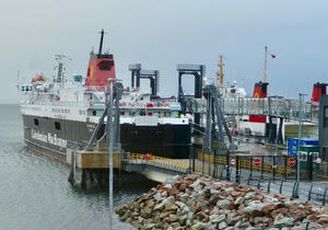
As it stands, this plan should be ringing alarm bells for the residents of Arran. Indeed, we do need an extended service from early morning to late night, very similar to the current service already provided for our nearest neighbour island of Bute. It is clear that a two ship service would provide an excellent timetable, but what are the drawbacks? The Caledonian Isles has a carrying capacity of 110 cars. The two smaller ships currently serving Bute, Argyle & Bute (locally known as the “Polish Twins”) have a combined capacity of 120 cars. Arran would need two ships the size of the new Finlaggan with a capacity of 85 cars each to see any significant increase in vehicle carrying capacity. That would be perfect if only the passenger carrying capacity of a ship the size of Finlaggan was larger. She is capable of carrying just 550 passengers which would only be an increase of 10% over the Caledonian Isles. Also the Finlaggan is only four metres shorter than the Caledonian Isles and a ship of that size would have the same problems entering and leaving Ardrossan in the winter.
It is interesting to note that Transport Scotland feel there is a capacity problem at the Brodick terminal and, as noted in a recent press article, are earmarking £14 million to build a new terminal as a solution. With two smaller ships and a more frequent service that problem will disappear. However, no solution is offered for the real cause of winter disruptions which is the frequent failure of the Caledonian Isles, or any other relief vessel, to negotiate the entrance to Ardrossan Harbour. The sum of £14 million would be much better spent on creating an all-weather mainland terminal which could also act as a relief for the Bute ferries when they are unable to dock at Wemyss Bay.
Many years ago, the Arran ferries always used Fairlie in the winter and for a very good reason. It has a very sheltered pier which, although not currently in good repair, could be upgraded to host a modern Clyde Coast Ferry Terminal. The Scotrail Glasgow to Largs service runs nearby and there used to be a station very close to the old pier. Surely, that’s where the Scottish Government should be putting their £14 million.
Unfortunately for the ferry users of Arran, our views are are represented by a clandestine organisation known as the Ferry Committee. Members of the public may attend the AGM of the Ferry Committee, held in June, but are not allowed to attend any of the regular monthly meetings, which are held in secret with no agendas or minutes being published. Island businesses may attend by invitation, but must pay an annual subscription of £75 for membership. Both North Ayshire Council and the Arran Community Council have seats on the Ferry Committee (with their subscriptions being paid by NAC), but delegates from these organisations are not allowed to make the minutes available to the bodies they represent or to Council Tax payers.
You have until the 30th of March to offer comments on Transport Scotland’s “Draft Ferry Plan” and responses can be made online at: http://www.surveymonkey.com/s/QZ25CFT
or by post or email to Colin Grieve at: Transport Scotland, Ferries Unit, Victoria Quay, Edinburgh EH6 6QQ
Tel: 0131-244-1539.
Email: colin.grieve@transportscotland.gsi.gov.uk
Comment:
I am astonished at the negative coverage in this month’s ‘Arran Voice’ of the Scottish Government’s ‘Draft Plan for Consultation’ on the Scottish Ferry services. This is exactly what it says it is – a consultation, so any negative views will of course be taken into consideration before any final decisions are made. However, for perhaps the very first time, the needs of island and rural communities in Scotland are being thoroughly examined and the prospect of a comprehensive overhaul of ferry services along the lines of Scandinavian models, including the introduction of RET and major financial investment on Arran, is at last in sight.
John Baraclough’s litany of complaint seems to centre on the design and capacity of the proposed two ferries, and the continuation of the use of Ardrossan as the destination port. However, the draft document states quite clearly that the change to a two-vessel system would take place either as part of the CHFS tender or the vessel renewal programme that will be contained within the Final Ferries Plan. By all means raise the difficulties of present vessels, but do not assume that these existing ferries will be the vessels of the future. I would hope that the new vessels will not only be more fit for purpose, but also more environmentally friendly and economical to run. In Scandinavia, more and more ferries are being run on biogas, and the latest Calmac ferries to be commissioned are hybrid vessels, the first low-carbon, battery-powered seagoing passenger ferries in the world. Not only that, but they are being built here on the Clyde, at Ferguson Shipbuilders in Port Glasgow.
As far as the complaint about Ardrossan is concerned, by all means raise the issues, but it would be a very blinkered approach indeed to assert that the £14 million investment should be spent in Ardrossan or Fairlie instead of Brodick. No one can surely contend that the present situation at the ferry terminal is acceptable or sustainable or even safe, and I for one welcome this major investment in upgrading our ferry terminal, linkspan and surrounding infrastructure in preparation for the further investment in our island economy that RET undoubtedly represents. At last there will be a 21st century approach to island living, tourism and sustainable development.
Where I do agree with John Baraclough is in his comments about the Ferry Committee, and in the interests of democracy, transparency and accountability, I would certainly propose a root and branch overhaul of this organisation, and see no reason why this should not happen in tandem with the improvements being mooted in the consultation document.
I do hope that many Arran residents will respond to the consulation and that many relevant points will be raised. However, we should at least be recognising the very positive developments and financial investments that are taking place and seize the opportunity to improve our ferry services and bring them at long last into the modern age.
John Bruce, Corrie, 1/2/12
http://www.transportscotland.gov.uk/water/ferries/subsidised/clyde-hebrides-ferry-services
Comment:
Re- John Baraclough’s opinion
John is going a bit OTT when he suggests that two Finlaggans are required as our old chum the Saturn can carry 531 passengers. "guid gear comes in sma’ bulk"
Ian McCallum.