Alison Prince
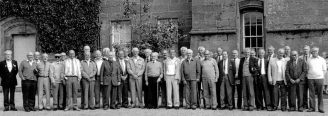
Parents have always worried about their children’s education, but this year’s poor GCSE results seem to confirm that they have good reason for concern. I was mulling over this when an e-mail came out of the blue from Edmund, an ex-colleague who worked with me in the 1960s in a 2,000-strong comprehensive school called the Elliott, in Putney, south London. Edmund had been one of the ten staff members in the Art Department, which I headed. He sent photos of those days and was deeply grieved to say that the school, once voted ‘the most friendly school in London’, had been closed.
The Comprehensive education pioneered by London County Council seemed a triumph at the time. Successive Conservative governments have always loathed it, perhaps because of its inherent democracy, and now are expunging it as a failure. It’s a disputable claim, to say the least. The flexible structure of classes allowed each child to work at his or her own pace and move to a faster or slower-moving group when needed, and it seemed to be a good system. But flexibility does not fit the current concept of education as a prescribed process. Even in broader-minded Scotland, bureaucracy has imposed the service of itself as a main task for teachers, curtailing their freedom to use their time with the children creatively and in response to their interests.
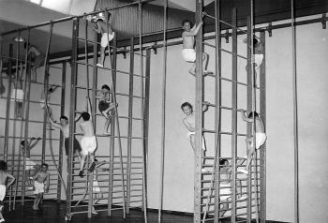
The pictures that came with Edmund’s e-mails brought those Elliott days back with vivid immediacy. They show the visitors, many from overseas, who came to see what we were doing. They evoke the busy activity. They record the dazzling daylight that streamed so exhilaratingly through the wide windows of the brand-new concrete post-war building. And they bear witness to the crazily ambitious project wished on us by the Headmaster, Maurice Holmes, who decided in the opening week that we needed a huge artwork to back the wide stage in the assembly hall.
Paper would have been impossible to handle on such a big scale, so we ended up making a fabric map of the surrounding district, using joined lengths of hessian as the background. The thing was the size of a squash court, so one art room had to be devoted to it full-time. The hessian map with its striped ticking roads and appliqué houses and pubs filled the floor and everyone had to take their shoes off when they came in. Rotating classes of children stitched and cut and embroidered for seven weeks. Heroically, they didn’t make much fuss about stepping on the odd drawing pin.
The 84 members of staff from all departments met several times a day in the big staff room (flanked by two smaller ones, for smokers and for privacy-seeking female members, neither of which groups seemed to be much missed.) The rest of us were constantly talking and hatching plans - concerts, games, outings, a pantomime - anything was possible. The cross-fertilisation of ideas as Technical teachers talked to the English department and Music to Geography, PE to Classics, History to Cookery, was immensely enriching. We probably learned more from each other than any of us had in our post-grad Education year.
The school had its awkward squad of course, both among children and teachers, but professional Subject Advisors were on hand to give department heads some help if needed. In that first decade of moving forward after recovery from the war, the task of educating the huge population of children schools was a challenge, but the main thing was, we were implicitly trusted. Each of us was expected to do a good job, using whatever tactics and materials we could think of. Communication and creativity were our most essential resources, backed by funding for any need that we felt justifiable. All teachers (except the odd dead-beat who got quietly shuffled off) worked phenomenally hard, but with a sense of personal responsibility and freedom to improvise. The stress level was high, but it was never a treadmill.
The children quickly came to love their huge school. They were not an easy lot, but with so many adults around, they could usually find someone they thought was OK and could confide in. For them, too, it was a question of trust - and trust can be a lifeline. But it’s all gone. Buildings have been closed, children redistributed to schools that work in watertight ‘faculties’ that sound more posh but have little or no communication between them. Departmental staff bases have replaced the creative stew-pot of a general staff room where everyone meets and can toss ideas around. Perhaps there are no ideas to toss. A terrible sense of stalled and decaying rigidity has set in, like some grand old engine rusting in a siding.
I can only wonder how long will it be before the wheels begin to turn again and we can start to recover flexibility. I cannot believe that we are corroding into a permanent state of immobility, for young people’s innate creativity and intelligence is still there, blossoming wherever it can. Arran’s young students are evidence of that, for they have the great benefit of people in the community who help them to develop their indomitable inventiveness. In the wider world that waits, I wish them luck and tenacity. For many less fortunate others, there can only be deep concern.