

Creative Scotland’s nation-wide competition called Creative Places was judged in Kilmarnock on January 29th, and the £100,000 prize went to Peebles. They had presented a very coherent business plan for use of the money – but it was a close-run thing. Heather Gough and her team from the Arran Theatre and Arts Trust, who had master-minded the very complex entry, came back from Kilmarnock in an upbeat mood, saying the enhanced connections with Creative Scotland were immensely positive and useful.
A valuable legacy for Arran is the ten-minute film made by Edward O’Donnelly, showing the island and its creative people.
Ed, as most people know him, put in an enormous amount of work all over the island, interviewing and recording. The close-packed film shows a multitude of people engaged in every conceivable aspect of art; painting, sculpting, weaving, spinning, writing music, writing poetry, making furniture and Taiko drums and bagpipes, turning wood, dancing, acting, singing, producing films and playing a multitude of different instruments. Both as solo creators and working in groups, the range of achievement is astonishing.
We emerge from the Creative Places exercise no better off in money terms, yet with a curious sense of excitement and new confidence. Arran is a place of extraordinary energy and ability, and we know far more now than we did before about the stunning wealth of creativity that enriches our community.
Day in the Dark
Be quick - this is happening today, Saturday February 1st. Drop everything and join the fun in Corrie Hall!
It kicks off at about 11.30 am after coffee, with a stunning film about Mallory's expedition to climb Everest in 1924. Soup and sandwiches at lunchtime, then The Artist and the Model, about art and love during the Nazi occupation of France, followed by Farinelli, the story of the last castrato Italian opera singer. Tea, then Gimme Shelter, on the Rolling Stones 1969 US tour. Supper is at about 7.00pm and the flick-fest ends with The Commitments, from Roddy Doyle’s very funny book about an Irish soul band. It’s all free - pop in as you choose or go for the day’s immersion.

Corrie Film Club
On Sunday February 9th the Film Club shows an enchanting film called Wadjda. It soared into the Best Film of 2013 as a funny, romantic story that keeps its political edge subtly hidden. It is the first Saudi Arabian feature to be directed by a woman, and it’s an absolute delight.
Shot in the suburbs of Riyadh, it tells the story of Wadjda, a 10-year-old girl who has set her heart on a green bicycle she has seen, because she wants to race against her friend Abdullah. Her mother is horrified. She believes a girl might lose her virginity if she rides a bike, and anyway, Wadjda is approaching puberty and should not now be playing with a boy she has known since she was small.
Wadjda, played by Waad Mohammed, understands all that, and doesn’t care. She knows, too, that the Islamic religion plays a large part in the restrictions that Saudi women accept, and devises a way to use it for her own purposes. She enters a Qur'an reading competition at school, presenting herself as a devout, serious student - and wins. The prize is the money she needs to buy the bike. This gentle send-up of the male-dominated religious system can hardly be described as revolutionary, but it must have caused many women in Islamic countries to smile - and for the wider world, it is an enchanting eye-opener.
The showing starts at 8.00pm in Corrie Hall and is open to everyone, free of charge, though contributions to hall heating costs are always welcomed.
Four great jazzers
The Bill Fleming Quartet, who played last Saturday in Brodick, delighted the audience with their subtle, inventive variations on a wide variety of jazz music. Each of the players was a master of virtuoso technique, but above and beyond that, they combined to make thoughtful, evocative music that stayed long in the mind.
In their hands, a chirpy little tune like Tea For Two developed a smart yet smoochy persuasiveness that was utterly beguiling. John Lowrie, in his first percussion solo, electrified the audience and it became evident that Paul Tracey, guitar, balanced perfectly with Bill Fleming’s saxophone, producing a front-line sound that was extraordinarily fluent and vocal, like a pair of singers. Just the Way You Look Tonight moved outward from the known tune to a series of conversational interactions that carried listeners into a kind of dream, full of possibility and excitement.
James Lindsay’s own composition called 'Creel' began with a seductive theme played with a bow on his double bass, and the beauty of this was picked up by the other players and developed into something so complex and lovely that many people wished they could hear it again. John Lowrie on drums was outstandingly creative, and took the theme into new, but always clear, complexities.
At the end, the audience went out into the rain seeming enchanted and astonished. Even those who admitted that they hadn’t expected to enjoy modern jazz were thrilled - a great treat on a wet January afternoon.

Cumbrae marine research centre saved
The University Marine Biological Station on the Isle of Cumbrae lost its funding when the University of London withdrew its annual grant of £400,000 in December 2012. The centre was forced to close in October 2013, but happily, ownership of the site is to transfer to the Field Studies Council (FSC) and the centre will reopen this month.
Both North Ayrshire Council and Glasgow University have been awarded £500,000 from the Regeneration Capital Grant Fund, and together they have enabled the work of the research centre to continue. Councillor Willie Gibson, leader of North Ayrshire Council, stressed the importance of the facility - ‘not only for the island community, but for North Ayrshire and indeed Scotland as a whole.’
Good Energy
If you want to feel truly smug about your energy provider, have a look at Good Energy, which uses only fully renewable sources and has topped the Which? customer satisfaction survey for the third year running. Its very straightforward green tariffs were awarded a five-star rating for value for money, and they’ve frozen their prices until the end of March to make sure none of their customers will get stung for winter heating.
As their website says, ‘Our electricity comes from clean, natural sources like Cornish sunshine, Scottish wind and Welsh rain.’ Well worth a look. www.goodenergy.co.uk
Sensible banking suggestion
The Green Party has proposed a banking system that will have a clear separation between retail banking and the so-called ‘casino’ processes that have led to the current financial crisis. The new proposal calls for all derivatives and complex financial products to be subjected to a social usefulness test. On the practical level, it would like to see a network of community, not-for-profit banks that would provide local businesses with low-cost funding.
Credit unions already do this. If anyone out there is feeling uneasy about the future of our banking arrangements, it could be an idea to investigate the alternative.
“Better Together”? Doubts grow
David Donnison, who some months ago sent us his reasons for being unable to join the Yes campaign, writes now about his further considerations. David is an Emeritus Professor of Urban Studies at Glasgow University.
Some days ago I found myself in a seminar with old friends and colleagues at the London School of Economics - one of the best teams of economists and social scientists you can find working on problems of social policy anywhere in the world. Most of them had long experience of advising Governments and senior politicians.
As our discussion dissolved into informal chat I found myself surrounded by Professors asking me how the Scots will vote on independence, and how I shall vote. Most of them were baffled to know why any intelligent Scot would be voting for independence, and I was compelled to clarify my own thinking. What matters most, I said, is not how an independent Scotland will fare, but what kind of a country its rulers want to make of the U.K.; and whether we in Scotland want to be part of it.
The most important question facing Scotland, whether independent or not, is whether we can enable people living in Britain’s greatest concentrations of poverty - mainly in the central belt and around the Clyde - to share in the opportunities every Scot should have. I used to think that remaining in the U.K. and sharing its resources would be the best answer, but I am not sure now that it has much interest in that question. Even the relics of its Labour Movement seem indifferent.
The current issue of the Fabian Journal, produced by the U.K's most venerable political think-tank, begins with an analysis of the votes Labour will have to attract if they are to win a majority in the Westminster Parliament. The approach is statistical. How many will be new voters? Former abstainers? Ex-Lib-Dems? Ex-Conservatives? In which marginal constituencies will they be found? This analysis is followed by chapters written by leading politicians and commentators of the Left, laying out policy proposals that may win these votes for Labour. These mention the economy, immigration, education, housing and crime, but say hardly a word about poverty, social justice and inequality, thought these are the traditional concerns of radicals.
Professor John Curtice of Strathclyde University holds that average Scottish voters are no more egalitarian or radical than their English counterparts. As a leader in his field, I cannot challenge him. But a political culture is not always fully expressed through simple questions in a mass survey. Thinking Scots tend to take it for granted that proposals for new policies should help to create a fairer and more equal society. They assume that proposals for solving social problems should be prepared in consultation with the people who have these problems. Though the achievements do not always live up to the aims, it is assumed that they will be generally accepted by Scottish central and local governments and by a wide range of "opinion formers", regardless of which party is in power. None of that can be said of the English political class.
At a press conference launching the independence White Paper, a correspondent from the Daily Telegraph asked Alex Salmond how, in a country with high rates of unemployment and high proportions of pensioners, he expected to pay for the envisaged developments. The First Minister replied, "An independent Scotland will attract more young workers to this country". The Telegraph man, as though asking the killer question, said, "You mean more immigrants?" "Yes" said Salmond calmly, "they make an important and creative contribution to our society and we need more of them." I doubt whether any serious English politician could have said this. And if it had been said, would it have passed unnoticed, as it did in Scotland?
The referendum will be eight months before the next Westminster election, so we will have to make what guesses we can at England's political trends. Some of the current indications make me feel I would rather get out, whatever the hazards of independence. Staying in the U.K. may mean living in a country that leaves the European Union. Almost certainly it will impose increasingly punitive and humiliating sanctions on its poorest citizens, and Labour spokespersons seem determined to show they will be even more brutal than the Tories. The present Home Secretary promises to repeal the Human Rights Act. Ideally, we need a White Paper, agreed by all main political parties, on the future plans and problems, not of Scotland but of the rest of the U.K..
The U.K. is rapidly becoming the most centralised government in the Western world, strangling local governments and killing off civic leadership. If this continues, and if our armed forces go on acting as mercenary outriders supporting American foreign policy, I want no part of it.
How a bridge can make cups of tea
An outfit called Solar Century was handing out free cups of tea at London’s Blackfriars bridge last week, to demonstrate how effective solar power can be. The bridge is undergoing an upgrade, so engineers grabbed the chance to put solar panels on it, capable of making up to 79,000 hot cuppas a day. You can see the story on www.blackfriarssolarbridge.com and the full case study is on www.solarcentury.com.
Jan’s kitchen
Jan Inglis sends us another yummy-sounding recipe
Puy Lentils with Leeks
1 packet of Merchant Gourmet puy lentils
2 medium leeks
3 or 4 rashers of bacon, or chestnut mushrooms as a vegetarian option
Parmesan cheese
Finely cut the leeks into circles (they will disintegrate in cooking) and fry in oil.
While they are cooking, half fill a saucepan with boiling water and put in the pouch of lentils, unopened. Simmer for 10 minutes.
Fry the diced bacon or the mushrooms.
Tear open the pouch of lentils and add them to the frying pan.
Add a little salt and a good grinding of black pepper, stir and eat, with a generous sprinkle of Parmesan cheese.
Between a frack and a hard place
In Britain, strapped-for-cash local councils are being heavily bribed by the government to accept fracking – a hard choice for authorities trying to eke out constantly shrinking budgets. Meanwhile, in America the Environmental Protection Agency (EPA) has long lost the fight to prevent fracking but keeps up a constant battle to control its worst effects. Last week it issued a new rule requiring oil and gas fracking firms to report how much polluted wastewater and fracking fluids they dump in the ocean, and what chemicals it contains. Over half the extraction companies in the state are routinely dumping their waste in the sea.
The California Coastal Commission is concerned that these dumped fracking fluids may be affecting marine environments. Officials were slow to get off the mark but the State Governor, Jerry Brown, signed a new law last year to regulate hydraulic fracturing on land, compelling firms to report the chemicals they pump underground. In most states, such information is considered "proprietary information" and is often kept secret by drilling firms.
In England and Scotland, we will have a big fight ahead if (or when) desperate councils take the money and accept fracking. The British Isles is only a tiny fraction of the size of America, and the environmental impact of fracking technology with be proportionately far greater.

Arran Antiquarians
Arran Antiquarians encourages the study of all aspects of local history, archaeology and related subjects by its members, through meetings, and field trips. Meetings are held in Brodick public hall on the third Monday of each month (except December) and commence at 2.00pm. We have an interesting variety of speakers, both local and from off the island.
All are welcome to come along to meetings and annual membership is a very reasonable £10. However, you are very welcome to come along as a visitor, for a donation of £2, should you wish “try before you buy”. We are sure you will find our meetings both interesting and informative.
Click here to see our programme for 2014, hope to see you on 17th February.
Just £5 to get your cat neutered …
says Linda Hartley of the Cats Protection League
For male cats, neutering means they wander less and fight less. It reduces their urine odour and means they won’t spray in the house. They have less risk of disease and injury fighting over females and mating.
For females it means no unwanted pregnancies, followed by the problem of trying to find homes for kittens and cats. A breeding female can produce 12 kittens a year, and from her and her grown-up daughters, this could add up to nearly 12,000 new cats in five years! As a responsible pet owner would you really be able to find that many homes? Neutering before a female comes into heat can reduce her risk of uterine, ovarian and mammary cancer…yes, they can get the same cancers as we do.
In the last few years Cats Protection has managed to neuter around 22 cats and kittens on the island, but even so, this year we had a struggle to find homes for kittens as well as cats. Please help to prevent unwanted pregnancies and have your cat neutered. A cat does not think she’d like to have at least one pregnancy before she is neutered so you are not being kind by allowing that. There are risks, too, in advertising kittens without knowing who they are going to. There have been dreadful reports of kittens being being used for the cruel and barbaric trade of dog baiting.
In February, March and April of this year, you can have your cat neutered for just £5. No means testing, no catches. You pay the vet direct and we pick up the rest of the cost. If you want more information on this generous offer, please contact Cats Protection either by email on neutering@arran-cats.com or private message on our Facebook page. Or you can always telephone 01770 820611.

Ferry fatuity
Arran’s ferry services have deteriorated sharply ever since the misconceived Caledonian Isles was launched. Built to maximise profits from the summer tourist trade, no thought was given to her suitability as a year-round service vessel. As a result, Arran is stuck with increasingly unreliable connections to the mainland that break down entirely in bad weather.
Making travel plans or ensuring the arrival of both visitors, home-comers and vital supplies is impossible. Even finding out what is going on presents difficulties, for although the status update on CalMac’s website gives news of proposed services for the day it does not reveal where the ferry has gone, thus confounding intelligent guesswork. The ludicrous excuse given is that the website does not have enough space, but we all know cyber space is limitless to the competent.
Following the Christmas storms and total breakdown of ferry function, countless disaffected travellers look forward to the 3-week annual absence of the Caledonian Isles and a period of blessed reliability when Captain McCrindle sailed the Clansman daily, at least to Gourock if Ardrossan was inaccessible. Older Arran residents look back to the golden days of the paddle steamers that rocked and battled their way through every known weather condition, providing a constant, if rough, reliability. In those days, you could be at the Broomielaw in Glasgow’s centre in less than two hours. Half a century of technological improvement has left Arran far worse served than it used to be.
CalMac’s response to the long-endured crisis has been bizarre. The proposed vastly expensive rebuild of the Brodick terminal is irrelevant, since simple dredging would deal with the shallow-water problem. A glitzy airport-style terminal will do nothing to solve the mainland access problem - and do we trust lifts as the means of passenger access? We have not forgotten the constant pantomime over the failure of the gangplank mechanism supposed to provide access to the Caldonian Isles. Neither does the deployed personnel seem confidence-inspiring. Guy Dale-Smith, the company’s new Head of Marine, wrote a survey of potential mainland ports that included Campbeltown, thus suggesting ignorance of where Arran actually is. Oban, in passenger terms, is closer than Campbeltown, but access to either depends on the almost non-existent Lochranza ferry, cut to near-zero in the winter. Fairlie and Largs would work perfectly well and lack nothing more than a linkspan. Would it not make sense to dump the Brodick rebuild plans and spend a small amount of the money saved on providing docking facilities at one of these alternatives?
The public mood on Arran has gone beyond exasperation. People are seriously angry about the continuing indifference to the island’s needs and to our human rights. Confidence in the secretive, undemocratic Ferry Committee is at a low ebb. Arran’s population has a right to be heard. It is time for CalMac to look beyond its narrow profit-making interests and accept that they have a duty to provide a tenable public service.
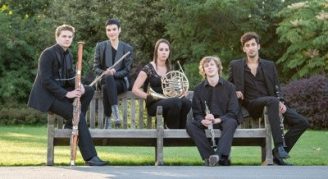
Wind Quintet for next Music Society concert
On Saturday, February 15th, the prize-winning Marylebone Wind Quintet will be giving a lunch-time concert in Brodick Hall, starting at 1.30 pm. This brilliant group of young players won the coveted Tunnell Trust award for the current year, and Arran is privileged to be included in the Music Societies selected for their all-Scotland tour.
The classical group features five distinguished players, each one of whom is making a mark in the professional music world. Dominic Tyler (bassoon), Max Welford (clarinet), Tom Wood (horn), Fraser MacAulay (oboe) and David Ruff (flute) will be playing in the Arran concert, and each of them has a distinguished history of study at leading music colleges and current inclusion in outstanding orchestras including the London Sinfonietta. All of them are in high demand and we are fortunate indeed to be able to welcome them on Arran.
Their programme will include Malcolm Arnold’s Three Shanties for Wind Quintet, Jean- Michel Damase’s Dix-Sept Variations, the Danzi quintet in G minor and a w ind quintet arrangement of Ravel's Tombeau De Couperin.
Tickets at £10 (including lucky prize draw programme and tea or coffee) can be bought at the door or from Inspirations, just across the road from Brodick Hall, or online from www.arranevents.com.
Bridge Challenge
Can South make two spades against the lead of ♠J?
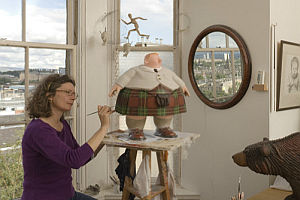
Paper sculpture workshop
Arran Visual Arts continue their splendid series of workshops with a two-day session run by Mhairi Corr on making small sculptures with paper pulp. It will take place in the Ranger Centre at Brodick Castle, as always, on Saturday and Sunday 22nd and 23rd February. The first day takes students through the techniques of building an armature with wire and plaster bandages, and the second will move on to the completion of whatever form you have dreamed up - a figure, an animal, a thing imagined. If you are short of time, you can do the first day and complete the figure at home in your own time. All details from Alison Barr on 303 607.
For an idea of what can be made, look at Mhairi’s website, www.mhairicorr.moonfruit.com.
Help to Buy – but be careful
A survey of more than 2,000 people has shown that most of them do not understand how a mortgage through the government’s Help to Buy scheme may affect their future credit applications.
In Scotland, 24% of those surveyed said they would consider using the scheme to purchase a property with the year, but nearly half of them intended to take out further credit within a year, even though many of them had no deposit savings. A further 21% had less than £5,000 saved.
42% of those applying for a mortgage had never checked their credit report and seemed unaware that such a thing existed, so it will come as a shock when hire purchase applications are turned down and overdrafts refused. There is a real danger that the government scheme will entice people into loan-shark borrowing that they cannot repay. It is no way to ensure secure ownership of any property so be careful!

Beliefs and the ballot
A group called Theos has been researching the relationship between religion and politics in Britain, and the results are intriguing.
Among Christians, Anglican church-goers are generally authoritarian in their views on such matters as law and order, school discipline and respect for British values (though some Anglican bishops hold left-leaning views). Catholics are far more left wing and the least authoritarian, in favour of welfare and more likely to vote Labour. Non-conformist churchgoers are evenly split between the three main parties.
Non-Christian religious believers incline towards the left. In 2010, Muslims tended strongly to vote Labour, as did Hindus and Sikhs. The Jewish vote was more Conservative. Buddhists tended to be Lib Dems.
People who attend any form of religious service regularly tend to be pro-welfare, and those who worship in non-Christian religions, notably Islam, are most consistently left wing in their values. Agnostics and non-church-goers of course span the whole range of political opinion, but are consistently libertarian, taking a strong line against censorship. They tend to be sceptical about management and convinced that ordinary working people do not get a fair share of the nation’s wealth.
Marx might have been amazed to see his views carried forward by a bevy of doubters, Muslims and Catholics. The opium of the people has not lost its power.
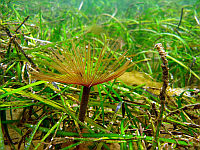
SNH marine survey features Arran
Scottish Natural Heritage (SNH) has been running surveys of Scotland’s marine wildlife and habitats, in connection with the hoped-for network of Marine Protected Areas (MPAs), and the proposed South Arran MPA is of course included. Scottish Government Ministers are considering thirty-three sites around the coast of Scotland.

Art in Mind
We are delighted to have news from Sarah Hay, who is a member of Art in Mind, about the immensely valuable work they do with people who may never have realised what abilities they have.
ART IN MIND is an Arran community project set up in 2004, that aims to introduce local people with mental health and/or social isolation problems to Art, Creativity and Self-expression, helping them gain in confidence and self-worth. At that time, the statutory services could not meet this need, but now, Art in Mind takes referrals through the Mental Health Team on the island.
Felicity Walker, a professional artist from the mainland, comes over to the weekly Friday class, to teach and support members with their artistic efforts, helping the class immensely. Artworks are often entered into the Arran Visual Arts and Brodick Castle Exhibitions, and have sold, (a wonderful boost to your confidence - to feel someone appreciates your creativity.) It’s a proof of the major role Felicity plays within the class, and no mean feat, as there is a large social element and gathering us up from various chatting haunts can be a task!
The atmosphere is relaxed, friendly and supportive, and those who come soon get to know it is a safe place, and you can discuss “stuff ” in your head or going on in your life freely and without judgement. Also there can be a really industrious atmosphere, not to mention frequent doses of laughter! Time can be spent in group activity or doing your own “thing”, with Felicity near by for help, support and advice, often achieving great results and finding hidden talents.
A very important aspect of Art in Mind is the understanding that people can often feel ill, low, scared and very alone. It can be a real effort to come to the group, but the atmosphere is such that you come away feeling you’ve achieved something that day, and maybe you’re not so alone.
We have a number of volunteers who help those who need support, especially when we get adventurous and try some more complicated mediums or methods of art and creativity! They also help with transport, to and from the group. A core membership of the class comes each week for companionship and enjoyment in creativeness, meeting up for coffee and a chat after the class, but since Art in Mind started, there have been many people for whom the group fulfilled a passing need. When they gained the support, confidence and sense of self-worth they needed, they could move forward with their lives. It’s lovely to see them when they pop in for a coffee, or occasionally feel the need to come back for a while.
Art in Mind has been going strong for over nine years now, and still has the capacity to help in many ways. It provides people with a sense of belonging, friendship and purpose, helping some to move on and make difficult choices in their life and others to face a very different life altogether, all with a feeling of self-worth and being capable of contributing to the community in which they live.
How does it work? Is it the art and creativity, the members, those who organise and teach, the volunteers, the beautiful situation where we meet? (Brodick Rangers Centre, in the Castle grounds.) Personally, I think it’s a truly lucky combination of all these things. If I could pop the atmosphere and the essence of empathy in poly-bags and send them all over the country, I would!
Greg Allison, my Community Psychiatric Nurse, referred me to the first meeting of the class in 2004, I had to take early retirement in 1995, and by 2004 had managed to crawl out of a very black, hard and painful place, to realise I didn’t feel much like “me” anymore, and was really scared of life most of the time. I didn’t want to go to another “self-help” group, but was persuaded!
Thank you Greg and Art in Mind, I am in a much gentler place in my life!
Sarah Hay
Art in Mind member
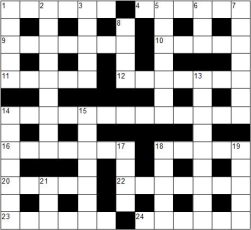
Crossword
Across
1 Slick, as found in ash (6)
4 What Geoffrey Boycott might like on his fish? (6)
9 American university colleague, for the most part (7)
10 Arctic expedition companion sees part of boat escape
11 Quiet Italian instrument (5)
12 A means of power for medical man (unknown) found in prison room (3,4)
14 Replace the fine polish on HMS Victory, for instance (4,2,3,4)
16 Something to forget about (7)
18 Object when refusing to leave trifle (5)
20 That man there followed 6? Fine! (5)
22 A pressing time? (4,3)
23 Father (catholic) handed Spanish bundle (6)
24 A wish to camp? (6)
Bikers for YES?
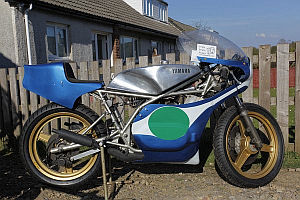
Racing enthusiast (and ace photographer) Lenny Hartley, of Brodick, is set to link two of his interests (bikes and Independence) with an imaginative project.
His 35-year-old Scottish designed and built racing bike with a Yamaha TZ engine is currently being serviced and set up for a long-awaited return to the racing scene. In celebration of the Auld Alliance, French rider Lancelot Unissart has been enlisted to race the classic in the Bob McIntyre Memorial Races at East Fortune near Edinburgh on June 7th/8th this year, in preparation for an international outing at Chimay, Belgium from July 18th to 20th.
So what’s this got to do with the Referendum on September 18th?
In preparation for the races, the Yamaha needs to be repainted, and what better way could there be to highlight the momentum of the Yes Campaign? So the challenge is now out there to Arran’s artists and graphic designers, young and old: a Yes-themed design for the seat and fairing, eye-catching, yet simple enough to be professionally hand-painted. There will be a modest prize. Contact Lenny (liquidlenny@hotmail.com) for further details or with design proposals, during February.

… and finally
One of our readers sent us this scan of box from a domestic light bulb bought in ASDA!