Illegal Fishing Prosecution Undermines Scotland’s Marine Conservation Efforts
Following a recent incident involving illegal fishing activity in the Lamlash Bay No Take Zone, COAST issued the following press release last month:
The recent prosecution of a skipper caught illegally hand-diving for scallops in the protected waters around the Isle of Arran has sparked widespread concern among many communities, who argue that the penalty falls far short of reflecting the gravity of the offence. This incident underscores the broader issue of inadequate enforcement within Scotland’s so-called “Marine Protected Areas” (MPAs), raising questions about the effectiveness of current measures to safeguard critical marine environments.
Following an investigation into reports of suspicious fishing activity within the Lamlash Bay No Take Zone in November 2023, the master of the vessel in question, Lee MacPherson, was handed a Fixed Penalty Notice of £10,000 by Marine Directorate Compliance earlier this year. MacPherson, who denied the allegations of hand-diving in the no fishing area, failed to pay the Notice and the case was submitted – along with community impact statements and a research impact statement from NatureScot – to the Procurator Fiscal. Last month, MacPherson pled guilty to the offence and was fined £4,175; a paltry amount compared to the estimated retail value of £15,400 of scallops illegally fished and sold to market.
Long-term Research Jeopardised
A small part of Lamlash Bay, designated as Scotland’s first (and still only) No Take Zone (NTZ) in 2008, is a haven for marine life where all fishing activity is strictly prohibited. Today it is part of the larger South Arran Marine Protected Area (MPA), designated in 2014 following successful campaigning by local marine conservation charity, the Community of Arran Seabed Trust (COAST), and the Arran community. Low-impact fishing, including hand-diving, is permitted within the South Arran MPA, whereas more damaging bottom-fishing methods have been largely prohibited since 2016.
COAST believe that the protected waters around Arran, with their unique zoning of fishing activities, provide a living laboratory to study seabed conservation and recovery. Áine Purcell-Milton, COAST’s Executive Director, says “the protected water around Arran has become a renowned site for scientific research, providing invaluable data on how marine ecosystems recover in the absence or reduction of fishing pressure. The area serves as a model for community-led marine management across Scotland and beyond, offering insights into how similar protections might be implemented on a larger scale to restore Scotland’s seas.” Illegal fishing incidents undermine this approach by not only breaking the law, but by disrupting critical time-series data collected from over a decade worth of studies.
“For over a decade, Lamlash Bay has been a beacon of hope for marine conservation, and a natural laboratory for researchers studying ecosystem recovery,” said Dr Bryce Stewart, a leading fisheries scientist at the Marine Biological Association and the University of Plymouth. “Illegal fishing in this zone not only damages the physical and biological environment, but also distorts data that researchers rely on to monitor biodiversity, habitat recovery, and the effects of conservation measures. The long-term consequences of this disruption are profound and could set back years of scientific progress.”
Inadequate enforcement
This incident shines a harsh spotlight on the broader issue of inadequate enforcement of MPAs across Scotland. While the creation of MPAs and No Take Zones is a crucial step towards marine conservation, these protections are only as strong as their enforcement.
“Commercial fishing is prohibited in only 66 km2 of Scotland’s 90,400 km2 inshore waters. Lamlash Bay is the jewel in the crown of this tiny area. And if it can’t be adequately protected, then what hope is there for the rest of the seas?” questions Alex Watson Crook from the Sustainable Inshore Fisheries Trust. “This instance undermines the Fixed Penalty Notice system by imposing an almost meaninglessly small penalty for a serious marine offence. This is not the first time this has happened. The Scottish Government needs to urgently review how penalties are calculated.”
David Stinson, of the Scottish Scallop Divers Association, was horrified to hear of the illegal incident stating: “This illegal act makes a mockery out of other scallop divers and fishers who wholeheartedly support conservation measures for the marine environment”. Mr Stinson went on to say that “most of us whose livelihoods rely on the sea recognise the importance of protecting it and enforcement needs reform to ensure this is done. Scotland had a three-mile limit for nigh on a century; it is simple to understand and enforce, and my preference is the Scottish Government step up and reintroduce a modern version to protect our Inshore Waters.”
It is clear that this case damages the reputation and interests of all law-abiding, conservation- minded fishers around Scotland, and highlights that the current measures for monitoring and deterring illegal fishing are insufficient.
The Need for Vessel Monitoring Systems
Currently, marine enforcement is largely reactive, relying on reports from members of the public and limited government patrols, resulting in inconsistent and insufficient protection of MPAs. As part of a package of new fisheries measures, the Scottish Government recently consulted on rolling out vessel tracking devices on commercial fishing vessels – a move that coastal communities and inshore fisheries groups largely support.
“We congratulate the local community, fishery officers and procurator fiscal service who caught and successfully prosecuted this culprit. However, as has so often been the case, the penalty comes after extensive illegality, showing the Government still do not have the systems to ensure compliance in Scottish fisheries.” said Phil Taylor, Director of Open Seas.
“Scottish Ministers spend tens of millions on fisheries compliance each year but focus on the wrong tools – such as £1.7m on two aircraft per year. The solution is to implement robust electronic monitoring systems across the different parts of the fishing fleet – something Scottish Ministers have promised since 2015, and ran a consultation on in 2023, but have yet to progress beyond a limited roll-out on scallop dredgers. It’s another case of Scottish Ministers failing to be able to deliver when it comes to ensuring healthy and prosperous seas.
Protecting Scotland’s Marine Future
The illegal activity in Lamlash Bay NTZ serves as a stark reminder that without effective enforcement, Scotland’s Marine Protected Areas remain vulnerable, a decade on from implementation.
Conservationists and scientists alike stress the urgency of addressing these gaps in enforcement to ensure that areas like Lamlash Bay can continue to thrive and provide critical data and other benefits for the restoration of Scotland’s seas.
As Scotland continues to push forward in its efforts to combat climate change and protect marine biodiversity, stronger measures must be implemented to ensure that the sanctity of protected areas, like those around the Isle of Arran, are preserved for future generations.
“We need to treat our marine environments as the precious resources they are. History tells us what is possible, and Lamlash Bay’s success is living proof that protection works—but only if we enforce it,” said Purcell-Milton.
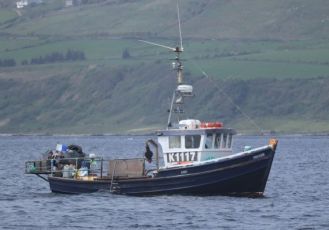
Featured Image shows the vessel skippered by the guilty party at the time of the offence occurring. Credit COAST.