

Arran, as always in the summer months, has moved into full entertainment swing. The Folk Festival kicks off this month with great concerts and lots of free sessions at the Douglas, and on the 19th we are fortunate to have the six brilliant performers of Mr McFall’s Chamber in Brodick Hall, with a programme linking Scottish islands with Caribbean ones. Meanwhile, the String Orchestra of Edinburgh University is giving its second free concert in Brodick Church on this coming Monday, and the High School is girding its loins for a four-day run of Grease. The new, combined Arran choir is busily rehearsing for two concerts early next month, followed soon after by the Ugly Bug Ragtime Band in Whiting Bay in early July.
All this takes a lot of organising. Traditionally, we have always worked on a voluntary basis, booking shows, providing meals and accommodation (and sometimes music stands) and constantly tackling the overall need to secure funding. We do begin to wonder, though, what will happen when the old stalwarts who cope with all this start to fade away. The voluntary sector, as it is known, is a wonderful thing, but it cannot claim to be reliably sustainable. Is it time to look at Arran’s busy arts scene with a more professional eye, and try to set up a paid administrator who will take over the mixed bag of work and co-ordinate it? Nobody wants to change Arran and its wonderful capacity for doing things co-operatively, but, as the old song said, ‘The times, they are a-changing’. Perhaps we need to recognise that art is nowadays also the art business. Perhaps Arran itself, in its mysterious way, will make our future clear. Meanwhile, we need to take a straight look at all the possibilities.
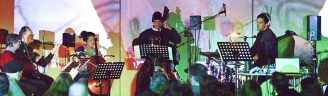
On The Shore of the Mind – a fantastic concert
Through great good fortune, Arran is included in a prestigious tour by the renowned group, Mr MacFall’s Chamber. They will be playing in Brodick Hall on Thursday, 19th June, at 7.30, and their wide-ranging programme is on the theme of Islands, both Scottish and Caribbean - hence the title. The five players will be joined by Susan Hamilton, the glorious soprano whose recordings with the Dunedin Consort of such classics as Messiah and the Bach B Minor Mass have made her internationally famous. It also features the outstanding Cuban violinist José White.
The six musicians are on a tour that includes Lewis, Arran and Mull then goes to London, Edinburgh and the Glasgow Concert Hall. They are fielding two different programmes, and the one to be performed on Arran is called Island of the Mind. The theme highlights words and music from such varied sources as Burns, Purcell, Ian Hamilton Finlay, the famous Belize poet Derek Walcott and the composer Gabriel Jackson, born in Bermuda. The variety of material and styles will cater for every possible taste.
All the players are consummate professionals, but everyone who has heard them agrees that they are also seductively easy to listen to and great fun. They move easily from 18th century London to traditional Scotland and to the present-day Caribbean, with a touch of calypso on one hand, and on the other, the soaring voice of Susan Hamilton to stir every heart. As The Times reviewer remarked, ‘Why can’t all concerts be like this - engaging, witty, relaxed, sophisticated, exquisitely played and just plain fun?’
Tickets for the Arran concert at £10 are available from Inspirations in Brodick or online from Arran Events. Also at the door.
See a sample of what Mr McFall’s Chamber can do on their website.
Edinburgh University Strings
Students in the Edinburgh University string orchestra are spending a few days on Arran and have generously offered two free concerts. One, in Shiskine Hall, will have taken place by the time this issue of the Voice goes live, but the second is at Brodick Church on Monday evening, 2nd June, at 7.00 pm. The programme is an enticing one, with John Ireland’s A Downland Suite, followed by the well-loved Bach Double Violin Concerto and Grieg’s Holberg Suite. Also included is a double bass concerto by Alex Lamb, which won the Emre Araci composition contest. There’s no charge for entry, though donations would of course be welcomed.
Arran Folk Festival
Adding to the torrent of good music on offer this month, the Arran Folk Festival begins on Friday 6th June at mid-day, with an Open Session, at the Douglas Hotel, Brodick. What could be easier? Off the ferry and into the Douglas. Free admission but you buy your own beer.
That same Friday evening, the opening concert is at 7:30pm in Brodick Hall. It features the Lorne MacDougall Band, followed by Arran’s own Gillian Frame with Findlay Napier and ending with the the Mary Ann Kennedy Trio. Tickets £17.00.
Saturday 7th June sees another Open Session, Douglas Hotel from 12 - 5pm, but Gillian Frame has generously offered to run a workshop called "A Really Big Sing" from 2.00- 3.30pm. This is a fantastic chance to improve your skills in putting a song over. Gillian, a singer and fiddler from Arran, best known for her work with Back of the Moon and then with Findlay Napier and The Bar Room Mountaineers. She helped to found the Hidden Lane Choir - a women's choir singing everything from contemporary pop to traditional material, so she is a very experienced and likeable tutor. This workshop will be great fun, covering really singable songs for all ability levels. It will be Brodick Church Hall (note change of venue) and costs a mere £5.00.
The concert that evening, at Brodick Hall, 7.30, Tickets £17.00, will feature The Tim Edey Band then Scott MacDonald, ending with the extremely popular Jenn Butterworth and Laura-Beth Salter.
The survivors of all that are welcome to stagger into the Douglas on Sunday 8th June for a final 12 - 5pm session, again free. Those who are still game for it are welcomed to an Open Mic Night at the Douglas, beginning at 8:00pm. No charge for that, either.
Arran Poetry – Export Strength
The poetry scene on Arran has been burgeoning in recent years. The McLellan Festival runs poetry workshops and a competition every year as part of the overall Festival, and a group of local poets meet regularly to discuss poetry and organise poetry events whenever possible. And now, poetry joins Arran’s other tasty exports such as whisky and chocolate, with three local poets scheduled to do a reading in Lancaster early in June.
David Underdown, Cicely Gill and Tim Pomeroy will be reading at the Storey Auditorium in Lancaster on the 5th June as guests of a writing group called April Poets, one of whose members, Ron Scowcroft, won a prize in the McLellan poetry competition last year. It is hoped that this initiative will stimulate further connection with other writers’ groups and lead to more exchanges.
Although island-dwelling, our poets’ subjects are far from insular. While they often refer to land and sea-scapes, their issues are wide-ranging, touching on personal and social relationships to the inscrutability of theology and the cosmos. In September some of the April Poets will come to Arran as part of the McLellan Festival.
David Underdown’s collection, Time Lines, was published in 2011 and he was shortlisted for two significant poetry prizes last year. Cicely Gill recently published a crime novel, Ivory, and Tim’s joint collection of 2007, Their Proper Names has sold out.
To investigate Arran poetry further click here.

Green Party branch for Arran?
Is anyone interested in an alternative to the tired old Labour/Conservative split? The Green Party had long offered an intelligent, far-left-of-centre approach to the way we live in the world, and is now standing well ahead of the Lib Dems in all polls. Here on Arran, there is a move to form a branch of the Green Party already active in Ayrshire.
There will be a public meeting in Whiting Bay Lesser Hall on Friday July 11th, 8.00 pm to discuss the setting up of an Arran branch of the existing Ayrshire Green Party. Many people share a feeling that this year may see a surge in the Green outlook, based as it is on common sense, humanity and a care for the world that supports us. Fresh ideas will be welcome, and procedural business will be kept to a minimum. Please come if you can - this promises to be very interesting.
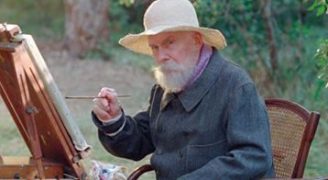
Corrie Film Club shows ‘Renoir’
As all film buffs know, there are two Renoirs - the famous painter and his equally famous film-maker son. They were connected by a girl who enchanted them both and supplied hope and inspiration at a very hard time. Corrie Film Club shows this evocative film on Sunday, 8th June, in Corrie Hall, beginning at 8:00 pm. As always, all are welcome and there is no charge, though donations to the hall’s upkeep are welcomed.
The film opens in the summer of 1915, when Pierre-Auguste Renoir, the Impressionist painter, is struggling with the pain and limitation of rheumatoid arthritis, and with the grief of having lost his beloved wife, Aline. He is 74, but determined to carry on. ‘I refuse to paint the world black,’ he says. World War I is raging in the north, but here, at his farm, Les Collettes, at Cagnes-sur-Mer on the Cote d’Azur, the illusion of tranquillity persists - but only just. His son Jean returns from the front on crutches. His brother has also been injured, and despite the plentiful servants and attendants who look after the famous painter, he is depressed and in such severe pain that working is hard. Matisse recommends a 15-year-old model known as Dedée, who duly arrives. She is delectable, with sumptuous red hair, but irreverent and mouthy. For both father and son, she brings new life, even while infuriating the caretakers who have so long looked after the household.
Exquisitely photographed by the Taiwanese cinematographer Mark Ping Bing Lee, and brilliantly acted by Michel Bouquet as the painter, the film won the 2012 Best Director Award at Cannes, yet it split the critics. Stephen Holden of the New York Times loved it, while the Guardian’s Peter Bradshaw wrote it off as trivial and passionless. Viewers will react as seems fit to the injured men on the roadside who stare with hopeless hunger at Dedée, and to Jean Renoir’s helpless infatuation with the red-haired girl. In true life, he married her when the war ended, and went on to make the films for which he is famous. This film about him and his famous father is one perhaps simply to be looked at rather than analysed, for it celebrates the glory of colour that fascinated the painter and still lives in his pictures.
Arran Visual Arts newsletter May 2014
Jan McGregor’s AVA newsletter congratulated members on a successful Easter exhibition in Arran High School, which saw 450 visitors over the week. 365 of them voted for their favourite piece and the winner was Wendy Kilroe with Winter Light, which got 27 votes.
Handing in day for the Lochranza Exhibition will be Thursday 24th July and the show will run until Thursday 31st July. It is hoped to run family workshops again, probably on the Tues and Wed afternoons.
How not to mend a road
In these past weeks of seeing Arran cut in half by road works on the String, questions must be asked about how these things can be done better. Nobody doubts that the men working on an upgrade of the road surface are doing a good job - but communication with the public has been abysmal. As so often in this increasingly privatised age, we are seeing an ‘outsourced’ company put in charge of how to provide a residual way for people to continue their lives while effectively cut off from the rest of the community. Convoy systems have alternated unpredictably with traffic lights and often left blank periods when neither was available, even though the road looked perfectly capable of taking one-lane traffic.
In the old days when Councils employed their own work squads, members of the public at least knew what number to phone and ask for information. The privatised approach declares itself cheaper and more efficient, but there are countless points at which this must be questioned. Paying for the High School, for instance, will continue for many years, having been based on a ‘partnership’ funding scheme which was in fact the most expensive way to borrow money. Several generations of children will have grown up and have children of their own before the building and its maintenance ceases to be in private, profit-making hands. Many of us suspect that road contracts are similarly lucrative for private firms, whose employees do not see communication with the public as a necessary part of their job. The whole operation has too often verged on a lunacy reminiscent of Chaplin’s Modern Times.
How not to run an election
Whiting Bay Hall was as usual a Polling Place for the European elections last week. But forgetting to bring the Poll Card caused the presiding people no end of trouble, because (you won’t believe this) the names and addresses were in completely random order. This, apparently, is because Arran doesn’t have streets, so it doesn’t fall into the approved scheme of things. But would it really be so difficult to put the names of voters in alphabetical order? Computers have been around for a long time now, and they are quite good at that sort of thing.
Arran Women for Independence
On Friday, 2nd May, Dr Philippa Whitford held a packed audience in the Ormidale spellbound as she talked about her reasons for backing Scottish independence. She explained that she did not mind (much) which way people chose to vote, but it distressed her to hear women say they were afraid Scotland could not afford to ‘go it alone’. The figures she presented spoke for themselves, showing how Scotland already had a better GDP than Britain put together, standing 8th in the world. It spends more on public services, health care and schools than England does, and we should not be unnerved by Westminster’s scare-mongering.
Philippa spoke with clarity and passion about the NHS. As a consultant breast cancer surgeon, she is horrified to see the National Health Service being broken up and put out to tender for the highest bidders. Already, the rising costs were having a devastating effect, with a third of all prescriptions not being taken up because patients could not afford to pay for them. Regarding illness as a profit-making business was no way to help people to lead healthy lives that enabled them to work and earn their way, she pointed out. Investing in people was the only sustainable way to build a productive economy. The paid-for American health system leaves many people derelict, and is the most expensive in the world.
Questions came thick and fast, with one or two people expressing exactly the reservations that Philippa identified, but most were in heartfelt agreement. There was a palpable sense of excitement about what we may be able to achieve, and as one person said, ‘Regardless of the referendum result, things will never be the same again.’ This is a genie that is not going back into any bottle.
Avaaz gets death threats
Avaaz, the campaigning petition site, raises money as well as amassing signatures, and has some astonishing successes. Last month, it sent an e-mail round saying, ‘We're buying a rainforest!’ and sure enough, it had given $1million to protect two vital preserves in Borneo that are the last habitat of free-living orangutans.
Who could dislike that? Quite a few, it seems. Members of the Avaaz staff have received death threats. Their computers and emails have been hacked. They have been threatened on television and radio. One has had his car tampered with. An Avaaz campaigner arriving at Cairo airport to deliver a petition against Egypt's largest mass execution in recent history was taken into a windowless room and interrogated for hours. They had, he said, detailed information about his personal life and his work with Avaaz. Still, it shows that the message is getting through.
An Arran suffragette
Flora Mckinnon Drummond, née Gibson, was a tiny person, only 5 feet 1 inch tall. She was born in Manchester on the 4th August 1878. Her mother, Sarah Cook, had grown up on Arran, in Pirnmill, but she married Francis Gibson, a tailor, and went with him to Manchester in search of work. However, within a year or so they came back to Pirnmill, so Flora grew up on Arran and went to school on the island.
At the age of 14, she moved to Glasgow to train at a civil service school, where she qualified as a post-mistress. However, she was declared an inch too small to meet the minimum height requirement of 5 feet 2 inches, so could not be a post-mistress. Flora, though furious, doggedly gained qualifications in shorthand and typing and attended lectures on economics at the university - a rare thing for a young woman then. Her resentment at being refused a position as a post-mistress because of her small size never left her, and did much to turn her into a fighter for the rights of women.
In a strange replication of her mother’s life, Flora fell in love with a boy from Manchester, an upholsterer called Joseph Percival Drummond. They married on the 26th September 1898 and set up home in Manchester, where they both became involved in the Independent Labour Party and the Fabian Society. Flora accepted a number of short-term jobs, which expanded her personal understanding of how women were low-paid and badly treated. A severe drop in the upholstery trade led to Joseph becoming unemployed, so Flora found herself the main wage-earner.
In 1905 Christabel Pankhurst and Annie Kenney, members of the Women’s Social and Political Union (WSPU) were imprisoned for interrupting a local Liberal rally. Flora went to a protest meeting held in Stevenson Square, and quickly made her mark as an inspiring orator, fiercely able to deal with hecklers despite her small size. She moved to London a few months later and became an active member of the WSPU, wearing a military-style uniform and leading women’s rights marches mounted on a large horse, which earned her the nickname of ‘The General’. At the end of 1906, following arrest at a House of Commons demonstration, she was imprisoned in Holloway- but it did not deter her. In October 1908 she was the main organiser of the Trafalgar Square rally, and protested with the Pankhursts from the House of Commons public gallery. A further three-month spell in Holloway followed. Flora was in the early stages of pregnancy at the time, and was released for health reasons after fainting and being transferred to the prison hospital wing. When her son was born she named him Keir, after the political leader, Keir Hardie.
Flora came back to Scotland and in October 1909 organised the first suffragette procession in Edinburgh. She was imprisoned nine times, sometimes going on hunger strike, though she was spared the brutal practice of forced feeding because she was so well known that risking visible injury to her would not have been wise. However, the starvation took its toll and her health began to fail. She returned to Arran and the family home for the summer of 1914 to recover, but when the First World War broke out on the 28th July, she returned to London, concentrating on administration and public speaking so as to avoid further spells of imprisonment. Four years later, in 1918, women over the age of 30 were given the right to vote.
Flora’s husband, Joseph, cannot have found marriage to The General easy. He left Flora and emigrated to Australia. In 1922 she divorced him and married a cousin, Alan Simpson, though for political and business reasons she kept the name of Drummond. In 1928 she was a pallbearer at Emmeline Pankhurst’s funeral -and that same year, all women over the age of 21 were given the right to vote and to stand for parliament election.
In the years between the wars Flora founded the Women’s Guild of Empire, a group opposed to both communism and fascism. Her London home was destroyed in the London blitz and her husband was killed. Flora came back to Scotland and lived near relatives in Carradale, Kintyre, across the water from her childhood home on Arran. Five years later, on January7th 1949, she was engaged building a new home at Carradale at the age of 70 when she suffered a stroke and died.
Flora Drummond was buried in Brackley graveyard, Carradale. Recently local people collected funds to mark her grave with a stone inscribed, ‘The Suffragette General’. A tiny but indomitable woman.
Affordable ‘village’ houses at Auchinleck
On Sunday 11th May, a group of members and friends of Arran Civic Trust enjoyed a most interesting visit to the new village of Knockroon, which is a development on the Dumfries House Estate near Cumnock, and Auchinleck House, the host of the Boswell Book Festival.
Scottish Salmon Company boasts of harmlessness
A triumphal blast of publicity from the Scottish Salmon Company, which owns the Lamlash fish farm, boasted of its expansion plans and in the same breath declared itself to have no adverse effect on the environment. Many Arran residents were staggered. As one person enquired, ‘Short term memory loss?’
The photos in the Arran Voice when it was a newsprint production told a different story, showing bins full of maggot-ridden dead salmon. The St Molios fish farm in Lamlash Bay has a long history of over-stocking and disease, and though it has worked hard to improve things, the unending struggle against sea lice goes on. The long-term damage to the seabed is clearly visible. Divers from COAST saw for themselves the build-up of faeces, surplus food and chemicals, spreading its footprint far beyond the pen. See http://www.int-res.com/articles/feature/m326p001.pdf detailed scientific paper on effects of fish farms on the sea bed.
The company’s chosen name can be queried, as well. A glance at the directors’ annual report for 2013 shows something very different from shortbread-tin Scottishness. Far the largest shareholder is SIX SIS AG (formerly SWX Swiss Exchange), based in Zurich. Its board of directors at is headed by Robert Brown III, who owns 350,000 shares in the company. He is a general partner of the Kazakhstan Investment Fund and Chairman of Quorum Fund, a private fund investing in listed Russian shares.
The other directors are equally non-Scottish. Martins Jaunarajs is a Senior Investment Director of BaltCap, a private equity and venture capital group in Latvia, Estonia, and Lithuania. Viacheslav Lavrentyev is Head of Corporate Finance Advisory with FMC Advisors Ltd, Russia. Ms Merete Myhrstad, with a mere 40,000 shares, has extensive experience from the Norwegian stock market. Philip Smith appears to be a tax consultant - though there are a lot of Philip Smiths about and this is difficult to verify. The St Molios fish farm, in fact, belongs to a group of directors whose main interests are in the happy hunting grounds of Eastern Europe.
Fishwise, it has not been a happy year for the ‘Scottish’ Salmon Company. Hampered by diseases — mainly amoebic gill disease— and bad weather, its harvest fell from 23,945 tonnes in 2012 to 20,825 last year. Of this total, 1,479 tonnes consisted of small fish weighing less than 1 kilo - no more than babies, by salmon standard. These immature fish were therefore harvested at cost.
The company, controlled by its Ukrainian-born investor, decided to issue no dividends for the year. Its directors, however, did not suffer. The outgoing CEO, Stewart McLelland, who quit his job at the end of last year. was paid a salary of £221,000 during the year, and £29,000 in additional payments. CFO Robert Wilson took home £202,000. Craig Anderson, who replaced McLelland as CEO on Jan. 1, 2014, is on a £43,000 salary but through other benefits took home £87,000. By big banking standards these figures may be peanuts, but it’s not bad pay from a company that could declare no dividend.
Australia: A Land of Two Parts
Foolishly, Australia had never been on my “must go” list but when our son, Fraser, moved there Stuart and I wanted to see him after an 18 month separation so Australia it was. I say ‘foolishly’ because I had been taking no account of how interesting, tolerant and vibrant this vast country is.
Bridge Challenge
Can South make two no-trumps against the lead of ♠2 from West?
Fish to feed fish
Salmon are carnivorous. In the wild, they will eat any small living thing they can find. In pens, they are fed on frequent scatterings of fishmeal pellets, delivered automatically. These pellets are made from smaller fish.
Many thanks to John Page, who sent an interesting paper on Feed Conversion Efficiency in the Chilean Salmon Farming Industry. It’s a hefty document, but facts pop out like gifts in a bran tub.
Feed-fish to salmon weight ratio (John Page e-mail)
Frankensalmon?
The U.S. Food and Drug Administration (FDA) is reviewing the first genetically engineered (GE) animal for human consumption. And it's a salmon. Produced by AquaBounty, this transgenic fish adds genetic material from a pacific Chinook salmon and an eelpout (Zoarces americanus) to cause Atlantic salmon to greatly overproduce its own growth hormones. The new fish will grow two to six times faster during winter than wild stock and be ready to harvest at an earlier age.
By November 2013, Canada had announced that it would support the export of AquaBounty's GE eggs to Panama. The decision marked the first time any government had given the go-ahead to commercial scale production involving a GE food animal. The FDA has yet to rule on the GE fish.
To date AquaBounty has spent about $60 million trying to coax the FDA and public into accepting their product. Within the last year, supermarket chains including Whole Foods, Kroger, Safeway, Aldi, and Trader Joe's have said they will not stock the GE salmon.
What we must keep in mind is that this animal has never existed before; it is new to the planet; we made it. We really have no idea of what it will do when we lift it off the 'operating table'.
The FDA states that highly secure facilities will prevent GE salmon from escaping and affecting natural ecosystems. We are told that they won't be able to breed because they are all going to be females; each and every one of them. The GE salmon will also be made infertile to prevent breeding with natural stock should some fish escape. (Actually it's reportedly 99.7% infertile which means thousands of breeding fish out of the millions produced).
The future of the wild salmon stocks couldn't be bleaker. Norway is losing half a million "designer" salmon a year from 'secure' farms, wild stocks in Europe and the US are collapsing, yet this new fish supposedly can't escape and even if it does, none of the millions of fish AquaBounty produces will interbreed with wild fish.
Craig Altier, a member of the FDA's Veterinary Medicine Advisory Committee and an associate professor at the College of Veterinary Medicine at Cornell University said, "We need to treat these (GE) fish as we would a potentially dangerous medicine or pharmaceutical, and apply all of the same security measures to its production and transport." (1)
A REPORT published today 02 May reveals how Scottish Government plans to create a network of marine protected areas (MPAs) have received an impressive level of support from the public.
Campaigners now say there is a strong democratic duty, as well urgent ecological need, to set up MPAs to help recover Scotland's damaged sea life.
Over 14,000 people responded to the public consultation on proposals for 33 new MPAs last summer, the vast majority of whom indicated popular support for stronger protection of Scotland's sea life with a full network.
Environmental charities are now urging the Scottish Government to take heed of public opinion and secure a network that will help the seas recover from centuries of over-exploitation. They argue that legislation passed by MSPs in 2010 places an overriding legal duty on Ministers to both protect and enhance Scotland's marine environment.
Calum Duncan, Convenor of Scottish Environment LINK's marine taskforce and Scotland Programme Manager for the Marine Conservation Society, said:"The growing momentum of public support for Marine Protected Areas is clear. The Scottish public called for a network of effective MPAs, a requirement of the marine legislation they helped push for in the decade up to 2010. A network of MPAs that do what they say on the tin, adequately protect areas of sea, are being called for by the Scottish people to help recover the sea and contribute to a fair and just society. Scottish Ministers don't just have a legal duty to designate new MPAs, they now have a democratic mandate to do so, delivered by people from across Scotland."
Dr Richard Luxmoore, Senior Nature Conservation adviser for the National Trust for Scotland said:"The results of this public consultation clearly show that the overwhelming majority of the Scottish people strongly support MPAs and want to see improvements in the way we manage our seas. Our marine habitats have suffered the industrial legacy of damage to our seabed.This has had dire consequences for the diversity of our marine life - from the magnificent fan mussel to the humble sandeel, many species and habitats are well below historical levels of abundance. MPAs are desperately needed to reverse these sad declines."
Kara Brydson, Head of Marine Policy at RSPB Scotland, added: "Cabinet Secretary Richard Lochhead said in May 2013 that he would 'listen closely to the views of Scotland in making final decisions.'He must now listen to the view of the vast majority of consultation respondents who want effective MPAs for Scotland and protection for other species currently excluded from the network, such as whales, dolphins,seabirds and other fragile seabed plants and animals."


Greece finds a way out of the frying pan
We are supposed to believe that the ferocious austerity measures imposed on Greece are working - but are they? Dimitri Papadimitriou, President of the Bard College Economics Institute, thinks not. Writing for the US site, Truth-out, he contends that two bailouts have spread ‘the economics of social disaster.’ The debt is not sustainable and Greece now looks, he says, ‘like a badly battered boxer.’ The unemployment rate stands at 28%; the education and health care systems have been decimated and one out of every three Greeks is living below the poverty line.
Papadimitriou says a ‘parallel financial system’ is the only way to re-establish employment and market liquidity. It’s already happening. People have for quite a time been using the TEM, an acronym of the Greek capitals that stand for ‘Local Alternative Unit’, exactly as our LETS stands for ‘Local Alternative Trading Scheme’. The city of Volos has gone further, setting up a TEM Internet mutual banking system, Internet-based and hosted on a cheap Dutch server to keep administration costs down. Its currency is TEM credits. On joining, members are granted a deficit-spend of up to 300 TEMs - effectively an interest-free loan from the community, much like our Credit Unions.
Membership has expanded eight-fold in the last year. Transactions are transfers from one user-account to another, and to ensure transparency, user balances are recorded on the open database, for all users to see. The system cannot lend money at interest, but that is not its purpose. It has provided a viable alternative to the Euro, enabling Greece to help its own recovery. The principle stands as an example of what any nation may do when pressed too hard by the international finance-jugglers.

Richard III: A revisionist view
Alison Prince, as readers will know, is a woman of many parts. One of her latest ventures is an historical novel, The Lost King, aimed at young people about Richard III, that most maligned King of England, made notorious by Shakespeare, Josephine Tey and others in much higher places, as the murderer of his nephews, Edward V and Richard, Duke of York, the princes in the tower.
Controversy has raged for centuries amongst academics over Richard's reputation and his involvement in the death of the young princes but general public opinion, for the most part, has stubbornly found him guilty. This is understandable, given that most people’s knowledge of the hapless monarch derives from Shakespeare's eponymous play in which he is described as Richard Crookback. The discovery of his body last year does indicate a curvature of the spine, but in true Elizabethan style, his physical deformity became a metaphor for his personality and morality, thus demonising him as a ruthless, power- seeking, murderous monster in the eyes of succeeding generations. We cannot blame Shakespeare for that. The ‘historical’ sources available to him were dictated by his paymasters, whom he had to please. Henry Tudor, the triumphant final winner of the Wars of the Roses at the Battle of Bosworth, led Shakespeare to portray a version of history perpetuated by the victors. The new King Henry VII was desperate to consolidate his claim to the throne by destroying the reputation of Richard III and his Plantagenet lineage
So, how refreshing it is to read a piece which makes a convincing case for Richard's innocence and is utterly accessible, a great virtue given the incredibly complex era of the Wars of the Roses which formed the background to the life of Richard Plantagenet, of the house of York.
Alison uses a charming device to tell her tale - a young girl, Lisa, employed to be a companion of the young Prince Edward, heir to the throne, at Ludlow Castle where the young prince was living, safe from intrigue in London and visited often by his kindly Uncle Richard. As the story unfolds, Lisa becomes more and more involved with Prince Edward and his brother and more and more convinced of the kindness and moral strength of Richard III. Using contemporary sources, those written after the end of the Tudor dynasty when dissenters to the Tudor view dared to raise their voices and twentieth century research, Alison presents a compelling and logical case, not only for Richard's innocence but for his worth as a king in brutal times. And all so readable and engaging! If you are interested in history and in how history can be distorted, this is a worthwhile read - and not only for young people.

Crossword
Across
1 Destination of ripe feta (4)
4 Obscene company behind (6)
8 Enemy to revisit librarian (9)
9 No right to press particle (3)
10 Kick out beheaded outcast (5)
11 Follower remodels toy lace (7)
12 Hole discovered in baby's stuffed toy (5)
14 Cathy capsizes boat (5)
16 Dim rodent returns with shin shattered (7)
18 Martin initially dissipates returning pain (5)
20 For example - zero character (3)
21 Leonard daring to revisit old Russian city (9)
22 Good man caught up in entangled lace in tower (6)
23 Succeed in detecting first whiff (4)
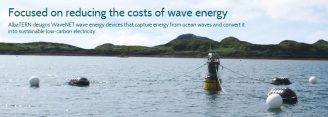
Where there’s Muck there’s WaveNET
Marine Harvest's latest salmon farm off the Isle of Muck is due to be stocked with smolts this summer - and it will generate its own electricity. A device called WaveNET has already undergone preparatory trials at the dry dock at Kishorn Port. Albatern, the company that developed the wave technology system, based it on a group of energy converter units, known as Squids, that are flexibly connected to each other while remaining free to move. Together, they form a ‘wave net’ that harnesses power - hence the name.
Each individual Squid unit has 6 pumping modules which move in response to the circular pressure field within the wave. The pumps drive a hydraulic generator system that produces electricity. At the moment, they are running at a minimal output of 7.5kW each, but this will be scaled up in decimal jumps, first to 75kW then to 750kW. It’s a flexible, highly innovative system that does not, of course, need to be associated with a fish farm. Something for Arran to think about?
Poem of the month
selected by David Underdown, who supplies the footnote
Who Makes These Changes?
by Rumi
Who makes these changes?
I shoot an arrow right.
It lands left.
I ride after a deer and find myself
chased by a hog.
I plot to get what I want
and end up in prison.
I dig pits to trap others
and fall in.
I should be suspicious
of what I want.
Rumi, the thirteenth-century Persian philosopher and mystic who founded the Whirling Dervishes, was also a poet. His lasting appeal, not just within oriental cultures but in the West, is founded on the accessibility of his verse and how it still speaks about the fundamental questions of human existence. This translation by the American scholar Coleman Barks is taken from the Penguin Classic edition of Rumi’s Selected Poems.

Fracked gas ‘a worse producer of global warming than coal’
demonstrate in Manhattan.
( Photo: CREDO / Flickr)

Big guns on Scottish Independence
Experts on both sides of the pond are getting excited about the prospects for Scotland, for various reasons. Jim McCluskey, author of The Nuclear Threat, is of course horrified by the Westminster government’s plans to spend £100 billion on renewing its nuclear arsenal, blowing £2.5 billion on new jet fighters, £6.2 billion in two new mega aircraft carriers, and £32.4 billion for ‘normal’ military spending in 2015. Writing for the American site, Truth-out, he tells US citizens about Dounreay, the ‘fast breeder’ reactor built as far away from Westminster as possible because of its obvious danger. Decommissioning it in 1994 was so dangerous that a robot had to be used, and irradiated fuel particles still infest the seabed and the beach. The total cost of cleanup will be around £2.9 billion, and the site will remain ‘hot’ for at least 300 years. McCluskey salutes the intention of a Scottish government to cut this expenditure and use it instead for health, education and welfare.
Cat story with a happy ending
Linda Hartley writes with relief about a good outcome for two bereft pets
I have good news!
Patch and Tiggy, the two cats whose owner died and left them homeless, have at last been rescued. But it took patience. Trying to catch an errant cat means sitting near a trap that requires you pull a string to drop the door when a cat goes in. And standing for hours at a time at a window that’s also closed with a piece of string waiting for a cat to jump in. None of it worked. And I couldn’t be twelve miles away from home, day and night. An automatic trap had to be set - but of course, such traps need to be checked regularly. And that’s where wonderful Liz and Tommy came to the rescue. They offered to check the traps each morning and evening, and I would do the rest of the day. At 6amcame the longed-for phone call. Patch was in the trap.I raced down there, and sure enough, there he was, very scared and bewildered, but unharmed. A quick spray of Feliway and a blanket over him helped calm him for the journey home., but he came out howling. I leave him in the cat house with a heater on, a warm, soft bed, food and water and a radio quietly playing.
Two days later, a phone call at 5.40am said Tiggy was in the trap. She is with Patch now and they are curled up together. In two weeks they will be in their new home. Thank you, Liz and Tommy, for all your help. Thank you everyone who has viewed my posts about Patch and Tiggy and been so supportive. It’s a happy ending. Whew! Reach for the tissues ……
Scotland Our Country
A poem by Campbell Laing
Scotland, our country, of which we are proud,
But for far too long we have lived under a cloud
In 1707 our Lords and Nobles decreed
To be part of Westminster was our very need.
This action was purely to line their own purse,
To the people at large it was really a curse.
Since then we’ve been subjected to Westminster rule
And treated by some as if we were fools.
We’ve suffered insults and injustice, there is a long list,
The latest one being, we really don’t exist.
The tide is now turning, we are lifting this cloud,
To be the nation again of which we’re so proud.
Free, independent, with equality of thought
And to continue this union we will not be bought.
Let’s take this opportunity we now have at hand
To govern ourselves the way we know that we can
For all, no matter religion, colour, gender or creed
But with care and compassion, wherever the need.
We have wonderful resources both in man and in nature
So let’s use these resources and uplift our stature.
We don’t want world power, that’s not our end,
We just want to be SCOTLAND, an independent nation again.
UNISON independence debate
On Friday 6th June UNISON are holding a public debate on the question 'Should Scotland be an independent country?' It will start at 7.30pm and is in the Community Theatre at Arran High School.
The YES side will be presented by Pam Currie of the Scottish Socialist Party and Malcolm Kerr of the Yes Arran campaign, while the NO side will have equally strong hitters in David O'Neill (Labour, President of COSLA) and Councillor Tom Marshall (Conservative) for 'Better Together'.
The debate will be chaired by Colin Turbett of UNISON, and contributions and/or questions from the audience will be encouraged and welcomed.
Grease at the High School
The ever-talented young players at Arran High School are rehearsing a production of Grease, the rock musical that still rocks audiences from Tuesday 17th June to Friday 20th. The songs are great, the hoofing will be marvellous, and there’s going to be a BIG car.
Tickets are available from the Book & Card in Brodick and from the school. Here are some pictures to whet your appetite!
200th anniversary of the Preaching Cave
On Sunday June 8th at 3.30pm, Rev Angus Adamson will lead a service in the Preaching Cave in the cliff in Kilpatrick. All are welcome, but there is limited car parking at Kilpatrick itself, so those who would like to come are invited to meet at the car park at the Kinloch Hotel, Blackwaterfoot, by 2:30pm to walk the mile along the coastal path to the cave.
The warm, dry cave became known as the Preaching Cave for a solid historic reason. In 1814, the minister at Kilmory Church died. The congregation wanted Angus Macmillan from Lochranza as their new minister, but the Duke of Hamilton over-ruled them and appointed the Rev Dugald Crawford. After one sermon, most of the congregation went on strike. Led by a farmer preacher called William McKinnon, they met each Sunday in the cave called Uamh Mhor, which ever afterwards became known as the Preaching Cave. It was a foretaste of the Great Disruption, which resulted in the formation of the Free Church of Scotland 25 years later.
When Rev Dugald Crawford was drowned off Pladda, the congregation returned to Kilmory church, but the cave went on being used as the local school until 1843, because it was warmer and less draughty than any of the village buildings. The school-in-a-cave had an outstanding teacher called Peter Craig, who produced many fine scholars.
Rev Angus Adamson said, ‘This will be a good way to celebrate Pentecost Sunday, which is the birthday of the church. We will have a mixture of the old and the new.’ He went on to say that though life is very different now from what it was 200 years ago, ‘We’ll be coming with the same sense of expectancy that this cave will be a place of encounter and spiritual refreshment.’
For more information please here or contact John Kerr.
Tel: 01770 860 498. email: kerrjh@btinternet.com.
Women can’t manage money?
Shirley Conran, who knows a thing or two about money, is sure that many women never learn how to get it, use it and keep it. She has produced an interactive maths course e-book called Money Stuff, to help with this, and ran a survey so as to have the figures at her finger-tips. The results proved her point.
95% of UK women say they were never taught how to manage personal finances in school. More than half of them don’t think they will ever be able to afford property and few of them do anything about life insurance. Conran, who used to be women’s editor of The Observer magazine and The Daily Mail, has put together her 4 step maths course e-book to give a bit of practical help. She doesn’t, of course, say how you should manage money if you haven’t got any, but as those notices in garages say, Miracles Take A Little Longer.
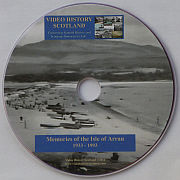
Memories of the Isle of Arran; 1933 – 1993
Video History Scotland has a catalogue of more than 40 titles on DVD. They are the work of Colin M. Liddell, who devoted a lifetime to capturing, collecting and preserving some of the most rare film footage of our rich Scottish history and heritage, not merely to ensure that knowledge of them was maintained but also to provide unique records that could be shared and enjoyed for generations to come. Colin was a renowned cinematographer and historian, whose passion and interest in film and history was recognised by many throughout Scotland, resulting in countless invitations to speak or to share his knowledge and film archives with audiences or the media. His favourite areas of interest included his passion for “The Lovely Valley” of the the Vale of Leven and his love for all things steam, whether it be Scottish steam locomotives or the great Clyde Paddle Steamers and other vessels once found on and around the Clyde and the West Coast of Scotland.
Memories of the Isle of Arran, 1933 - 1993 is an enchanting personal journey through some of the busiest times on the island. It is a compilation of photographs and film in both black-and-white and colour and includes many of the tourist attractions as well as farming activities. Of particular interest are the films of the Clyde Steamers arriving at and departing from the many piers that once were. Sadly the only pier left now is Brodick and the only steamer the PS Waverley.
Click here for more detail about the Memories of the Isle of Arran DVD and a full catalogue of the DVDs can be found on the Video History Scotland website.
Ian Devlin
Countless people will remember Ian for his appearances in Arran’s musical shows and his enthusiastic participation in choirs - and, beyond that, for his boundless enthusiasm and love of life. His death from cancer marks the passing of a brave, funny, creative and ethically committed man, one of a kind that is becoming more rare.
Ian was born in Aldershot, because his father was in the Army there, living with his wife in Married Quarters. In turn, Ian, too, joined the Army, becoming a medical assistant. However, he had always loved Scotland, and with his wife, Ruth, left Aldershot to settle in Govan, working as a psychiatric nurse. They came to Arran in 1990, when Ian took early retirement The island suited him perfectly, as he had always been keenly interested in music and theatrical activities. He had sung in the YCL (Young Communist League) choir as a youngster, and had been with Celtic Ballet for some while, so the musical productions and concerts were a natural home for him. He took part in countless performances with the Arran Music and Drama Club, and sang in various Arran choirs until he became ill. He was also intensely interested in engineering, and pioneered some interesting ideas on power generation.