
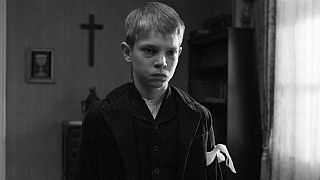
Corrie Film Club shows The White Ribbon
On Sunday October 13th, the new season of films begins with Michael Haneke’s 2009 black-and-white film called The White Ribbon (Das weisse Band). Set in the Germany of 1913, it is both beautiful and disturbing, offering a picture of a village in northern Germany that is repressively controlled by the Baron, the pastor and the local doctor. The resulting undercurrent of resentment finds expression through malicious crimes that sometimes have an obvious aim but can also leave innocent victims hurt and bewildered.
 The story is narrated by the now elderly local teacher who is raking through his memories in a need to find reasons for what happened next in Germany. Are his memories correct? We don’t know. But some things have a ring of absolute probability. The pastor, brought to convincing and dreadful reality through an outstanding performance from Burghart Klaussner, is a severe disciplinarian, obsessed with ‘purity’. His own children are made to wear a white ribbon round their arm as a penance for any wrong-doing, and this humiliating badge of guilt remains in place until their father considers them sufficiently ‘cleansed.’ Such opprobrious marking could have foreshadowed the yellow star later forced on Jews or the approved Nazi armband – but the connection is never explicitly stated, just left to grow in the viewer’s mind.
Repression breeds people who want to oppress. The White Ribbon explores a network of resentment that turns the village into a furtive spider’s web of festering tit-for-tat cruelties. When war comes in 1914, it is comes as a breath of relatively clean air, sweeping away these cancerous local resentments with the blast of a larger concern – and yet, the narrator sees the events of the two wars as a continuation of parochial sickness on a bigger scale. However, the film is far more than a study of German angst over the causes of the wars. Some of Haneke’s scenes and sequences have a classic quality that remains long in the mind. The schoolmaster’s tentative courtship of a local young woman is deeply touching, and the children are seen with a sympathetic eye as they try to come to terms with big questions.
Critics have called The White Ribbon ‘profoundly disquieting’, but its superb acting and direction pose questions that are still emotionally powerful, leaving a sense that at any moment, they may have to be considered again.
Corrie Film Club’s programme of the year’s films, shown on the second Sunday of every month, will be available at the showing of The White Ribbon. There is no entry charge for any film, and everyone is welcome, whether a member or not. Membership of the Film Society costs £15 for the year. This funds the purchase of DVDs to be shown and covers the costs of hall hire etc, so new members are always very welcome – but membership is not a requirement. The Corrie film shows are for everyone. They start at 8.00pm in Corrie and Sannox Hall.

