Perovskites?
They sound like supporters of some perverse revolutionary sect – but no such thing. Perovskites are an alternative to silicon, and they look set to revolutionise solar panels. They were announced at the Materials Research Society conference in Boston last December, and caused immense excitement. Think of this fact:
Turning just 1% of the sunlight falling on the British Isles into electricity would meet our entire energy demand.
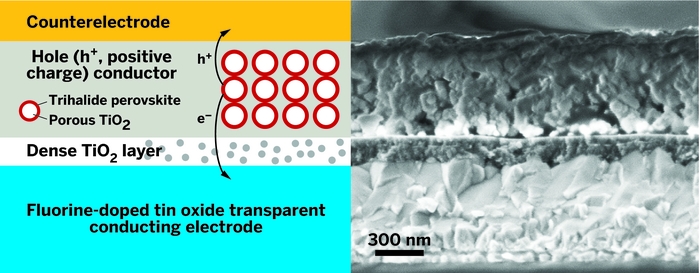
Cameron may dismiss this as ‘green crap’ but it is a hard fact. At present, we can’t achieve the 1%, because the silicon cells used in solar panels are expensive and not very efficient, because of their molecular structure. All of silicon’s four outer electrons are taken up in forming the chemical bond that holds the crystal together. You can tinker with this by adding a minute amount of phosphorous, creating a diode that lets electricity flow one way only. This is the way LEDs (light-emitting diodes) work. We’re all familiar with garden lights that work on a little solar panel on a stick that you shove into the ground. If you use the diode principle the other way round, instead of using the sun to make light, you can turn that light into power. That’s how solar panels work. But because they use silicon, they have been very expensive to manufacture. Perovskite cells, on the other hand are easy and cheap to make, because their natural structure has a light-flow in the opposite direction to that of a diode – not power to light, but light to power. They have a light-conversion efficiency of up to 20%, which is miles above anything achievable with silicon technology. After that conference session in December, immediate phone calls were being made all over the States and beyond, halting work on existing solar systems and switching to the use of perovskite cells.
If anyone here on Arran is thinking of installing solar panels, hold your horses for a bit. There is going to be a technological revolution that will make the present panels look as old-fashioned as wind-up gramophones.